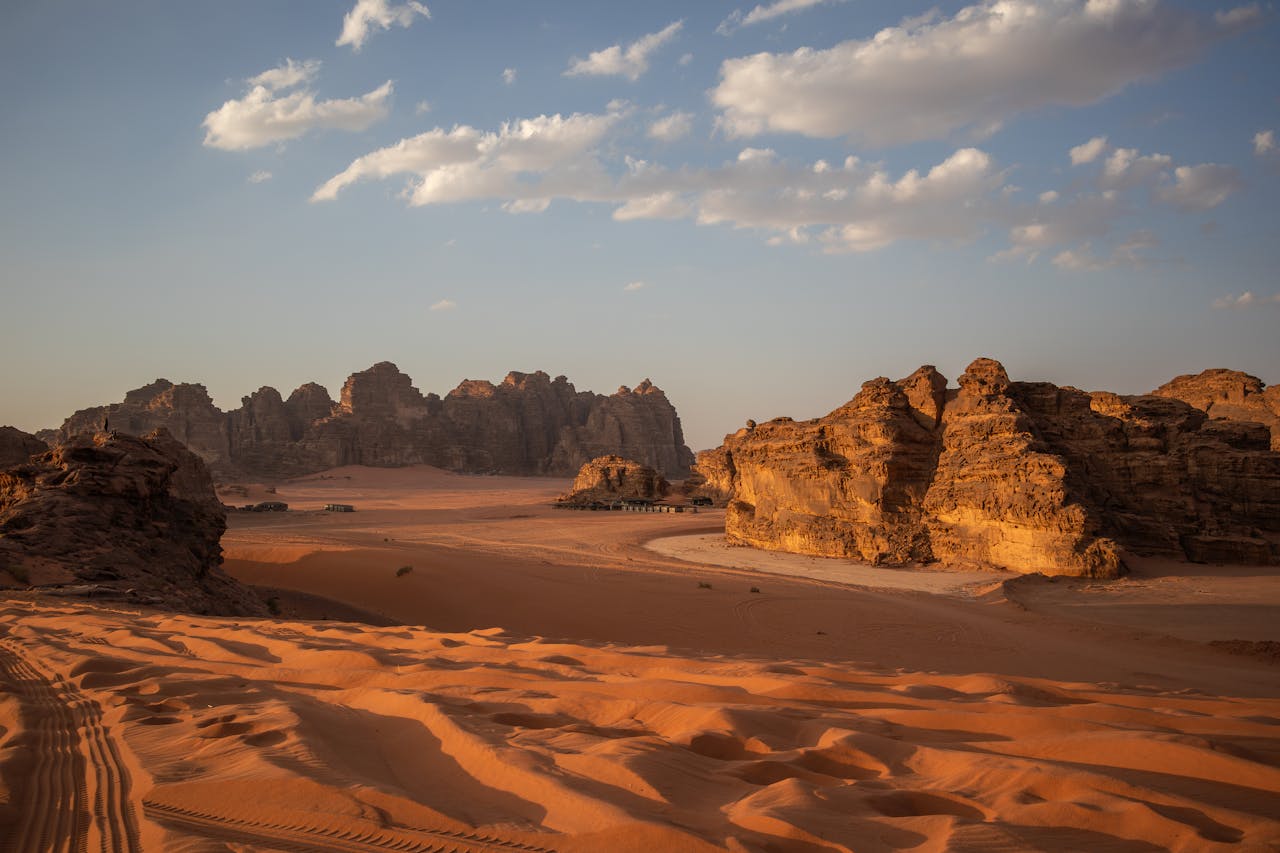
Wadi Rum (Valley of the Moon) — the extraordinary desert landscape of southern Jordan, 60km east of Aqaba and 100km south of Petra, a UNESCO World Heritage Site (2011) of 74,000 hectares of red and pink granite mountains, sandstone valleys, ancient rock inscriptions, Nabataean temples and Bedouin settlements, its valleys floor of rust-red sand and its sheer mountain walls (some rising 600 metres from the desert floor) illuminated by a light that ranges from pale gold at dawn to deep crimson at sunset — is one of the most visually extraordinary landscapes on Earth and one of the most cinematically famous: the location for Lawrence of Arabia (1962), The Martian (2015), Rogue One: A Star Wars Story (2016), Aladdin (2019) and Dune (2021), its alien-looking rock formations and vast silences having served as a stand-in for Mars, Tatooine and the planet Arrakis. T.E. Lawrence, who camped here in 1917 during the Arab Revolt, wrote in Seven Pillars of Wisdom: "The crags were capped in nests of domes, less hotly red than the body of the hill; rather grey and shallow. They gave the finishing semblance of Byzantine architecture to this irresistible place: this processional way greater than imagination." The landscape has not changed.
Wadi Rum is accessed through the visitor centre at Rum Village (the only permanently settled community within the protected area), where visitors purchase the site entry ticket (JOD 5) and arrange transport into the desert with the Bedouin jeep drivers who have managed tourism in the area since the 1980s. The standard experience is a half-day or full-day jeep tour visiting the principal rock formations, inscriptions and photographic viewpoints; the finer experience — and the one that most visitors who have done both consider transformative — is an overnight stay in one of the Bedouin desert camps, sleeping in a tent (or under the stars on a mattress placed directly on the sand) and watching the Milky Way in a sky with zero light pollution, one of the finest star fields accessible from any populated part of the Middle East.
Jeep Tours & the Principal Sites
The standard Wadi Rum jeep tour — arranged at the visitor centre with licensed Bedouin operators (JOD 25–35 per person for a half-day 4×4 tour; JOD 45–70 for a full day), typically in a Toyota Land Cruiser with an open back for standing and photographing — visits a selection of: Khazali Canyon (a narrow sandstone gorge with Nabataean and early Islamic rock inscriptions and human hand-prints at the entrance), Lawrence's Spring (the natural spring where T.E. Lawrence is said to have washed, surrounded by ancient inscriptions), the Seven Pillars of Wisdom rock formation (named in Lawrence's honour), the red sand dunes (the finest sandboarding location in Jordan), the Um Fruth Rock Bridge (a natural arch climbable on foot with good views across the valley), and Jebel Umm ad Dami (Jordan's highest peak at 1,854 metres, requiring a separate climbing arrangement). The drives between sites across the flat valley floors — the red sand, the improbable rock formations rising from it, the silence broken only by the wind — are themselves part of the experience: Wadi Rum is not a checklist of viewpoints but an immersion in a landscape.
Overnight Desert Camps
The Wadi Rum overnight camp experience — ranging from the Bedouin-hosted basic camp (a simple tent or open-air mattress, campfire, Arabic food including mansaf or maqluba, approximately JOD 35–50 per person including dinner and breakfast) to the luxury "bubble camp" experiences (transparent dome tents with private bathrooms, air conditioning and heating, luxury bedding, waiter service, from approximately JOD 150–300 per person — Wadi Rum Bubble Camp, Memories Aicha Luxury Camp) — is the most significant single decision in planning a Wadi Rum visit: staying overnight converts the desert from a tourist attraction into a genuine landscape experience. The stars above Wadi Rum (no light pollution within 100km; the Milky Way visible as a physical band across the sky, the satellite trail of the International Space Station visible on clear nights; Mars noticeably pink with the naked eye) are the finest accessible star field in the Middle East. The silence at 3am in the desert, with the rock formations silhouetted against the stars, is an experience that every visitor who has done it describes as one of the finest of their travelling life.
Getting to Wadi Rum
Wadi Rum is most easily combined with Petra (100km north, 1.5 hours by car or minibus): the standard Jordan itinerary visits Petra for 2 nights, then transfers to Wadi Rum for 1–2 nights before either continuing south to Aqaba (30 minutes) or returning north to Amman. From Aqaba (Jordan's Red Sea city, 60km west), shared taxis and minibuses run to Rum Village (approximately 45 minutes; JOD 5–8 per person). From Amman, JETT buses run to Wadi Rum (4 hours; JOD 7), departing Abdali bus station in the morning. Renting a car (available from Amman Queen Alia Airport from approximately JOD 30/day) gives the most flexibility for the Petra–Wadi Rum–Aqaba circuit, with the King's Highway (the ancient trade road running through Dana, Shobak and Petra) making the drive itself a significant experience. The recommended minimum in Wadi Rum is one overnight; two nights (with a full day of jeep tours and two evenings of stargazing and one dawn) is the ideal allocation.