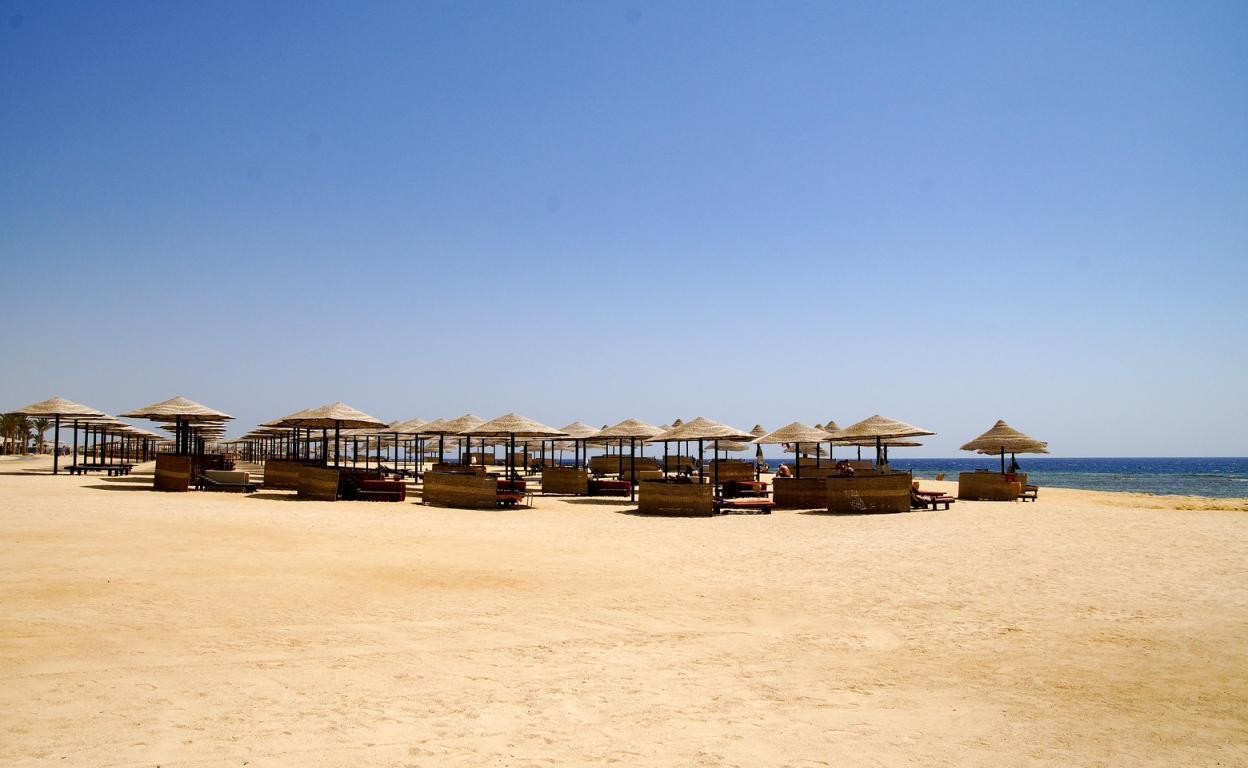
Aqaba — Jordan's only seaport and only coastal city, at the northernmost tip of the Red Sea in the Gulf of Aqaba, a 27km strip of coastline shared by four countries (Jordan, Israel, Egypt and Saudi Arabia — the city lights of Eilat are visible 10km to the west; the Saudi border crossing is 16km to the east), a resort and port city of 150,000 people with a mild winter climate (22–26°C November–March) that makes it one of the finest winter sun destinations accessible from the UK — offers a combination of Red Sea marine experience and proximity to Jordan's two principal land-based sites (Petra, 2 hours north, and Wadi Rum, 45 minutes north-east) that makes it the natural base for a southern Jordan itinerary. The Gulf of Aqaba — deeper, calmer and warmer than the Sinai coast of Egypt, its water clarity exceptional (20–30 metres visibility on good days, the coral formations of the northern Red Sea at their finest in the section between Aqaba and the Saudi border) — has the finest diving and snorkelling in the northern Red Sea outside the Sinai Protected Area, with the significant practical advantage over Egypt of Jordan's generally smoother entry requirements for UK visitors.
The Aqaba Marine Park — established 1997, covering the 27km Jordanian Red Sea coastline from the Saudi border to the Israeli border, with a series of protected dive sites marked by mooring buoys (to prevent anchor damage to the coral) — contains over 150 species of coral and 1,000 species of fish: the Cedar Pride (a Lebanese ferry deliberately sunk in 1985 to create an artificial reef, lying at 25 metres in the marine park, the finest wreck dive on the Jordanian coast), the Japanese Garden (a shallow coral garden of extraordinary colour accessible to snorkellers from the beach), the Tank (an M42 Duster anti-aircraft gun carriage sunk in the 1990s, lying at 5 metres with coral growth covering the turret), and the Power Station (a drift dive along the wall of the south port, with large fish and occasional shark sightings) are the principal dive sites. Visibility and marine life are generally finest October–May.
Diving & Snorkelling
Aqaba's diving industry is centred on the cluster of dive operators on the beach road south of the city (the South Beach, near the Royal Diving Club and the Marina): Aqaba Adventure Divers, the Royal Diving Club (one of the finest dive centres in the northern Red Sea, with a house reef immediately accessible from the beach), and several PADI-certified operations offer: discover scuba courses (half-day introduction dive from approximately JOD 40), single dives (JOD 25–40 including equipment hire and boat transfer), and PADI Open Water courses (3–4 days, from approximately JOD 200). Snorkelling is possible from the Japanese Garden beach (free public beach with snorkel hire available from the adjacent operators, 10km south of the city) and the Aqaba Marine Park northern section (accessible from the public beach, entry free). The most rewarding snorkel site in Jordan is the Japanese Garden at low tide on a calm morning — the coral heads are at 1–3 metres depth, the fish life extraordinary (surgeonfish, parrotfish, wrasse, moray eel, and occasional hawksbill turtles), and the experience of seeing the first quality Red Sea coral entirely free-of-charge is one of the best-value marine encounters in the region.
Aqaba Town — Fort, History & Eating
Aqaba's historic centre — compact and walkable, concentrated around the Aqaba Fort (a Mamluk-era fortress of the 14th–16th centuries, rebuilt by the Ottomans, the location of T.E. Lawrence and the Arab Revolt's capture of Aqaba in July 1918 — "Let's give them a demonstration," Lawrence wrote — subsequently reconstructed and surrounded by a flagpole bearing one of the world's largest flags, the Arab Revolt flag, visible from most of the city; entry JOD 1) and the Aqaba Archaeological Museum (in the former Ottoman Governor's house, entry free, with the finest Islamic archaeological collection in southern Jordan) — is manageable in half a day. The corniche (the seafront promenade from the ferry terminal to the South Beach, approximately 4km) has the finest evening walking in Aqaba, with the lights of Eilat across the water and the fishing boats coming in after dark. The city's fish restaurants (the working-class fish souk restaurants near the port, where the day's catch is grilled to order for JOD 5–8 per person) are significantly better than the tourist-oriented restaurants of the hotel strip.
Aqaba as a Jordan Base
Aqaba is the most practical base for southern Jordan: Wadi Rum is 45 minutes north-east (shared taxi JOD 5–8; private taxi JOD 25–35) and Petra is 2 hours north by car or JETT bus (JOD 7; book at jett.com.jo). The recommended southern Jordan circuit from Aqaba: Day 1 — drive to Wadi Rum, overnight camp; Day 2 — morning in Wadi Rum, afternoon drive to Petra (Wadi Musa), overnight; Days 3–4 — Petra (two days minimum); Day 5 — return to Aqaba via the Wadi Rum scenic route. Flying in and out of Aqaba (AQJ) rather than Amman (AMM) saves 4 hours of driving for a southern-focused itinerary; Royal Jordanian and flydubai connect Aqaba to European hubs via Dubai. The winter beach season (November–March) combined with Petra and Wadi Rum makes Aqaba one of the finest winter multi-activity holiday bases in the Middle East.