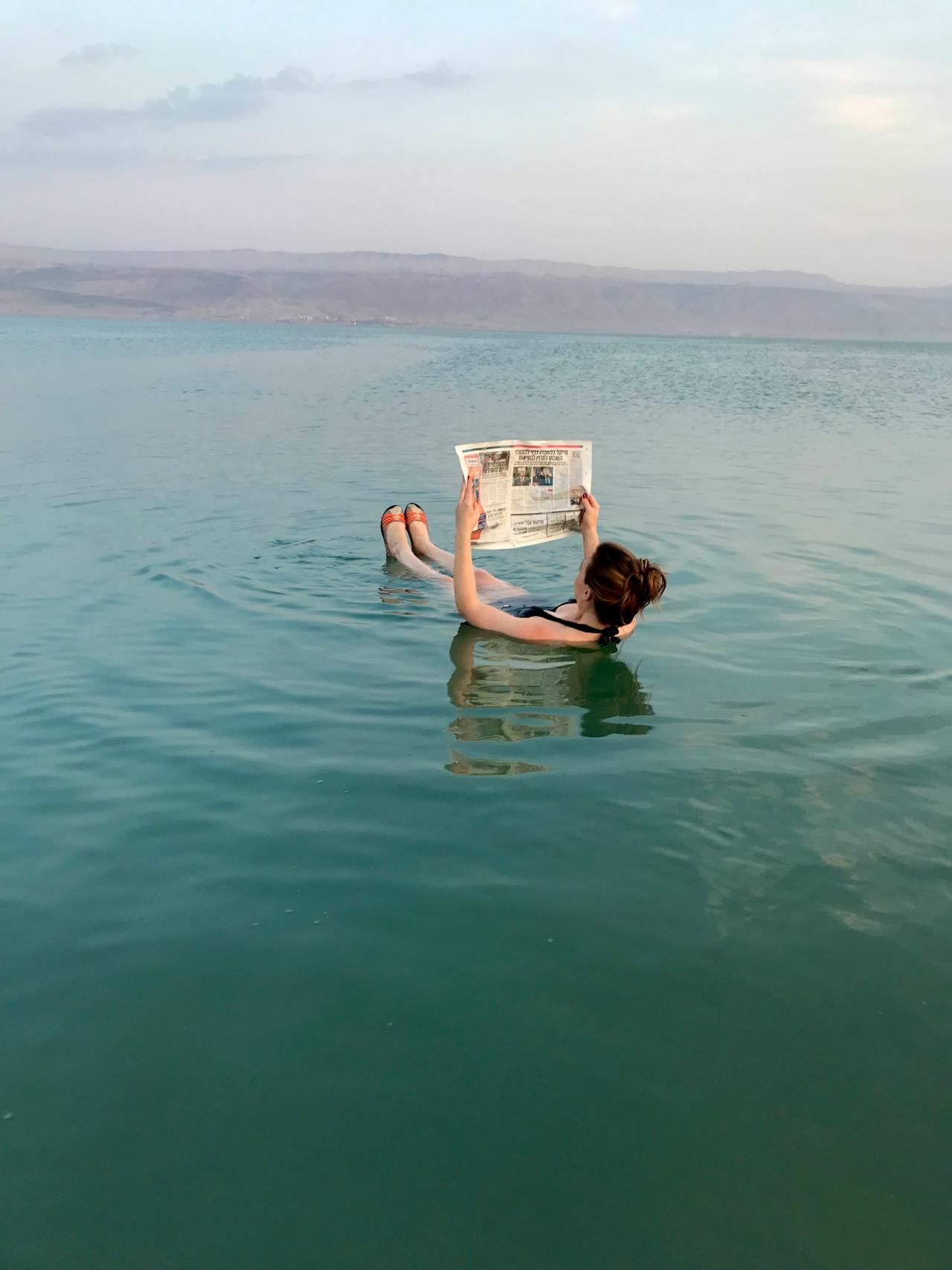
The Dead Sea — the salt lake on the border of Jordan and Israel/Palestine, its surface at 430 metres below sea level (the lowest point of dry land on Earth, and still falling by approximately 1 metre per year as the Jordan River inflow decreases and evaporation continues), its salt concentration of approximately 34% (nearly 10 times the salinity of the ocean) making it impossible to sink and supporting no fish, no plants and virtually no other life beyond salt-tolerant bacteria (hence "Dead") — is simultaneously one of the world's great natural anomalies, an ancient therapeutic destination (Herod the Great, Cleopatra and the Roman armies all used its mineral-rich mud and water for health treatments), and a straightforwardly pleasurable experience: floating effortlessly in warm (32–35°C in summer) mineral water that supports the body completely, covering yourself in the black mineral mud from the shoreline (a free exfoliant and skin treatment that hotels charge significant sums to replicate in their spas), and lying in the heat reading a newspaper held above the water are among the most consistently described pleasurable activities in the Middle East.
The Dead Sea's receding shoreline — the result of over-extraction of the Jordan River water that once replenished it — is one of the region's most visible environmental disasters (the lake has lost approximately one-third of its surface area since 1960 and the shoreline has receded by 2–3km from the luxury resort hotels that were built at the water's edge in the 1990s), creating the surreal spectacle of perfectly maintained hotel beach sections accessible only via a shuttle bus across former seabed, and enormous salt crystal formations (the "Dead Sea mushrooms") growing on formerly submerged surfaces. The sinkholes that have opened along the former shoreline (as salt deposits left by the retreating water dissolve underground) are visible on the approach road — a dramatic indicator of the geological change in progress.
The Floating Experience & Mineral Mud
The floating experience — entering the Dead Sea water (the texture is noticeably oily and heavier than seawater; the salt concentration coats the skin immediately) and lying back to find the body supported automatically with no effort — is the primary activity, but requires some practical management: the water stings any open cut or scratched skin intensely (avoid shaving the day before), the salt concentration means that swallowing even a small amount is violently unpleasant, and prolonged immersion (more than 10–15 minutes) is not recommended as the high mineral concentration begins to dehydrate the skin. The black mineral mud — available free on most public beach sections (scoop it from the shoreline shallows, apply to the skin, allow to dry for 10 minutes, rinse off in the sea) — is the finest free spa treatment in Jordan: the combination of magnesium, potassium, calcium and bromine in the mud has a measurable effect on skin softness. The resort hotel beaches charge for their managed mud sections but the public beach areas at Amman Beach (JOD 15 entry for the beach club, equipment hire, freshwater showers) or the free O Beach provide the same free mud access.
The Dead Sea Resort Hotels & Spas
The Dead Sea resort hotels — concentrated in the Sweimeh area 55km south-west of Amman on the Jordanian eastern shore — are the finest spa hotel concentration in Jordan: the Kempinski Ishtar Dead Sea (from approximately £180/night; the finest pool complex of the Dead Sea hotels, with six interconnected outdoor pools at different levels, the lowest reaching the salt lake), the Marriott Dead Sea (from approximately £120/night; a more manageable property with excellent spa), and the Mövenpick Resort Dead Sea (from approximately £100/night; the most popular, with the most direct beach access) all offer mineral pool treatments, mud wraps, and various Dead Sea mineral spa packages in addition to the sea access. Day visitors can purchase beach club day passes at most hotels (approximately JOD 30–60 per person including towel, lounger and fresh water shower, some including food and beverage credit); this is the most comfortable way to access the sea without staying overnight. The Jordan Valley Marriott and the Dead Sea Spa Hotel are the most budget-conscious options.
Getting There & the Dead Sea Circuit
The Dead Sea is 55km south-west of Amman (1 hour by car via the King's Highway south and then west through the Wadi Shu'eib descent — one of the most dramatic road descents in the Middle East, dropping 400 metres from the plateau to the seabed in 20 minutes). JETT public buses run from Amman's 7th Circle to the Sweimeh resort area (approximately JOD 5; check schedules at jett.com.jo). Taxis from Amman (approximately JOD 25–35 one way; negotiate a return pickup time) are the most practical option for a day trip. The Dead Sea Panoramic Complex (on the mountain above the resort area, accessible by the King's Highway, free entry to the viewing platform; small museum of the geological history) provides the finest aerial overview of the lake and the former shoreline: the contrast between the current waterline and the visible salt-bleached former shore is the most direct visual evidence of the lake's decline. The Dead Sea is most commonly combined with Bethany Beyond the Jordan (Machaerus; the biblical baptism site of Jesus, 10km north of the resort area, JOD 12 entry) and Mount Nebo (where Moses viewed the Promised Land; 30 minutes north of the Dead Sea on the plateau).