Petra — the ancient Nabataean capital carved into the rose-red sandstone mountains of southern Jordan, 230km south of Amman, its identity concealed from the Western world until 1812 when the Swiss explorer Johann Ludwig Burckhardt disguised himself as a pilgrim to gain entry, its famous approach through the 1.2km Siq canyon (a natural geological fault narrowing to 3 metres at its tightest, the cliff walls 80 metres high, the filtered light at the far end revealing the Treasury's columns in a way that 19th-century travellers described as the most dramatic architectural revelation possible) — is consistently ranked among the most extraordinary human places on Earth: a UNESCO World Heritage Site since 1985, one of the New Seven Wonders of the World (selected 2007), and still, despite receiving 900,000 visitors per year at its pre-pandemic peak, an experience of genuine power and archaeological astonishment. The rose-red city (the colour of the sandstone, which ranges from cream to gold to deep rose to purple depending on the light and the mineral content of the rock) was the capital of the Nabataean Arab kingdom from approximately the 4th century BCE, a prosperous desert trading city that controlled the incense routes between Arabia, Egypt and the Mediterranean, its wealth manifest in the extraordinary rock-cut tombs, temples and civic buildings that its citizens carved directly from the living rock rather than constructing from cut stone.
The site of Petra — approximately 264 square kilometres of ancient city, tombs, water channels and processional ways, of which the accessible tourist area covers about 10 square kilometres — requires a minimum of two full days to experience properly: the first day covering the Siq, the Treasury (Al-Khazneh), the Street of Facades, the Roman Theatre (seating 8,500), the Royal Tombs, the Colonnaded Street, the Qasr al-Bint temple complex, and the High Place of Sacrifice via the stepped processional way; the second day devoted to the Monastery (Ad-Deir) — a 45-minute hike of 850 rock-cut steps from the central basin, the destination equal in architectural drama to the Treasury and significantly less visited — and the Byzantine Church (with its extraordinary 6th-century CE mosaic floor, discovered 1990), the Renaissance Tomb, and the quieter northern areas.
The Siq & the Treasury
The approach to Petra through the Siq — entering at the Bab al-Siq (the triumphal arch, of which only the bases remain) and walking 1.2km through the narrowing canyon, its walls carrying Nabataean votive niches, a carved camel caravan, and the remains of a terracotta water pipe that supplied the city — is one of the finest approach sequences in architecture: the crack of light at the Siq's end gradually reveals the Treasury's upper columns and then, as the canyon opens, the full façade (43 metres high, 30 metres wide, its elaborate two-storey classical design carved in the 1st century BCE as a royal mausoleum, its urn at the top riddled with bullet holes from Bedouin trying to dislodge the hidden treasure they believed it contained — the name Al-Khazneh meaning "The Treasury" derives from this folk belief). The Treasury façade is at its finest in the morning (east-facing, it catches the first light directly) and at Petra by Night (the candlelit evening experience, Monday, Wednesday and Thursday evenings; JOD 17 additional entry; the Siq and the Treasury lit by 1,500 candles with traditional music — booking at the visitor centre). Spending 30–45 minutes at the Treasury before the tour groups arrive (arrive at the Petra visitor centre at 6am opening and walk the Siq) gives the finest uncrowded experience.
The Monastery & the High Places
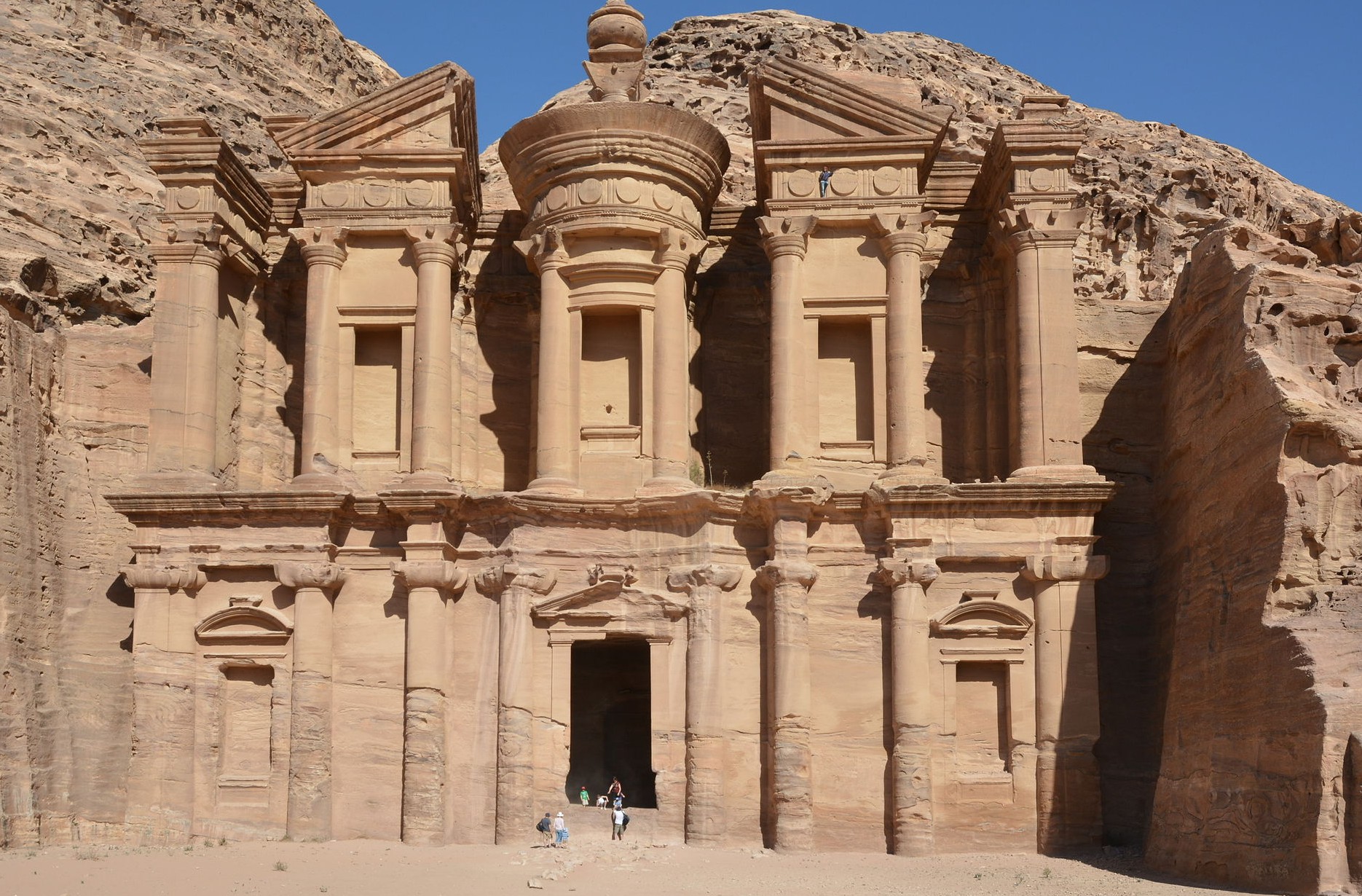
The Monastery (Ad-Deir) — reached by a 45-minute climb of 850 rock-cut steps from the central basin (following the signs from the Qasr al-Bint; donkey rides available for the ascent, approximately JOD 10–15 one way, but the walk is manageable for anyone of reasonable fitness) — is equal in scale to the Treasury (50 metres wide, 45 metres high) but more isolated and, in many visitors's judgement, more moving: the hike through the Wadi Kharareeb canyon passes dozens of lesser-known carved tombs and a landscape of extraordinary sandstone formations, and the Monastery plateau at the top has a café with one of the finest views in Jordan (the distant Wadi Araba and, on clear days, the Israeli Negev beyond). The High Place of Sacrifice (Al-Madhbah) — reached via the Wadi Farasa and the Great Temple complex — is a carved rock-cut altar platform on a mountain above the central basin, where the Nabataeans performed religious sacrifices: the climb (45 minutes via a carved staircase of 800 steps) is rewarded with a panoramic view of the entire central city and a sense of the Nabataean sacred landscape that the basin-level tourist experience does not convey.
Visiting Petra Practically
Petra entry (from the visitor centre at Wadi Musa village, the closest town) is JOD 50 for a one-day ticket, JOD 55 for two days, JOD 60 for three days — the two-day ticket is the minimum for a meaningful visit. The Jordan Pass (purchased online at jordanpass.jo before travel, from approximately £70 including entry and Jordan visa fee) provides the most economical access: three days of Petra plus Jordan visa (for stays of at least 3 nights) and access to over 40 other Jordanian sites. The visitor centre opens at 6am; arriving at 6am for the walk through the Siq to the Treasury at dawn is the single most important timing decision (the Treasury is crowded from 8am onwards when the organised tours arrive from Aqaba and Amman). Wadi Musa village has hotels from budget guesthouses (approximately £30/night) to the Movenpick Petra (directly adjacent to the visitor centre entrance, excellent dinner terrace overlooking the valley, approximately £120–200/night) and the Petra Guest House (where the Treasury street market behind the hotel leads directly into the site, particularly atmospheric at dawn). From Amman, Petra is 3 hours by car (the King's Highway route, through Wadi Mujib and the Dana Nature Reserve, is slower but considerably more scenic than the Desert Highway).