Amman — the capital of Jordan, built across seven (now more than twenty) hills on the Jordanian plateau 800 metres above sea level, a city of approximately 4 million people that has been continuously inhabited since at least the 5th millennium BCE (known as Rabbath Ammon to the ancient Ammonites and Philadelphia to the Ptolemaic and Roman city-builders), its downtown concentrated around the Roman theatre (built under Antoninus Pius, 138–161 CE, seating 6,000 people, still used for concerts and performances), the Citadel (the hill at the centre of downtown, with the ruins of the Umayyad Palace and the Temple of Hercules, whose gigantic hand — all that remains of a colossal statue, its fingers alone 1.5 metres long — points at the Roman theatre below), and the Jordan Museum (the finest museum in the country, containing among its collections the oldest statues of the human form ever found — the 'Ain Ghazal statues, over 9,000 years old, and the Dead Sea Scrolls fragments discovered at Qumran) — is both the practical gateway to Jordan and a city of considerable historical and cultural interest in its own right. The downtown (Balad) area — the old city market around the Roman theatre, its narrow streets lined with spice sellers, jewellers, sweet shops and the Nabulsi cheese vendors — is the finest urban walking area in Jordan.
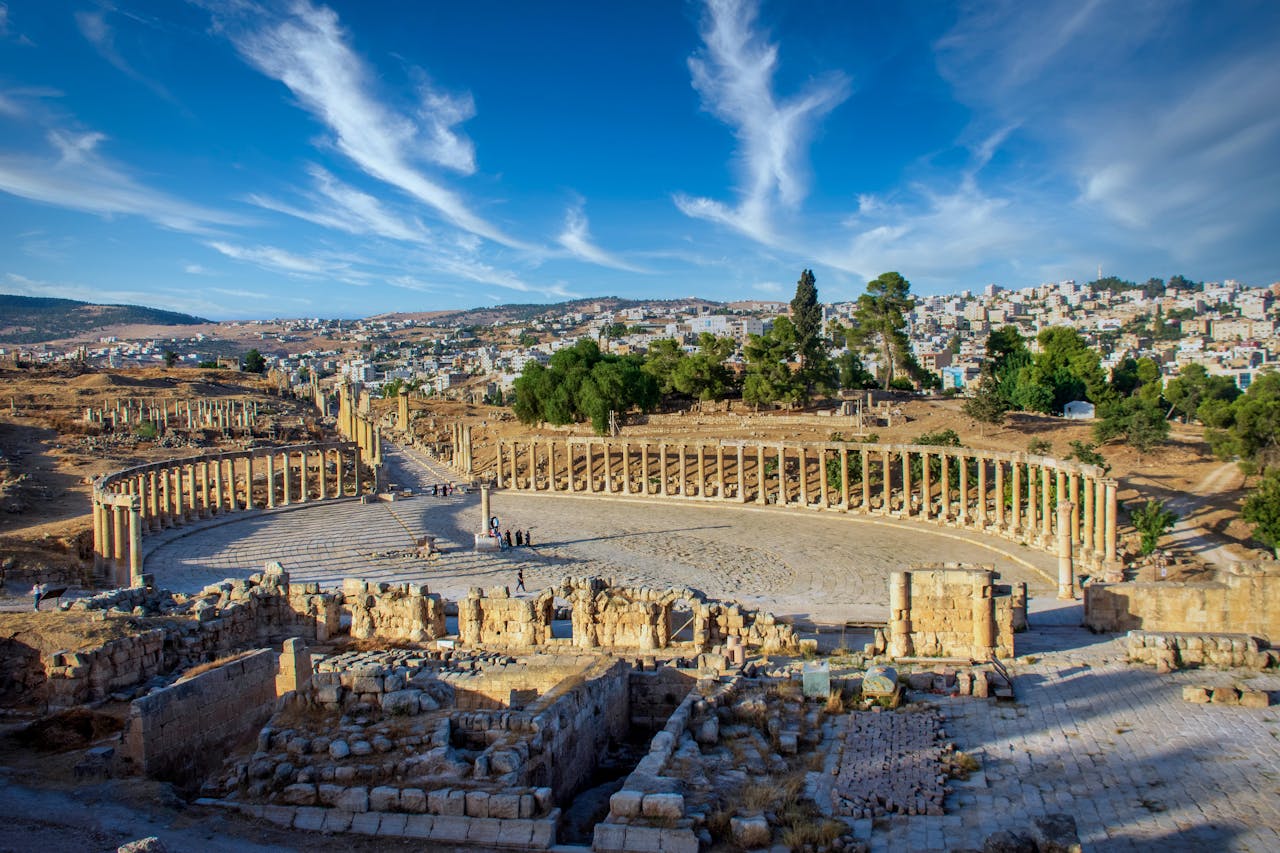
Jerash — 48km north of Amman (45 minutes by car or JETT bus), one of the best-preserved Roman provincial cities in the world and consistently described as the finest Roman city outside Italy and North Africa — was the ancient Gerasa of the Decapolis, a league of ten Romanised cities in the eastern territories, its prosperity peaking in the 2nd century CE when it produced the finest colonnaded civic centre outside Rome itself: the Oval Plaza (the most unusual public space in the Roman world, an elliptical colonnaded forum of 90 Ionic columns), the South Theatre (seating 3,000, its stage wall and colonnade in remarkable preservation), the longest colonnaded street in the Roman world (Cardo Maximus, 800 metres of original paving with chariot ruts still visible), the Hippodrome (chariot racing demonstrations performed by the RACE team daily in the southern end of the former track), and the extraordinary South Tetrapylon (four columned gateways at the crossroads of the main streets). The site is open daily from 8am to 6pm (winter hours shorter); entry approximately JOD 10 (included in the Jordan Pass).
Jerash — the Roman City
The Jerash site — entered through the Hadrian's Arch (built 129 CE to celebrate the emperor's visit to the city, its three openings and the outline of the planned but unbuilt extension to the city beyond it both visible) — follows a logical walking sequence: Hadrian's Arch to the Hippodrome (where the RACE team performs daily chariot racing demonstrations, 10am and 2pm, approximately JOD 8 entry additional; the only place in the world where Roman chariot racing is regularly performed in a partially intact hippodrome), then through the South Gate into the city proper, the Oval Plaza (the most photographed space at Jerash, its elliptical colonnade intact to first-storey height, the scale of the forum — 75 metres on its short axis — apparent only when you walk it), the Cathedral (5th-century Byzantine church with mosaic fragments), the Nymphaeum (an ornate public fountain of 191 CE, its two-storey façade partly intact), and the South Theatre (the finest Roman theatre in Jordan, its stage wall standing to full height with a remarkable acoustic — clap in the centre of the stage to hear the quality). The northern half of the city (the North Tetrapylon, the North Theatre, the Zeus Temple) requires a further 45 minutes and is much less crowded than the south.
Amman City — Citadel, Theatre & Jordan Museum
The Amman Citadel (Jabal al-Qala'a) — the hilltop site at the centre of the downtown, 850 metres above sea level, with a free public viewing terrace overlooking the Roman Theatre below and the spread of the modern city — contains: the Temple of Hercules (2nd century CE, its enormous columns and the gigantic marble hand visible from the city below), the Byzantine Church (6th century CE, its mosaic floor partially preserved), and the Umayyad Palace complex (8th century CE, the seat of the Umayyad governor of Jordan, its colonnaded entrance hall and the extraordinary octagonal domed throne room its architectural highlights). The Jordan Museum (on 3rd Circle, 15 minutes from the Citadel by taxi, entry JOD 3, open Tuesday–Sunday 10am–7pm) is essential context for Jordan travel: the 'Ain Ghazal statues (1988 discovery, 32 plaster-and-bitumen human figures dated to 7250–6000 BCE, the oldest human statues in the world), the Dead Sea Scrolls fragments (on loan from the Jordanian Antiquities Authority), and the extensive Nabataean and Roman collections collectively provide the finest introduction to Jordanian history available anywhere.
Eating in Amman & the Balad
Amman has the finest food scene in Jordan and one of the most underrated in the Middle East: the Balad (downtown) area around the Roman Theatre has the cheapest and most authentic eating in the city — the falafel and hummus shops on Al-Malek Faisal Street (open from 6am for breakfast; full plates of hummus, ful medames, falafel and fresh bread for JOD 1–2) are among the finest cheap breakfast experiences in the Arab world; the Palestinian knafeh shops (the hot orange cheese pastry drenched in sugar syrup, Nablus-style) are the definitive Amman street food experience. Rainbow Street (the restaurant and bar street in the Jabal Amman district, 20 minutes uphill from the downtown, easily accessible by taxi) has the city's finest café-restaurants: Sufra (upscale Jordanian cuisine in a restored Ottoman house, JOD 15–25 per person), Wild Jordan Café (on the Balad edge, with the best view over the downtown and the Roman Theatre), and a range of international restaurants. The Hashem Restaurant (open 24 hours, in the Balad near the Roman Theatre, cash only, beloved by Jordanians of all classes — King Abdullah reportedly eats here) serves the finest hummus and falafel breakfast in Jordan for JOD 2 per person.