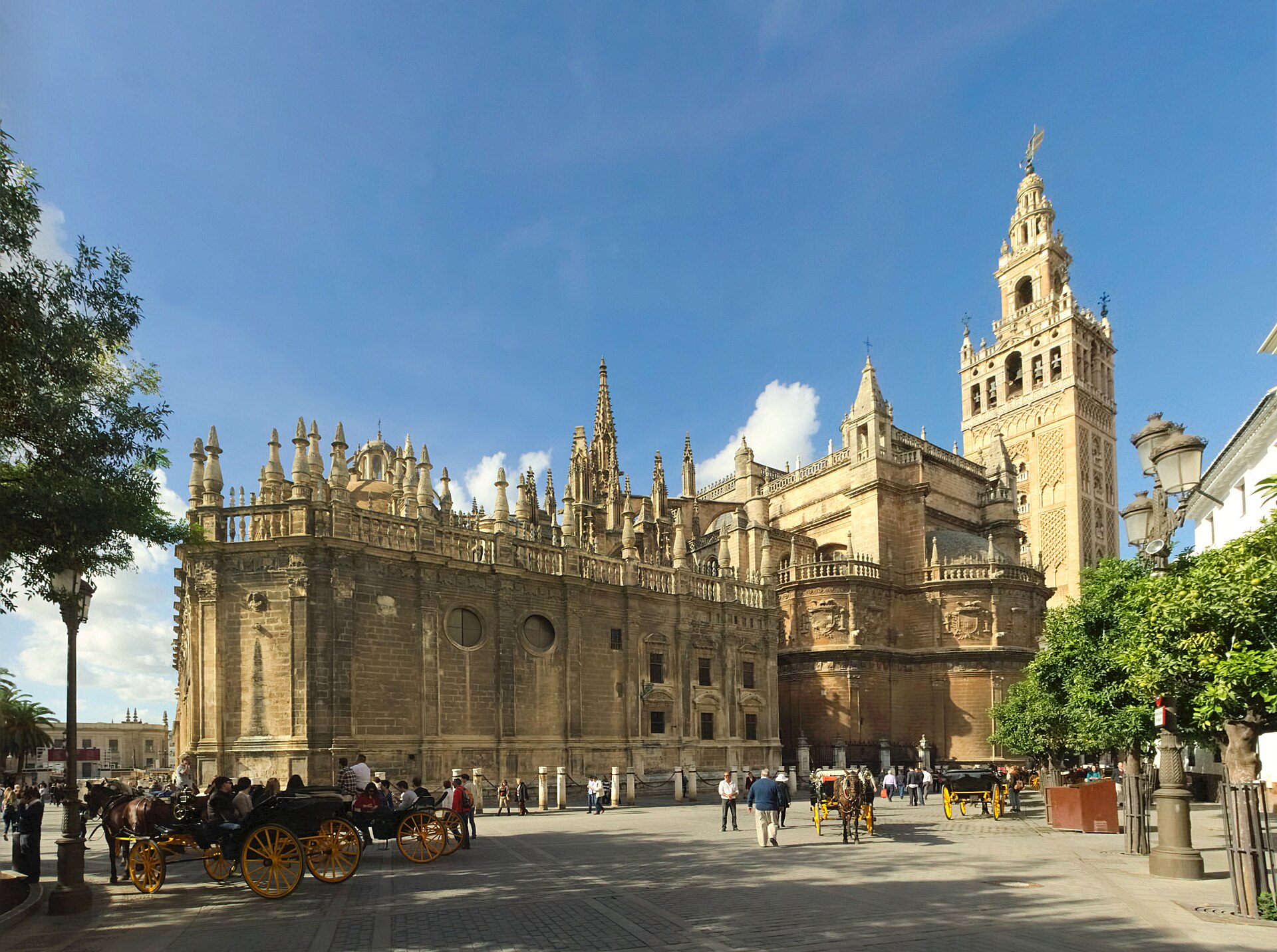
Seville (Sevilla) — the capital of Andalucía, a city of 700,000 on the Guadalquivir River, the most northerly navigable port in Spain (Columbus's three voyages to the Americas departed from Seville's harbour, and all the gold and silver of the Americas returned here, making 16th-century Seville the wealthiest city in Europe) — is considered by many the most beautiful city in Spain: a place of extraordinary architectural richness (the Alcázar, the largest Gothic cathedral in the world, the Renaissance exchange building and the 17th and 18th-century baroque palaces of the old quarter) combined with a pulsating street life, the most authentic flamenco tradition in the world, and the intense southern light of Andalucía that turns the city gold at dawn and dusk. The Feria de Abril (the April Fair, the week following Easter — a week of flamenco, sevillana dancing, sherry and traditional costume on the fairground outside the city) and Semana Santa (Holy Week, the Easter processions of the brotherhoods through the city streets, the most intense Catholic ceremony in Europe) are the city's two great annual events.
The Real Alcázar de Sevilla — a UNESCO World Heritage Site (together with the Cathedral and the Archivo de Indias), the oldest royal palace in continuous use in Europe (built on the remains of a Moorish palace from the 880s CE, substantially rebuilt for King Pedro I of Castile in the Mudéjar style between 1364 and 1366 and continuously modified and extended since) — is one of the most extraordinarily beautiful buildings in Spain: its Palace of King Pedro (the core Mudéjar building, its plasterwork as dense and extraordinary as the Alhambra's Nasrid Palaces, its courtyard the Patio de las Doncellas reflecting the sky in a pool of gold) is the direct artistic descendant of the Alhambra, built by Moorish craftsmen for a Christian king, representing the most sophisticated example of cultural synthesis in medieval Spain.
The Alcázar & Seville Cathedral
The Alcázar (Real Alcázar, entry €14.50 adult, timed entry essential — book at alcazarsevilla.org) requires 2–3 hours for the palace complex, the gardens (one of the finest gardens in Andalucía, a sequence of compartmented formal gardens with orange trees, fountains, myrtle hedges and a remarkable English garden section added in the 19th century) and the upper royal apartments. The Cathedral of Seville (Catedral de Santa María de la Sede) — the largest Gothic cathedral in the world by total area (more than twice the size of Notre-Dame de Paris), built between 1401 and 1528 on the site of the Almohad mosque (the Giralda tower, the mosque's minaret, is incorporated as the cathedral's bell tower) — houses in its interior the tomb of Christopher Columbus (whose remains were transferred from Cuba in 1899), the Giralda (climbable via a ramp built to allow horseback ascent, 35 ramps to the top, the finest view of Seville), and a treasury of extraordinary works including Zurbarán's Virgen de las Cuevas and Murillo's Vision of Saint Anthony. Combined ticket (Alcázar, Cathedral, Archive) €25.
Triana, Flamenco & the Barrio de Santa Cruz
Triana — the Romani quarter across the Guadalquivir from the historic centre, birthplace of the greatest flamenco artists of the 20th century (Carmen Amaya, Camarón de la Isla, Paco de Lucía grew up in this tradition) — has the most authentic flamenco culture in Seville: the Centro Flamenco Fosforito (the flamenco museum, free, in the Casa de la Memoria below the Triana bridge) and the tablaos (particularly La Casa del Flamenco in the Barrio de Santa Cruz, €25–30, small venue, genuine artistry) are the best introduction to flamenco for visitors. The Barrio de Santa Cruz — the former Jewish quarter (Judería) of Seville, a labyrinth of whitewashed alleyways, orange tree courtyards, and tiled house facades immediately east of the Alcázar — is one of the most beautiful historic quarters in Spain: the Plaza de Santa Cruz (with the cross of wrought iron at its centre) and the surrounding maze of the barrio reward a slow morning walk. The Plaza de España (built for the 1929 Ibero-American Exposition, a magnificent semicircular Baroque Revival building with azulejo tile alcoves representing every Spanish province) is the finest single building in Seville and genuinely breathtaking in scale and decoration.
Tapas, Sherry & Getting Around
Seville's food and drink culture is among the finest in Spain: the city's tapas tradition (free tapas with drinks in many traditional bars, though not as universally as in Granada) is expressed at its best in the Triana market (the Mercado de Triana, beside the Puente de Isabel II, with excellent fresh fish and produce stalls and tapas bars within), the Alfalfa neighbourhood (the most local tapas bar concentration in the historic centre), and the Macarena district (north of the historic centre, less touristic, with excellent neighbourhood tapas). Seville is one of Spain's finest sherry cities: the González Byass bodega in Jerez de la Frontera (1.5 hours south-west, the sherry-producing heartland) offers cellar tours and tastings of the full range of manzanilla, fino, amontillado, oloroso and Pedro Ximénez sherries — a world-class wine experience at very low prices. The AVE high-speed train from Seville to Madrid takes 2.5 hours; to Córdoba, 45 minutes (Córdoba's Mezquita — the 10th-century mosque-cathedral, the most important Islamic monument in Spain after the Alhambra — is an essential half-day excursion).