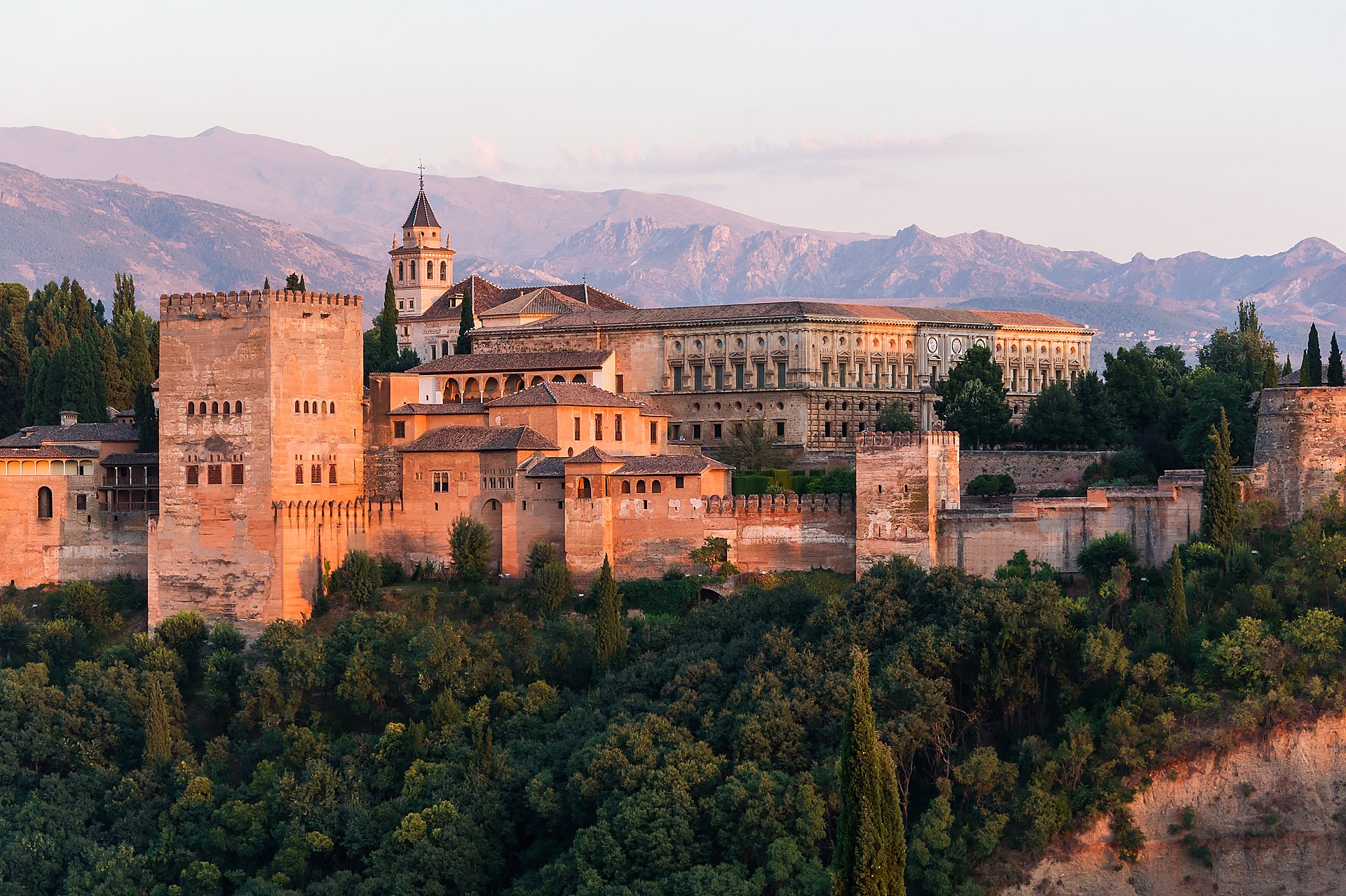
The Alhambra (from the Arabic al-qal'a al-hamrā, "the red fortress") — a palace and fortress complex on a hill above Granada, in the foothills of the Sierra Nevada of Andalucía, the final and greatest achievement of Moorish architecture in Spain — is one of the most visited monuments in the world and, by virtually universal agreement among architectural critics, the most beautiful building complex ever created: a sequence of interlocking palace courts, pavilions, gardens and water features of extraordinary aesthetic refinement, built primarily by the Nasrid dynasty (the last Moorish rulers of Granada, reigning 1232–1492) and embodying the Islamic paradise garden tradition in its most perfect physical form. The contrast between the Alhambra's severe exterior (the red brick defensive walls that give the complex its name, presenting a fortress face to the surrounding city) and the almost impossibly delicate interior (the Nasrid Palaces, with their muqarnas ceiling vaulting, their carved plaster arabesques and their reflection pools) is one of architecture's most powerful dramatic effects.
The Alhambra is visited by approximately 2.8 million people per year, making it Spain's most visited monument; the timed entry system limits the Nasrid Palaces to 300 visitors per 30-minute slot, and the tickets sell out weeks — sometimes months — ahead in summer. Booking online at alhambra-patronato.es as early as possible is absolutely essential; same-day tickets are essentially impossible to obtain in high season, and the disappointment of arriving in Granada without a ticket and being unable to enter the palaces is one of the most common complaints in Spanish tourism.
The Nasrid Palaces
The Nasrid Palaces — the three interconnected palace buildings at the heart of the Alhambra complex — are the supreme achievement of Islamic architecture and the primary reason for the visit: the Mexuar (the administrative palace, the smallest and oldest, with a prayer oratory overlooking the Albaicín below), the Comares Palace (the throne room complex, centred on the Patio de los Arrayanes, the Court of the Myrtles, with its reflecting pool flanked by myrtle hedges and the Torre de Comares rising above), and the Palace of the Lions (the residential palace of Muhammad V, centred on the Patio de los Leones, the Court of the Lions, with its famous 12th-century alabaster lion fountain and the most complex muqarnas ceiling vaulting in Andalucía — the Sala de las Dos Hermanas and the Sala de los Abencerrajes ceiling domes particularly). The carved plaster decoration of the palace walls (every surface covered with geometric and calligraphic pattern in a depth and complexity that increases on close examination indefinitely) represents Islamic decorative art at its absolute apex of achievement.
Generalife Gardens & the Alcazaba
The Generalife — the Nasrid sultans' summer garden estate above and east of the main palace complex, included in the Alhambra ticket — has the finest Moorish garden in Andalucía: the Patio de la Acequia (the Court of the Water Channel, a long garden aligned on a central water channel, its jets arching across the path, the garden compartments of roses and hedges on either side) is the defining image of Moorish garden design and the inspiration for the formal gardens of the Spanish Renaissance that spread across Europe. The Alcazaba — the military fortification at the western end of the Alhambra hill, the oldest section of the complex (9th–13th century), its towers offering the finest elevated view of the city and the Sierra Nevada from the Torre de la Vela — requires 45 minutes of walking on uneven surfaces but gives context for the Alhambra's defensive function that the palace interiors alone cannot provide.
Granada's Albaicín & Sacromonte
The Albaicín — the ancient Moorish residential quarter on the hill facing the Alhambra across the Darro valley, a UNESCO World Heritage Site extension — is the finest surviving example of Moorish urban domestic architecture in Spain: whitewashed carmenes (houses with private walled gardens), narrow alleys (cármenes) and the Mirador de San Nicolás (the viewpoint above the quarter with the most celebrated view of the Alhambra against the Sierra Nevada — the image on a million postcards) constitute an experience of medieval Andalucía that complements the palace grandeur across the valley. The Sacromonte quarter (east of the Albaicín, the traditional Roma quarter of Granada) has the finest flamenco shows in Andalucía: the cave houses (cuevas) on the Sacromonte hillside host genuine cuadro flamenco performances (musicians, singers and dancers together) rather than the stage performances of Seville — more intimate and more authentic in atmosphere. Book through a local agency for the best cueva shows.