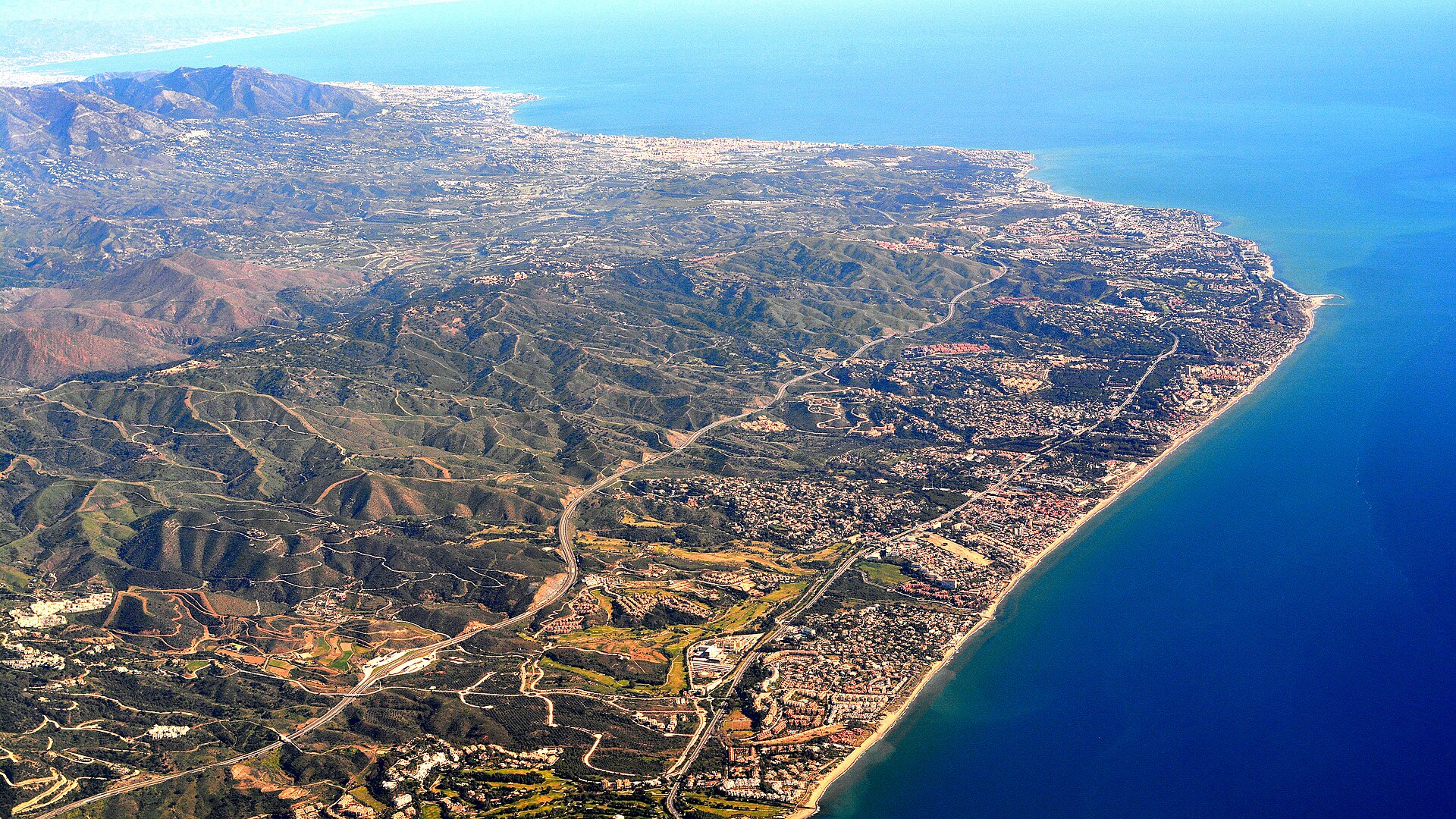
The Costa del Sol — the 150km stretch of Andalucían Mediterranean coast between Nerja in the east and Manilva in the west, centred on Málaga, Spain's sixth-largest city and the gateway for the region's massive British, German and Scandinavian tourist trade — is the most visited coastline in Spain and, by visitors from the UK, the most visited foreign holiday destination in the world after the Canary Islands: a consistent offer of guaranteed sunshine (320 days per year), warm Mediterranean water, well-developed resort infrastructure and the cultural richness of Andalucía (flamenco, Moorish architecture, sherry and fino wine culture, tapas) at flight times of 2.5 hours from London. The coast has been intensively developed since the 1960s — Torremolinos, Benalmádena and Fuengirola are unrepentant mass-market resorts — but contains within it several places of genuine architectural quality and natural beauty: Marbella (whose old town, behind the beach resort infrastructure, has preserved its 15th-century street plan), Nerja (a whitewashed clifftop town with excellent beaches), and Málaga itself (a genuinely excellent city, badly underestimated by visitors who treat it only as an airport transfer hub).
Málaga — the birthplace of Pablo Picasso, the capital of the Costa del Sol province, and a city that has undergone a remarkable cultural transformation in the past 20 years (from airport city to one of Spain's most vibrant cultural capitals, with the Picasso Museum, the Centre Pompidou Málaga and the Carmen Thyssen Museum all within the historic centre) — deserves at least one full day of any Costa del Sol visit: the Alcazaba (the 11th-century Moorish fortress above the city centre, with extraordinary views and an excellent museum), the Roman Theatre below it, and the historic centre's tapas bars (the finest free tapas culture in Andalucía after Granada) constitute a cultural experience that makes Málaga incomparably more interesting than its neighbouring resorts.
Marbella, Puerto Banús & the Golden Mile
Marbella — 60km west of Málaga, the Costa del Sol's most glamorous resort and the jet-set address of European wealth since the 1950s — divides between the Casco Antiguo (the old town, a whitewashed Andalucían village of flower-decked alleys and orange-tree squares that predates the resort entirely and is architecturally excellent) and the resort seafront (the Paseo Marítimo, Puerto Banús and the Golden Mile, where luxury hotels, beach clubs and superyacht berths constitute the Spain of expensive watches and designer sunglasses). Puerto Banús — the purpose-built marina 5km west of Marbella, completed in 1970 — is the most famous yacht harbour in Spain: the quayside restaurants and bars (overpriced, excellent for celebrity-spotting) face a harbour of superyachts that makes it an extraordinary display of concentrated wealth. The beaches west of Marbella (Nikki Beach, Ocean Club) are the most exclusive organised beach clubs on the Costa del Sol; the Marbella old town's hotel stays and tapas bars are significantly better value than the resort strip.
Nerja, Frigiliana & the Eastern Coast
Nerja — 55km east of Málaga, a whitewashed clifftop town of considerable charm whose Balcón de Europa (the clifftop promenade above the sea, with views east and west along the coast) is the finest natural viewpoint on the Costa del Sol — is the most architecturally preserved town on the coast and the most popular base for UK visitors who want both beach and cultural authenticity. The Nerja Caves (Cueva de Nerja, 5km east of town) — a spectacular system of cave chambers containing some of the world's oldest cave art (paleolithic paintings of seals and horses, approximately 42,000 years old, possibly pre-dating modern human arrival in Europe and attributed to Neanderthals) with dramatic stalactite and stalagmite formations — are one of the finest cave systems open to visitors in Europe (entry €15; open daily; book online). Frigiliana — a Moorish white village in the hills 7km north of Nerja, one of the most beautiful pueblos blancos in Andalucía — requires a car but rewards the 20-minute drive with a village of extraordinary architectural preservation and spectacular coastal views from the upper streets.
Málaga City & Cultural Coast
The Picasso Museum Málaga (Palacio de Buenavista, San Agustín 8) — housed in a 16th-century palace adjacent to the house where Picasso was born (now a separate birth house museum), with a collection of 233 works spanning his full career (donated by Picasso's daughter-in-law and grandson) — is the most important single museum on the Costa del Sol and one of the best collections of Picasso in the world; allow 2 hours (entry €12, combined with birth house €16). The Málaga Alcazaba (the 11th-century Nasrid fortress above the Roman Theatre, 500m from the city centre; entry €3.50, combined with the Castillo de Gibralfaro above €5.50) provides the cultural and historical grounding for the entire Andalucían coast: the Moorish presence that shaped Andalucía's distinct culture is visible in the Alcazaba's layered archaeology in a way that the beachfront resorts entirely conceal. The historic centre's tapas bars — particularly on Calle Carretería and around the Atarazanas market (the 14th-century Moorish arsenal, now a food market) — offer the finest free tapas culture on the entire coast.