Barcelona — the capital of Catalonia, a city of 1.6 million people on the Mediterranean coast of north-eastern Spain, the home of Antoni Gaudí and the Art Nouveau movement known as Catalan Modernisme — is one of the world's great cities: a place where extraordinary architecture (not just Gaudí's, but also Lluís Domènech i Montaner's Palau de la Música Catalana and Puig i Cadafalch's Casa Amatller), a beach promenade (the Barceloneta), one of Europe's finest food markets (the Boqueria), a medieval Jewish quarter (the Call) and a Gothic cathedral district of genuine medieval character coexist within an Eixample grid of Bourgeois late-19th-century apartment blocks — the most handsome urban planning in Spain. The Catalan identity (Catalan is the primary language of public life; Barcelona considers itself a European city as much as a Spanish one) gives the city a distinct cultural character that makes it the most internationally oriented major city in Spain.
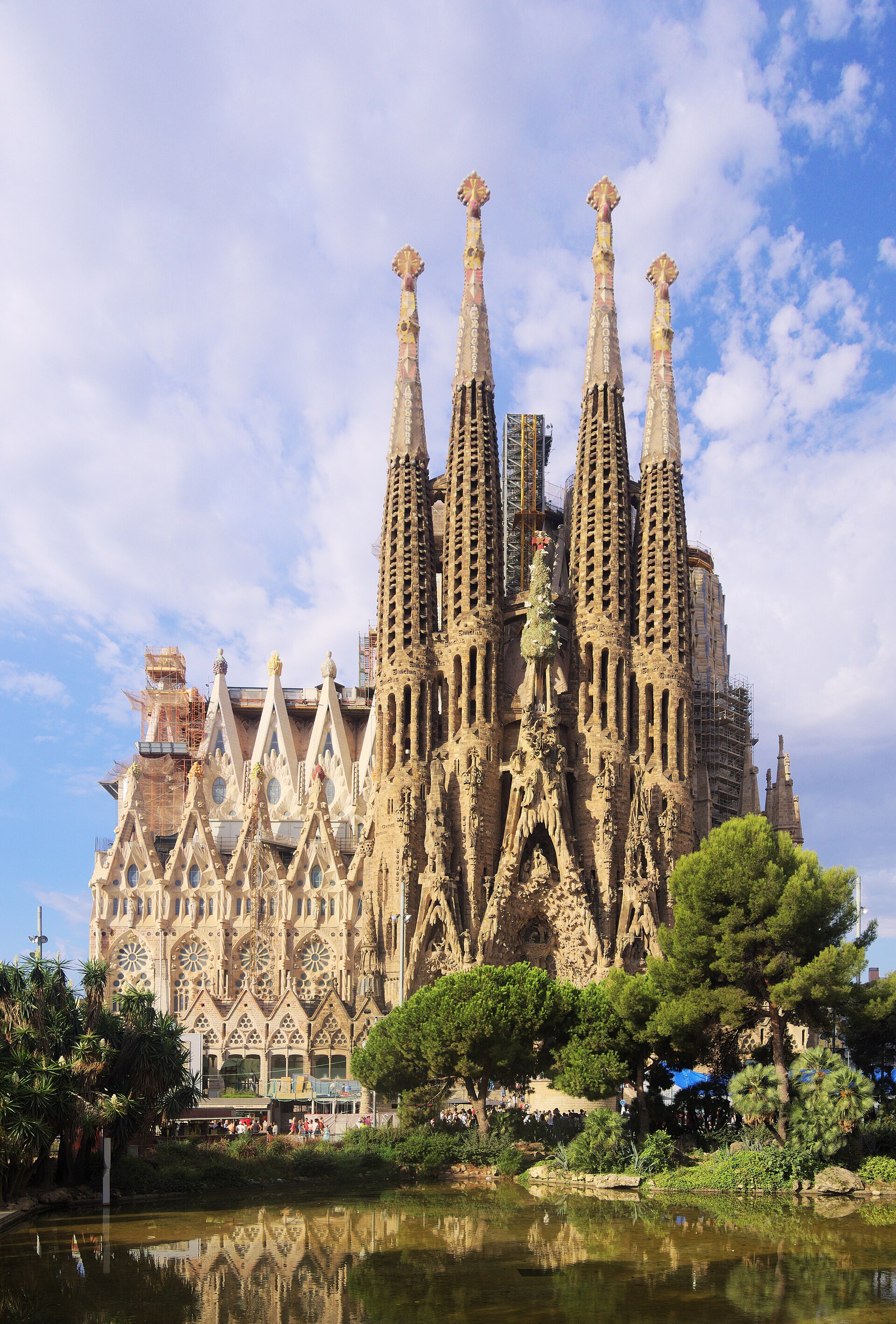
The Sagrada Família (the Basílica de la Sagrada Família) — Gaudí's extraordinary Catholic church, begun in 1882 and still under construction (completion expected approximately 2026, a full century after Gaudí's death in 1926), the most visited monument in Spain and one of the most distinctive buildings in the world — is a building unlike anything else in architecture: a Gothic-inspired but biologically-informed structure whose towers (18 planned, representing Christ, the Virgin, the Evangelists and the Apostles) rise in groups of organic spires, whose interior (flooded with coloured light from the stained glass of both facades, the columns branching like trees overhead) creates a sensation of being inside a natural landscape rather than a building, and whose ongoing construction makes it a unique experience of a living, evolving building rather than a completed monument.
Inside the Sagrada Família
The Sagrada Família interior — completed in the central nave section in 2010, when the Pope consecrated the church — is one of the most extraordinary interior spaces in European architecture: the columns branch overhead like a forest canopy (each column forks at the top into a cascade of supporting branches, distributing the vault load in a system Gaudí devised by studying trees and bones rather than traditional architectural precedents), and the stained glass creates an extraordinary chromatic world — green and blue on the cooler north side, gold and amber on the warmer south — that changes completely through the day as the light moves. The towers are climbable (by lift, included in the ticket at extra cost — worth purchasing): the Nativity towers (the original, older facade) give views across the Eixample grid to the sea; the Passion towers (the newer western facade) give views towards Montjuïc. Book tickets at sagradafamilia.org — standard tickets €26 adult, tower access an additional €9; time slots sell out weeks ahead in summer.
Park Güell & Gaudí's Barcelona
Park Güell — a public park of Gaudí's design (1900–1914, originally conceived as a private residential development that was never completed) on Carmel hill above the Eixample — contains the most concentrated assembly of Gaudí's decorative genius outside the Sagrada Família: the Monumental Zone (entry €10, timed slots required) includes the famous Dragon Staircase, the Hypostyle Hall (a forest of 86 Doric columns supporting the main terrace) and the Great Terrace (an undulating bench of broken tile mosaic, the trencadís technique, overlooking the entire city). The rest of the park (free, accessible without tickets) is extensive and excellent for walking. Other essential Gaudí buildings in Barcelona: Casa Batlló (Passeig de Gràcia, entry €35, the most spectacular interior); La Pedrera/Casa Milà (the building Gaudi called his greatest; entry €25); Palau Güell (2 blocks from the Rambla, Gaudí's first major commission, €12); and the Güell Park itself.
Gothic Quarter, Boqueria & Barcelona Life
The Gothic Quarter (Barri Gòtic) — the oldest part of Barcelona, its medieval streets retaining the Roman street grid beneath Gothic and Renaissance overlays — contains the Barcelona Cathedral (Gothic, 14th–15th century, free except for the cloister and choir), the remains of the Roman walls and temple of Augustus, the medieval Jewish quarter (El Call) and Plaça Reial (a handsome 19th-century arcaded square now serving as Barcelona's outdoor evening social hub). La Boqueria (Mercat de Sant Josep de la Boqueria, on La Rambla) — the most famous food market in Spain, its coloured stalls of fresh seafood, jamón and exotic fruit an iconic image — is genuinely extraordinary and genuinely overwhelmed by tourists; visit at 8am when the restaurant chefs are shopping and the tourist throngs haven't arrived. The Eixample neighbourhood (particularly the Passeig de Gràcia, with its famous "Block of Discord" containing Casa Batlló, Casa Amatller and Casa Lleó Morera side by side) is the finest urban display of Modernisme in the world.