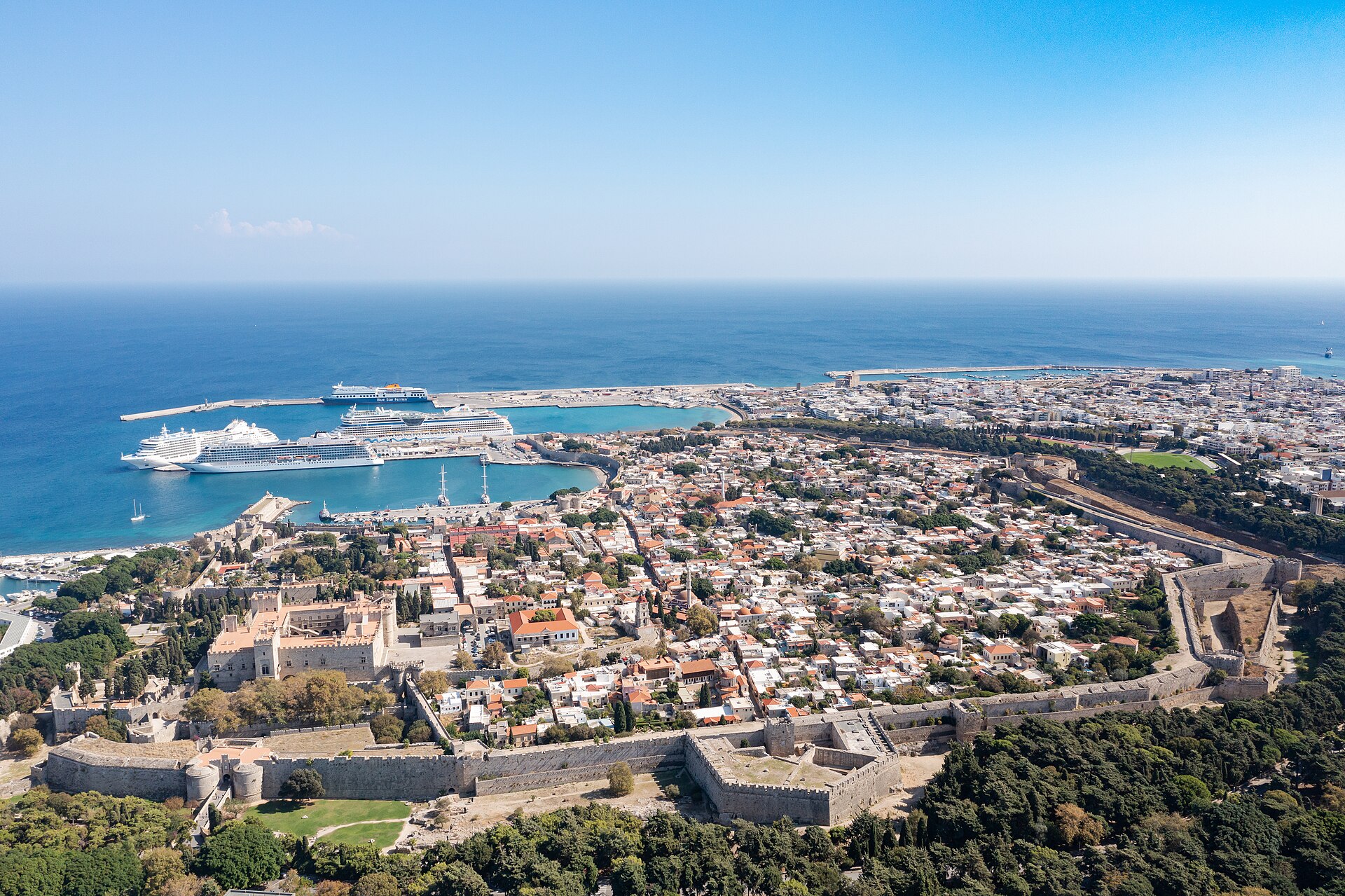
Rhodes — the largest of the Dodecanese islands, sitting at the south-eastern corner of the Aegean Sea closer to Turkey than to Athens — has one of the most extraordinary medieval cities in Europe: the Old Town of Rhodes, a UNESCO World Heritage Site since 1988, is a complete medieval urban environment enclosed within 4km of Crusader-built walls, its grid of streets, palaces, mosques and churches representing 2,000 years of overlapping occupation (Hellenistic, Roman, Byzantine, Crusader, Ottoman and Italian) in a state of preservation unmatched in the eastern Mediterranean. The Knights Hospitaller of St John — a Crusader military order that ruled Rhodes from 1309 to 1522, when Suleiman the Magnificent's Ottoman army ousted them after a six-month siege — left the island its defining architectural character: the Palace of the Grand Master, the Street of the Knights (the Odos Ippoton, the finest medieval street in Greece), and the massive sea walls and towers that still encircle the entire old town.
The Colossus of Rhodes — a bronze statue of the sun god Helios, approximately 33 metres tall, built by the sculptor Chares of Lindos between 292 and 280 BCE and destroyed by earthquake in 226 BCE — was one of the Seven Wonders of the Ancient World and stood (according to the most reliable ancient sources) at the entrance to Rhodes harbour for only 56 years before its fall. Its precise location is disputed; no significant remains have been found; but its legend gives Rhodes an extra layer of historical resonance that the Old Town's medieval architecture amplifies rather than diminishes.
The Old Town & Street of the Knights
The Rhodes Old Town divides into three historic zones: the Collachium (the northern section, where the Knights Hospitaller built their administrative centre — the Palace of the Grand Master, the Inns of the Langue, and the Street of the Knights); the Hora (the middle section, the medieval Greek town with its Byzantine churches and Ottoman additions); and the Jewish Quarter (the south-eastern corner, with the Square of the Jewish Martyrs and the remaining synagogue of Kahal Shalom, one of the oldest functioning synagogues in Europe). The Palace of the Grand Master — rebuilt in the 1930s by the Italian administration (which had ruled Rhodes from 1912 to 1943) as a summer residence for Mussolini, its current interior more Italian Fascist than Crusader — has an excellent museum on the lower floor and remarkable Hellenistic-era mosaic floors transported from Kos. The Street of the Knights (Odos Ippoton) — the most intact medieval street in the Greek world — is lined with the restored Inns of the seven Langues (national divisions) of the Knights Hospitaller.
Lindos & the Acropolis
Lindos — 50km south of Rhodes town on the east coast, its 5th-century BCE acropolis rising on a 116-metre cliff above the village — is the island's most dramatic landscape: the white cubic houses of the medieval village cluster below the cliff, the ancient acropolis (with a Doric Temple of Athena Lindia, a 4th-century Hellenistic stoa and Byzantine and Crusader fortifications) crowns the summit, and the view from the acropolis extends across the cobalt sea to Turkey. The village of Lindos — a UNESCO-listed ensemble of sea captains' houses with distinctive Rhodian pebble mosaic courtyards (hocklakia) — is more beautiful than the Rhodes Old Town for intimate architecture, though equally popular and very crowded in peak season. The beach at Lindos (below the village in the enclosed bay) is a fine pebble-and-sand crescent; St Paul's Bay (a small sheltered cove south of the main beach, where St Paul is said to have landed during his missionary journey to Rhodes in 57 CE) is the finest swimming on the south coast.
Getting Around Rhodes
Rhodes Airport (RHO) — the island's international airport, 16km south-west of Rhodes town — has direct UK connections in summer (approximately 3.5 hours from London). The island (78km long) is best explored by hire car: the east coast road (Lindos, Pefkos, Lardos) is more developed; the west coast is windier and less resort-oriented but has excellent beaches at Prassonissi (the southernmost tip, where the Aegean and Mediterranean meet, a world-class windsurfing destination). The local bus (KTEL) covers the east coast route to Lindos (1.5 hours, approximately €6 each way) several times daily. Rhodes town itself divides into the walled Old Town and the New Town (Nea Agora) — the Old Town is compact enough to walk completely in 2–3 hours; the New Town has the main commercial strip, Mandraki Harbour (where the Colossus allegedly stood) and several excellent fish restaurants on the harbour front.