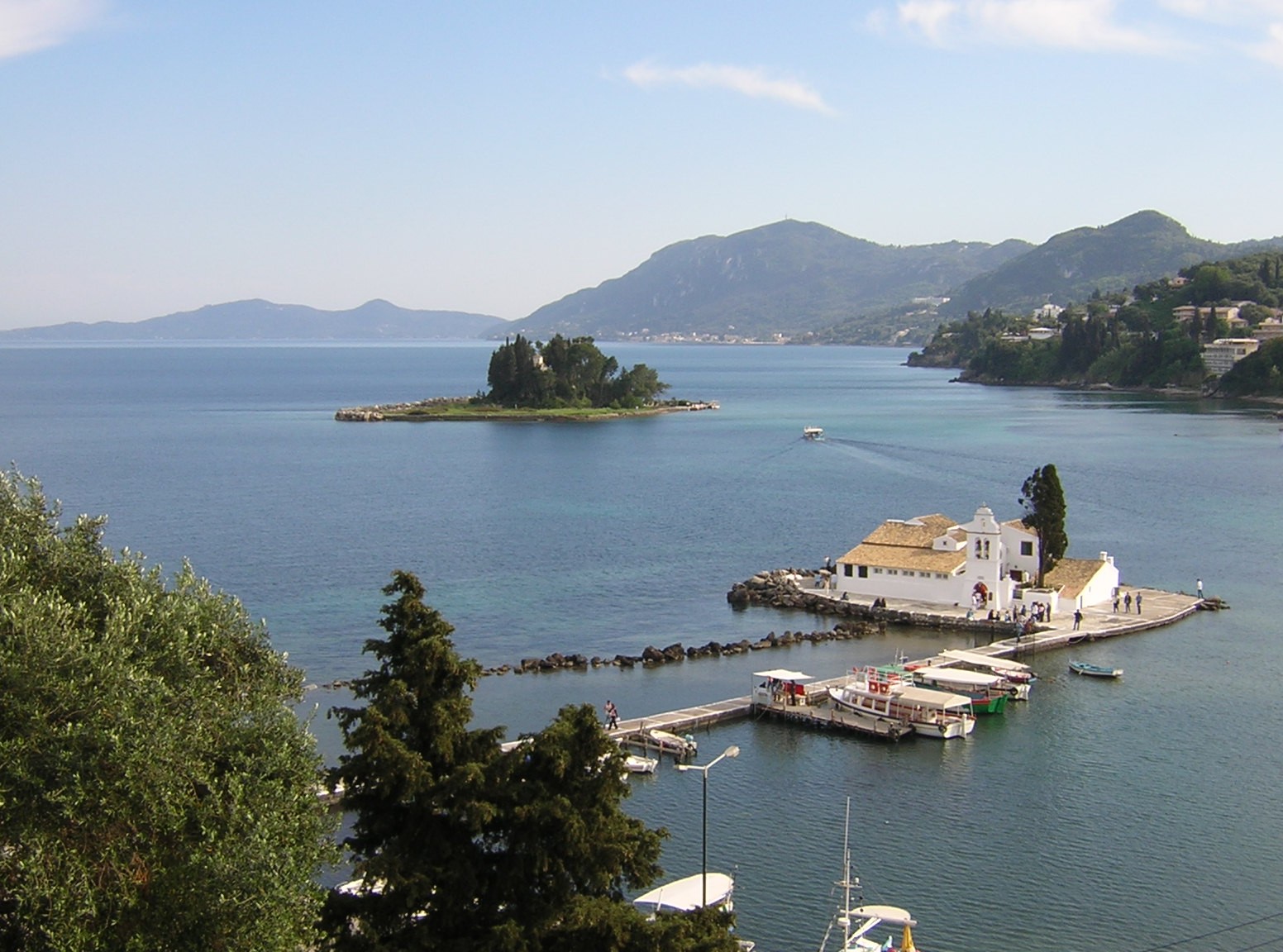
Corfu (Kerkyra) — the northernmost of the Ionian Islands, sitting in the Ionian Sea between Greece and Albania at the entrance to the Adriatic — is the most culturally layered and historically complex of the Greek islands: an island that was never under Ottoman rule (unlike most of Greece), that passed instead from Byzantine hands to the Angevins, then to Venice (whose influence dominated for 411 years, from 1386 to 1797), then briefly to France, then to Britain (a British protectorate from 1815 to 1864, which left cricket on the Spianada esplanade, ginger beer in the cafés, and a legal and administrative legacy that set Corfu apart from the rest of Greece), and finally to the Greek state. This layering of influences — Venetian Gothic palaces, Byzantine fortresses, Neoclassical British-era buildings, French colonnades and genuinely Greek Orthodox village life — makes Corfu Town (the UNESCO-listed Old Town, declared a World Heritage Site in 2007) one of the most architecturally extraordinary small cities in the Mediterranean.
The island itself — 60km long, covered in 3–4 million olive trees planted by the Venetians and giving the landscape an unusually lush, non-Mediterranean greenness — is one of the most beautiful in Greece: the Pantokrator mountain (906m) dominates the north; the Achilleion Palace (built by the Empress of Austria on a hill above Gastouri) is the island's most famous historic house; and the beaches of the west coast (Paleokastritsa, Myrtiotissa, Agios Georgios) represent some of the finest cove swimming in the Ionian.
Corfu Old Town & the Fortresses
Corfu Old Town — the most complete Venetian urban environment in Greece — is divided between the Old Fortress (Palaio Frourio, built on a promontory to the east, with Byzantine-era foundations rebuilt by the Venetians and later the British, entry €6) and the New Fortress (Neo Frourio, built by the Venetians in 1577 to cover the town's landward side, entry €4, excellent views from the walls). Between the two fortresses, the town unfolds in characteristically Venetian fashion: the Liston (a colonnaded arcade modelled on the Rue de Rivoli in Paris, built during the brief French occupation) faces the Spianada esplanade (where Corfu Cricket Club plays on the southern section — one of Greece's most surreal sporting vistas); the Campiello quarter behind the Liston is a labyrinth of Venetian arcaded streets (the sotoportegoes, as in Venice itself); and the Orthodox Cathedral of Agioi Iasonas kai Sosipatros (a Byzantine foundation) and the Catholic Cathedral of Saint James sit virtually side by side, a physical expression of the island's complex religious heritage.
Paleokastritsa & the West Coast
Paleokastritsa — 25km from Corfu Town on the west coast, a succession of six coves separated by wooded headlands, the water a remarkable sequence of turquoise and jade — is the most beautiful beach complex in the Ionian Islands: the sheltered coves have exceptional water clarity, the Byzantine monastery of Theotokos (founded in the 13th century, rebuilt several times, perched on a headland between the coves) has a small museum of Byzantine icons and an extraordinary location, and the view from the Old Fortress of Angelokastro (the Byzantine-Venetian castle 3km north along the coast, accessible by boat or a rough track) across the Ionian Sea to the Albanian mountains is one of the finest coastal views in Greece. Myrtiotissa Beach — 5km south of Paleokastritsa, accessible by a rough track or short coastal path — is a naturist beach of extraordinary beauty: a small cove of white sand backed by olive groves, consistently ranked among the finest beaches in Greece.
The Achilleion & Northern Corfu
The Achilleion Palace — built between 1889 and 1892 for the Empress Elisabeth of Austria (Sisi) on a hill above Gastouri village, 12km south of Corfu Town, and later purchased by Kaiser Wilhelm II — is an over-the-top neoclassical confection of colonnaded terraces, statuary (including a famous large-scale bronze Achilles drawing a spear) and tiered gardens overlooking the sea, now a museum (€7, open daily) that captures the extraordinary mixture of royal taste and classical ambition that characterised late 19th-century aristocratic culture. The northern village of Kassiopi (36km from Corfu Town) — with a Byzantine castle on the headland above the harbour, excellent seafood restaurants in the harbour square, and several accessible beaches nearby — is one of the island's finest bases for exploring the dramatic north coast. The landscape between Kassiopi and Corfu Town on the Pantokrator mountain road is the most beautiful in the Ionian: olive groves, cypress trees and sea views of extraordinary depth.