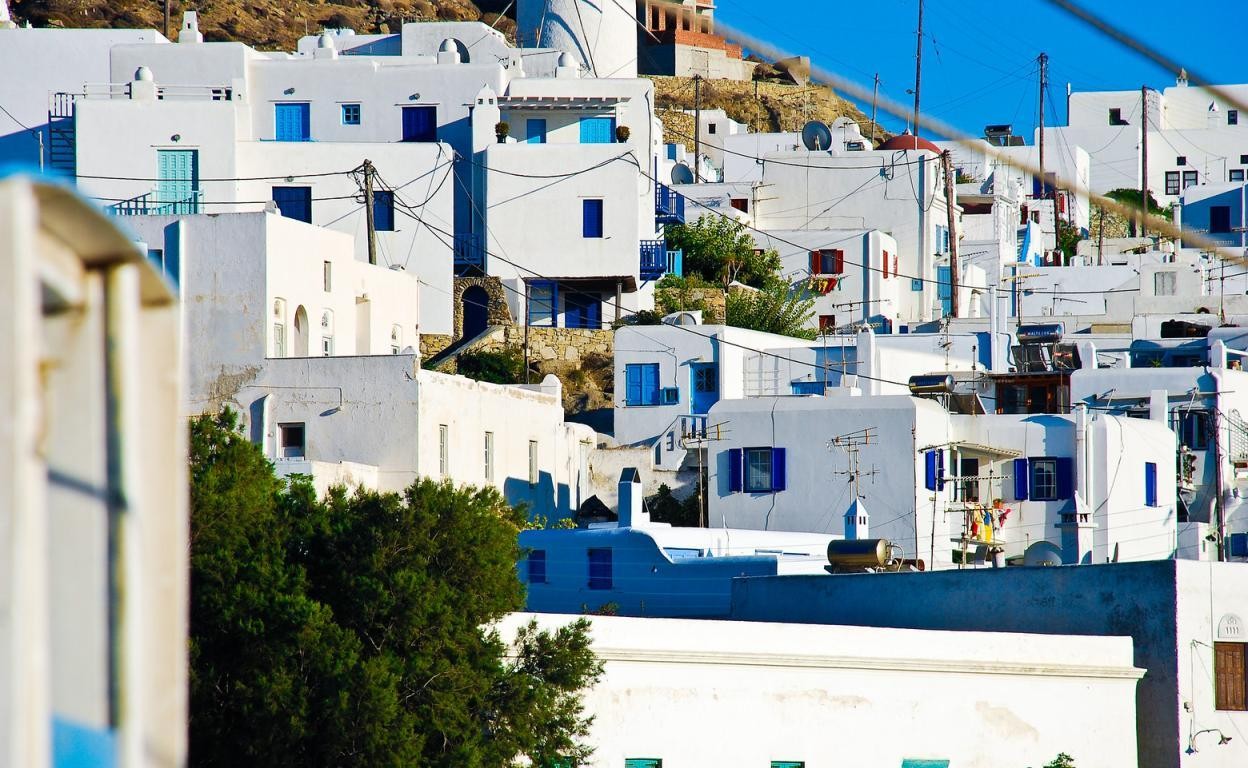
Mykonos — a 86 square kilometre island of granite and marble in the central Cyclades, its landscape of whitewashed cubic houses, blue-domed churches, windmills and bougainvillea defining the visual language of the Greek islands for international travellers — has been the most cosmopolitan and fashionable island in Greece since the 1950s, when artists and celebrities discovered its perfect Cycladic architecture, its extraordinary clear light and its then-tiny port town of Chora. Today it is one of the most sought-after summer destinations in Europe, with an international reputation for sophisticated beach clubs, excellent restaurants, a well-established LGBT+ scene (one of the most welcoming in the Mediterranean) and the kind of celebrity-sighting beach culture that makes high season (July–August) feel more like St Tropez than a Greek fishing village. But even in the height of the season, Mykonos retains genuine beauty: Chora's labyrinthine streets were deliberately designed to confuse Aegean pirates, and getting lost in them — stumbling across chapels, cats and bougainvillea-framed archways — remains one of the island's essential pleasures.
The island's beaches are its primary daytime attraction: Super Paradise, Paradise, Psarou and Elia (on the southern coast, sheltered from the island's famous Meltemi wind) have organised beach clubs with sunbeds, cocktails and DJ sets; Agios Sostis (north coast, no facilities, reached by rough road) is the island's finest wild beach. Platis Gialos, the long southern beach most easily accessible from Chora by bus, is the family-friendly option with multiple beach bars and water sports.
Chora, Little Venice & the Windmills
Mykonos Town (Chora) — built on a slight promontory above the main port, its streets a deliberate maze of whitewashed houses, blue-shuttered doors and narrow alleyways that double back and intersect without apparent logic — is the finest example of Cycladic vernacular architecture in the Aegean. Little Venice (Alefkandra) — a row of 18th-century sea captains' houses built directly above the water on the western seafront, their balconies overhanging the sea, now converted to bars and restaurants — is the most photographed streetscape on the island, particularly at sunset when the Venetian-style buildings catch the golden light above the translucent water. The 16 Kato Mili windmills on the hill above Little Venice — built by the Venetians in the 16th century to grind the Aegean islands' grain — are the iconic Mykonos image, their white sails and cylindrical towers defining the Chora skyline. The Parish Church of Paraportiani (a compound of five asymmetric chapels merged into a single whitewashed mass) is the most photographed church in Greece.
Delos — The Sacred Island
Delos — a tiny uninhabited island 5km south-west of Mykonos, reached by boat from Chora harbour (30 minutes, departing 9am and 10am, returning 12pm and 3pm, approximately €20 return) — is one of the most important archaeological sites in the Greek world: the birthplace of Apollo and Artemis according to Greek mythology, the island was the most sacred sanctuary and the most important trading port in the Cyclades, inhabited from the 3rd millennium BCE until the 1st century BCE when a pirate attack destroyed the city and killed or enslaved 20,000 of its inhabitants. The site — managed and excellently signed by the French School of Archaeology since 1873 — includes the Terrace of the Lions (a row of archaic marble lions guarding the Sacred Lake, their originals preserved in the site museum), the mosaics of the House of Dionysus (rivalling those of Paphos in quality), and panoramic views from the summit of Mount Kynthos (113m, 30-minute climb from the site). Allow 3–4 hours on the island.
Beaches & Getting Around
Mykonos's beaches require strategy: the southern coast beaches (Super Paradise, Paradise, Psarou, Elia) are the finest and most sheltered but require either a taxi (very expensive and scarce in peak season, €20–40 to far beaches), a beach bus from Fabrika square in Chora (regular, inexpensive, covers most beaches), or a water taxi from the old port. Psarou Beach — the smallest and most exclusive of the southern beaches, where the super-yachts anchor — has the finest water and the highest prices (sunbed hire €70–100 for two); Super Paradise has the most famous beach club atmosphere and the most vibrant LGBT+ scene. The Meltemi wind (a powerful north wind that crosses the Aegean in summer, particularly in July–August) can make the northern beaches uncomfortable — the south coast's natural shelter from the Meltemi is the primary reason for the island's beach geography.