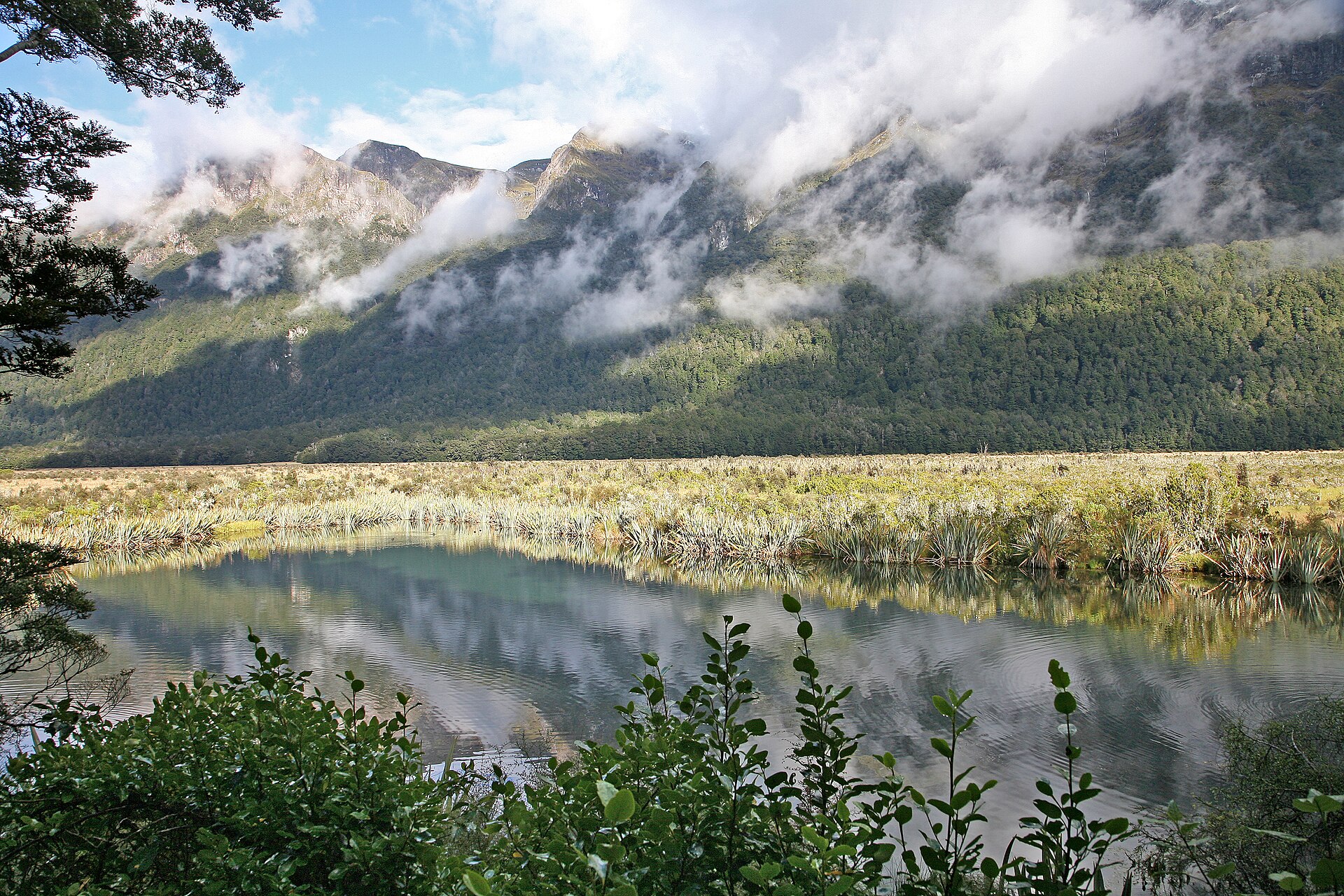
Milford Sound (Piopiotahi in Māori — "single huia bird" in memory of the Māori chief Te Hau who died here) — the fiord on the south-western coast of New Zealand's South Island, within the Fiordland National Park (the largest national park in New Zealand, 1.2 million hectares of the wettest, most rugged and least accessible land in the country), reached by a 2.5-hour drive from Queenstown through the Homer Tunnel (a 1.2km road tunnel through the Darran Mountains, unlined, its walls of raw black schist, opened 1954 after 19 years of construction by hand with pick and shovel) — is the most visited natural attraction in New Zealand and was described by Rudyard Kipling as "the eighth wonder of the world": a fjord of 16km length carved by glaciers during the last ice age, its walls rising 1,200 metres from the black water (Fiordland receives 7–8 metres of rainfall per year, the highest in New Zealand, the rainfall flooding off the vertical walls of the fjord in temporary waterfalls that can number in the hundreds after rain), its centrepiece the near-perfect triangular peak of Mitre Peak (1,692 metres, rising directly from the water, the most photographed mountain in New Zealand) reflected in the still dark surface when the rain pauses and the wind drops.
Fiordland National Park — of which Milford Sound is the most accessible point (the only road access; Doubtful Sound and the other southern fiords are accessible only by boat or small aircraft) — is one of the four parks forming Te Wahipounamu (South West New Zealand), a UNESCO World Heritage Site covering 2.6 million hectares of the wettest, most ecologically intact land remaining in Australasia: the park contains the rarest birds in New Zealand (the kea, the world's only alpine parrot; the takahē, believed extinct for 50 years before its 1948 rediscovery; the moose, introduced in 1910, rumoured to still exist in the Fiordland interior) and one of the finest walking tracks in the world — the Milford Track, a 4-day guided or independent walk from the head of Lake Te Anau to Milford Sound, rated among the finest multi-day walks on Earth.
The Milford Sound Cruise
The Milford Sound cruise — a 2-hour boat trip from the Milford Sound terminal into the fiord and to the open sea at the Tasman Sea entry, returning past the Stirling Falls (155 metres, accessible by the tour boats close enough to feel the spray) and the Bowen Falls (162 metres, one of the permanent waterfalls fed by a permanent stream above the fiord wall) — is the primary experience and operates year-round (Real Journeys, Go Orange, Jucy Cruize; from approximately NZD 80–120 per adult; book at realjourneys.co.nz or mitre-peak.com at least a day ahead in summer). The finest conditions are on a rainy day — the temporary waterfalls cascading off the cliffs in their hundreds, the low cloud hanging in the valleys and revealing the rock walls in sections, the surface of the fiord disturbed only by the rain — rather than in the clear conditions that most visitors hope for. The underwater observatory (a floating platform at Harrison Cove, accessible by some cruise operators for an additional NZD 20, descending 10 metres below the surface where the tannic acid from the rainwater creates a permanent dark layer that allows deep-water species — black coral, sea pens, bottlenose dolphins — to live in the shallow fiord as if at deep ocean depths) is the most unusual experience at Milford Sound.
The Milford Track
The Milford Track — a 53.5km guided or independent multi-day walk from the Glade Wharf at the head of Lake Te Anau to Sandfly Point at the south end of Milford Sound, typically completed in 4 days, passing through the Clinton Valley, over the MacKinnon Pass (1,154 metres, the highest point, with a 360-degree view of the Fiordland peaks and glacial valleys on clear days), and down through the Arthur Valley past the Sutherland Falls (580 metres, the tallest waterfall in New Zealand and one of the tallest in the world) — is rated by the New Zealand Department of Conservation as one of the nine Great Walks of New Zealand and consistently described by experienced trampers as one of the finest multi-day walks on Earth. The guided walk (through Real Journeys, accommodation in private lodges; from approximately NZD 2,400 per person for the 4-day walk, fully guided with meals) is comfortable and rewarding; the independent walk (accommodation in DOC huts; from NZD 70/night, booked through the DOC Great Walks booking system which opens in June for the following season) is the more austere and more intimate experience. Bookings open in June each year for the October–April season and fill within hours — plan and book well in advance.
Getting to Milford Sound
Milford Sound is reached from Queenstown (3 hours) or Te Anau (2 hours) by road via the Homer Tunnel; from Queenstown, the day trip (departing 7am, arriving by 10am for the cruise, returning by 7pm) is the most common approach, either self-driven (a full day's drive; spectacular but tiring) or by coach tour (departing Queenstown from approximately NZD 150 including the cruise). The most recommended alternative for those with more time: fly from Queenstown to Milford Sound by scenic flight (30 minutes by small aircraft, over the Darran Mountains and the fiord landscape; from NZD 300 per person; Glenorchy Air or Milford Sound Scenic Flights) and return by coach — the aerial approach to Milford Sound through the mountain valleys, with the peaks at eye level and the fiords below, is one of the finest scenic flights in the southern hemisphere. Te Anau (2 hours from Queenstown, the closest town to Milford Sound at 120km) is the preferred base for multi-day explorations of Fiordland, with a range of accommodation from NZD 30/night (backpacker) to NZD 200/night (comfortable hotel).