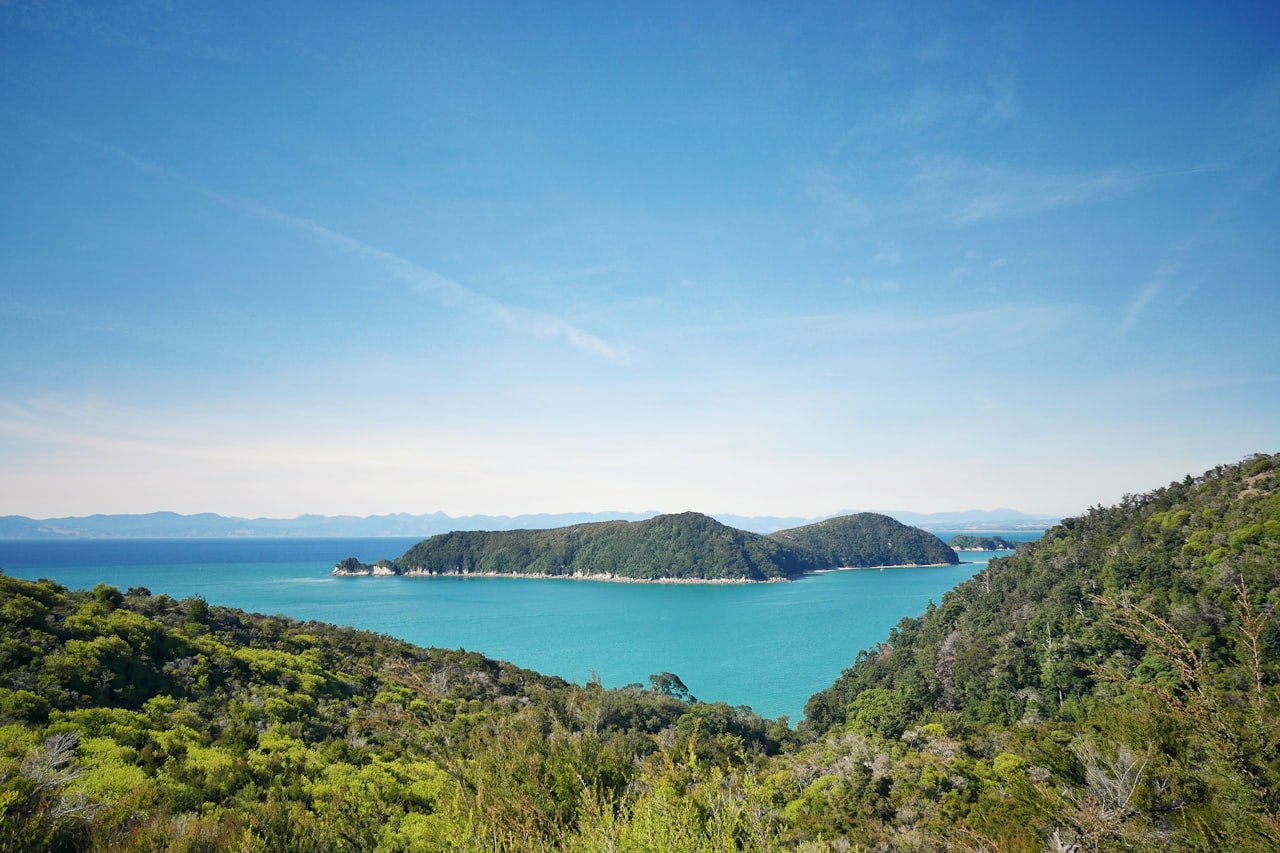
The top of New Zealand's South Island — the region between Nelson (the sunniest city in New Zealand, averaging 2,400 hours of sunshine per year) and Picton (the Marlborough Sounds ferry terminal) — contains two of the country's most beautiful natural environments and one of its finest agricultural landscapes: Abel Tasman National Park (New Zealand's smallest national park but its most visited in terms of overnight walker numbers, a 60km coastline of golden granite sand beaches, turquoise sea, native bush and the most consistently clear water of any accessible coastal park in New Zealand), the Marlborough Sounds (the drowned river valley system at the top of the South Island, 1,500km of sheltered waterways created when the sea flooded the Wairau and Pelorus river valleys at the end of the last ice age, now the finest sea kayaking ground in New Zealand and the location of the mussel and salmon aquaculture industry that produces a significant portion of New Zealand's seafood export) and the Marlborough wine region (the Wairau and Awatere valleys, where the combination of long days, cool nights and free-draining alluvial soils produces the Sauvignon Blanc grapes that have made Marlborough the most significant New Zealand wine appellation in world export markets — Cloudy Bay, Brancott Estate and Villa Maria's Marlborough vineyard all have cellar doors open for tasting).
Abel Tasman National Park — accessed from the Nelson or Motueka township, reached by water taxi, sea kayak or on foot from the Marahau car park (the southern trailhead of the Abel Tasman Coast Track) — has the finest beach-accessible coastal walking and sea kayaking in New Zealand: the Abel Tasman Coast Track (a 60km, 3–5 day Great Walk of New Zealand, overnight in DOC huts or private lodges, from approximately NZD 70/night for the huts) follows the coastline between Marahau and Wainui at the northern end of the park, passing through native bush above the beaches and descending to them at intervals throughout the day. The track can also be walked in individual day sections, with water taxi transfers between points on the coast, making it one of the most flexible of the Great Walks.
Abel Tasman Beaches & Sea Kayaking
The beaches of Abel Tasman — Bark Bay, Anchorage, Onetahuti, Totaranui, Awaroa (tidal, crossable only 2 hours either side of low tide) — are among the finest in New Zealand: the granite sand is golden rather than white (the specific geology of the park, with granitic rocks producing a distinctive warm-coloured sand), the water is calm on most days (the park is sheltered from the prevailing westerly swells by the northern tip of the South Island), and the bush comes directly to the sand. Sea kayaking (guided or independent hire; Abel Tasman Kayaks and Kahu Kayaks are the main operators in Marahau; guided day tour approximately NZD 120; multi-day guided kayak and camping approximately NZD 250/day) is the finest way to access the more remote beaches: the sheltered waters allow paddling by most fitness levels, the water is clear enough to see the bottom in 5–6 metres, and the option of landing on any beach for a swim before continuing is the definitive Abel Tasman experience. Water taxis (from Marahau, approximately NZD 50–80 one way to various beaches; Abel Tasman Aqua Taxi) allow day visitors to access the park beaches without the full track commitment.
Marlborough Sounds & Picton
The Marlborough Sounds — the drowned valleys at the top of the South Island, most accessible from Picton (the ferry terminal for the Interislander and Bluebridge services connecting the South Island to Wellington, the North Island capital, 3 hours across Cook Strait) — are explored by sea kayak (the Queen Charlotte Track, a 70km multi-day walk or kayak from Ship Cove to Anakiwa, is the finest route through the Sounds; cycling is also popular on this track), water taxi, or the couriers and mail boats that still deliver provisions to the remote baches and farms of the Queen Charlotte and Kenepuru Sounds. The highlight of the Marlborough Sounds is Queen Charlotte Sound (Te Hoiere): the entry channel for the ferry from Wellington and the most dramatic 30 minutes of ferry travel in New Zealand (the Interislander ferry, from approximately NZD 55 per person one way, an 8-hour crossing from Wellington that includes 30 minutes of extraordinary narrow-channel navigation through the Sounds; booking at greatjourneysofnz.co.nz — taking the ferry from Wellington to Picton or vice versa is one of the great short sea voyages in the southern hemisphere). Fresh Marlborough mussels (half-shell, steamed or in chowder) and oysters are available from producers directly in Havelock (the mussel capital of the world).
Marlborough Wine Region
The Marlborough wine region — the Wairau Valley (the main valley, where the majority of the 25,000 hectares of vineyard are concentrated, with the Wither Hills visible on the valley's southern edge) and the Awatere Valley (drier, cooler, producing more mineral Sauvignon Blancs and increasingly acclaimed Pinot Noirs and Rieslings) — is New Zealand's largest and most important wine region, producing approximately 70% of the country's total wine volume and 90% of its Sauvignon Blanc, a grape variety that New Zealand has effectively made its own in the international market. The cellar door experience: Cloudy Bay (the most famous Marlborough producer, its Sauvignon Blanc the wine that established New Zealand's international reputation in the early 1990s; tasting NZD 15, cellar door open daily; book at cloudybay.co.nz), Brancott Estate (Heritage Centre and restaurant with vineyard views, tasting from NZD 10), and the Allan Scott, Saint Clair and Fromm cellar doors (smaller, more personal tasting experiences, all within 10km of Blenheim town centre) collectively provide a wine trail of 4–5 hours. Blenheim (the main Marlborough town, 30km south of Picton, 1 hour from Nelson) is the base for the wine region and 1 hour from both Picton and Nelson.