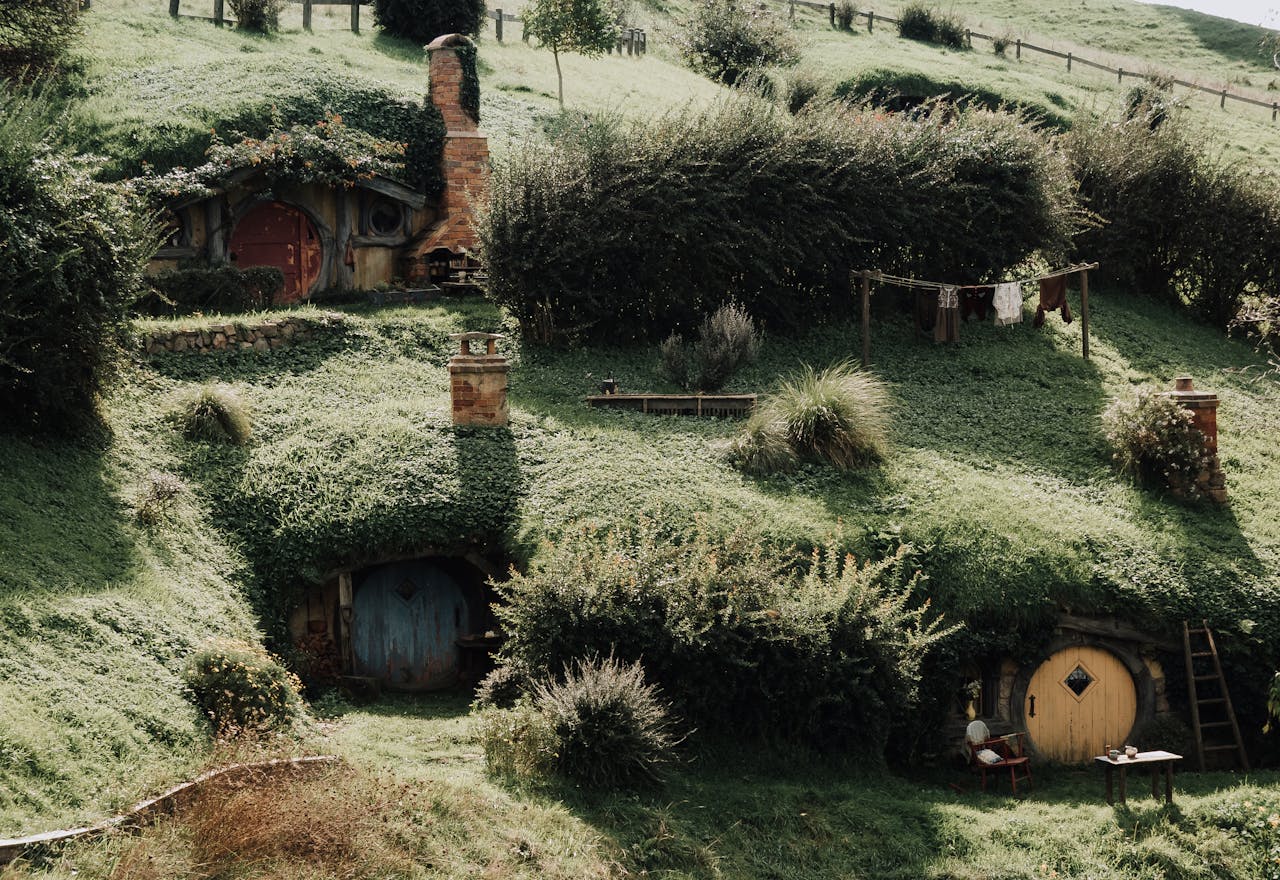
The North Island of New Zealand's central region — the farming country between Hamilton and Rotorua, an area of rolling green hills, geothermal volcanic activity and Māori cultural heartland — contains two of New Zealand's most visited attractions: the Hobbiton Movie Set at Matamata (the permanent recreation of the Shire from Peter Jackson's Lord of the Rings and Hobbit film trilogies, maintained on the Alexander farm and open for guided tours year-round — the only major Lord of the Rings film location that has been preserved rather than demolished) and Rotorua (the geothermal city on the southern shore of Lake Rotorua, its streets steaming with natural vents, its parks containing boiling mud pools, silica terraces and the world's most active geyser zone, and its Māori population — the largest urban Māori population in New Zealand — offering the most accessible and respected Māori cultural experiences in the country). The two attractions are 60km apart and can be combined in a single day trip from Hamilton or Auckland, or as a 2-day itinerary from Auckland with an overnight in Rotorua.
Rotorua — a city of 75,000 people on the floor of the Taupo Volcanic Zone, the most geologically active region in New Zealand and one of the most active in the world, the city's infrastructure built over the top of a hydrothermal system that supplies every garden with its own natural vent and fills the air with the characteristic sulphur smell that Rotorua residents simultaneously complain about and defend as part of the city's identity — has been a major tourist destination since the 1880s, when the Pink and White Terraces (massive silica terrace formations comparable in scale to Pamukkale, destroyed by the 1886 Tarawera eruption) attracted visitors from across the British Empire to see what was then described as the eighth wonder of the natural world. The thermal attractions that replaced the terraces — Wai-O-Tapu, Waimangu, the Whakarewarewa Māori village thermal park — are individually extraordinary and collectively make Rotorua the finest concentration of accessible geothermal activity in the world.
Hobbiton Movie Set
The Hobbiton Movie Set — on the Alexander sheep farm near Matamata, 80km south-east of Hamilton, 2.5 hours from Auckland — is one of the finest film tourism experiences in the world: 44 Hobbit holes built into the hillside above the party field (the original 2001 set was demolished and rebuilt in permanent materials for The Hobbit trilogy, 2011–2014), the Green Dragon Inn (a working pub serving ales and ciders brewed specifically for the set), the Party Field with its oak tree (constructed from steel tubes and 200,000 artificial leaves, each attached by hand), and the double-arched bridge over the mill pond collectively create an experience of extraordinary fidelity to the source material for any Middle Earth enthusiast. Guided tours depart from the Hobbiton Tour Centre in Matamata (standard tour approximately NZD 49 adult, 2 hours; evening banquet tours NZD 195 including the 3-course dinner in the Green Dragon, evenings only, most recommended; book at hobbitontours.com months ahead for the evening tour). The farm setting — genuinely rolling New Zealand pastoral country, identical in every respect to the landscape Tolkien's illustrations evoked — makes the experience coherent in a way that a studio tour cannot.
Wai-O-Tapu & Geothermal Parks
Wai-O-Tapu Thermal Wonderland — 27km south of Rotorua (30 minutes by car), open daily 8:30am–5pm, entry approximately NZD 40 adult — is the finest single geothermal park in New Zealand: the Lady Knox Geyser erupts daily at 10:15am (with a soap-powder catalyst that breaks the surface tension; the eruption reaching 10–20 metres, 20 minutes of continuous flow) and the walking circuit through the park passes: the Champagne Pool (a large thermally heated pool of 74°C, its brilliant turquoise water rimmed with orange arsenic and antimony mineral deposits creating one of the most vivid natural colour combinations in the world), the Primrose Terrace (silica terraces stained yellow by sulphur, the closest equivalent to the destroyed Pink and White Terraces), the Artist's Palette (a flat silica plain with vivid green, yellow and orange mineral deposits), and a series of boiling mud pools and sulphur vents. Waimangu Volcanic Valley (15km south of Rotorua, open 8:30am–5pm, NZD 45) is the more geologically significant site (the youngest geothermal area in the world, created by the 1886 Tarawera eruption) and contains the Inferno Crater Lake (whose water level rises and falls on a 38-day cycle driven by geothermal pressure changes) and the Frying Pan Lake (the world's largest hot spring, 38,000 square metres).
Māori Culture in Rotorua
Rotorua's Māori cultural experiences — the most accessible in New Zealand — range from the historic Whakarewarewa Māori Village (a living Māori village within the geothermal park at the city's southern edge, open daily, guided tours NZD 45 including the thermal park access, cultural performance and hāngī meal — a meal cooked underground in a natural steam vent; the only place in New Zealand where this traditional cooking method is still practised commercially using actual geothermal steam rather than electric ovens) to the Te Puia cultural centre (the more theatrical option, with a twice-daily kapa haka performance — the haka and waiata performed in a purpose-built wharenui, entry approximately NZD 70 including the Whakarewarewa geothermal area and the New Zealand Māori Arts and Crafts Institute where carving and weaving apprentices work publicly) to the Mitai Māori Village (evening-only experience including a waka ceremony on the river, cultural performance and hāngī dinner, approximately NZD 120 — the most complete single evening experience of Māori culture available in New Zealand). The Rotorua Museum (currently closed for earthquake strengthening; check status at rotoruamuseum.co.nz) in the 1908 Bath House building is the architectural centrepiece of the Government Gardens.