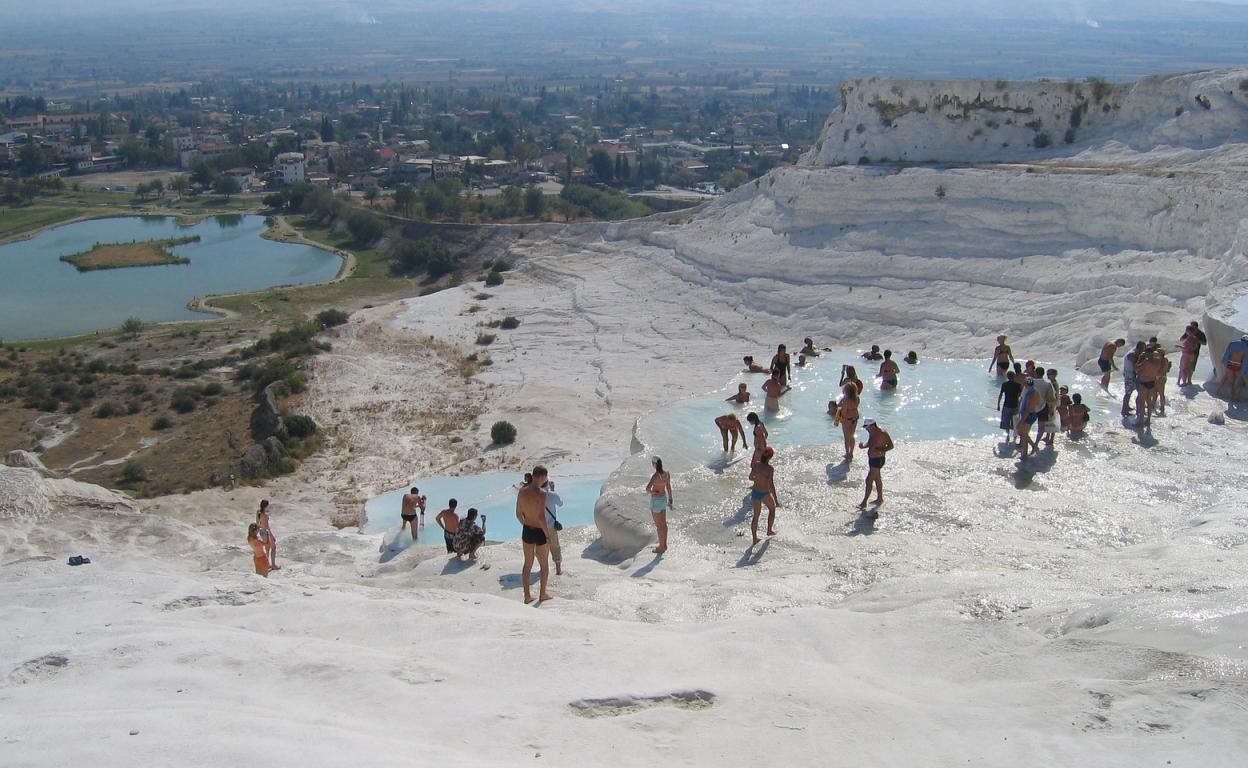
Pamukkale (Cotton Castle in Turkish) — a hillside in the Denizli province of western Turkey where thermal spring water rich in calcium carbonate has, over tens of thousands of years, deposited the mineral in a series of terraced pools and cascades of brilliant white calcite that flows down the hillside like a frozen waterfall of snow — is one of the most immediately recognisable and most otherworldly natural landscapes in the world: a UNESCO World Heritage Site (listed 1988, together with the adjacent ancient city of Hierapolis) whose white terraces, filled with warm (35°C) turquoise water, have been drawing visitors since the ancient Greeks established the first therapeutic baths here in the 2nd century BCE. The combination of the geological spectacle (the continuous deposition of calcium carbonate, creating new terraces and sealing old ones, is an ongoing process) and the ancient city above (Hierapolis, founded by the Attalid kings of Pergamon, a Roman spa city of considerable size and historical importance) makes Pamukkale one of the finest combined natural and archaeological destinations in Turkey.
The travertine terraces — the most recent of which fill with warm mineral water creating natural baths of extraordinary visual beauty — are accessible on foot (barefoot, shoes must be removed at the site boundary to protect the delicate calcium surface) from both the top (Hierapolis entrance, where most visitors arrive) and the bottom (the village of Pamukkale below, where the most dramatic face of the white cliff is visible). The UNESCO listing required the removal of the hotels that had been built directly on the travertines in the 1970s and 1980s (their foundations are still visible), a decision that has significantly restored the site's natural purity — though the summer crowds (the site receives 2 million visitors per year) remain a challenge at peak times.
The Travertine Terraces
The Pamukkale travertines — 2,700 metres long and 160 metres high on the hillside above the Menderes plain — are accessible via two routes: the main path from the top (from the Hierapolis North Gate, where most organised tours arrive) descends through the active terraces to the bottom village; or visitors can ascend from the bottom (the base of the white cliff, with the most dramatic photography of the white formations from below). Shoes must be removed before stepping onto the travertine surface — white plastic bags for shoes are provided at the entry gates. The active terrace pools (warm, slightly milky water, varying depth from ankle to waist) are open for bathing in designated sections; some pools are restricted to foot-level entry to prevent erosion. The finest photography of the terraces is from the village below at sunrise, when the white calcite turns from grey to gold to brilliant white in the space of 30 minutes — a perspective unavailable from the top-entrance approach.
Hierapolis Ancient City
Hierapolis — the ancient spa city built by the Attalid kings of Pergamon in the 2nd century BCE and extensively developed under Roman rule, eventually destroyed by earthquake in 1334 CE — spreads across the plateau above the travertines and contains: the finest necropolis in Turkey (over 1,200 tombs, sarcophagi and mausoleums extending 2km along the plateau edge, the most extensive ancient burial ground in Anatolia), a Roman theatre of 12,000 capacity (remarkably intact, its carved reliefs still vivid), the Martyrium of St Philip (a 5th-century CE octagonal church at the hilltop, where the Apostle Philip was martyred c. 80 CE), the colonnaded Domitian Gate and main street, and the Hierapolis Museum (housed in the restored Roman baths, with excellent finds from the city). The Plutonium — the cave of toxic carbon dioxide used in ancient religious ceremonies (priests could survive the fumes; sacrificial animals could not, a feat considered divine by the ancient world) — has been excavated and is now accessible for viewing (though still emitting CO₂ and cordoned off for safety).
The Antique Pool & Getting There
The Antique Pool (Cleopatra's Pool, Antik Havuz) — a swimming pool of naturally thermal mineral water (35°C, rich in carbonic acid and mineral salts, supposedly with health benefits) whose floor is covered with submerged Roman marble columns and architectural fragments from the 7th-century earthquake — is one of the most extraordinary swimming experiences in Turkey: the warm water, the ancient columns, and the view over the Menderes plain below (with Pamukkale's white cliff visible at the pool's edge) combine to create an experience that is part archaeological, part spa, part natural wonder. Entry to the Antique Pool (approximately €15 in addition to the site admission) is worth the cost for an hour's swim. Pamukkale is most conveniently reached from Denizli (19km by dolmuş minibus, approximately €1 and 30 minutes) or by organised day tour from İzmir (2.5 hours), Antalya (3 hours) or Ephesus (2.5 hours). The Denizli-Çardak Airport (DNZ) has limited connections; most visitors fly to İzmir or Antalya and travel by road.