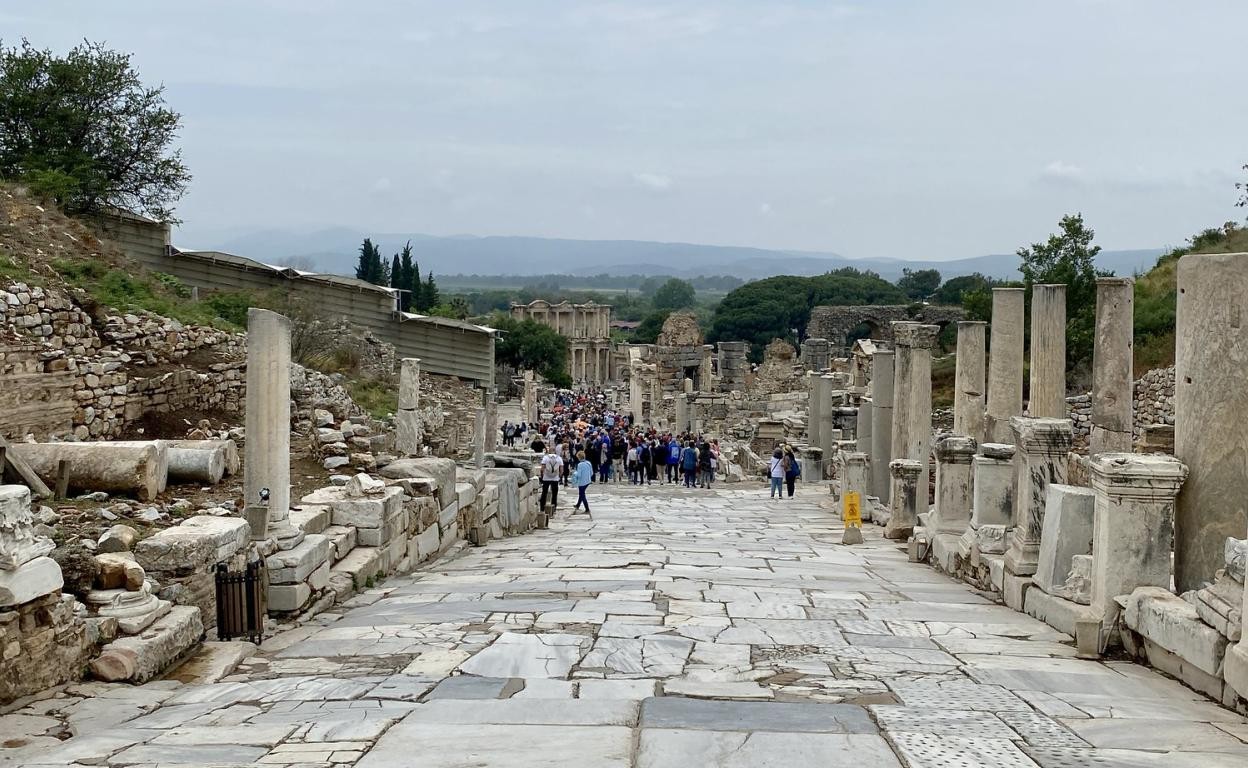
Ephesus (Efes) — the ancient Ionian Greek and Roman city 80km south of İzmir on the Aegean coast of Turkey, once one of the largest cities in the Roman Empire (with a population of 200,000–500,000 at its peak in the 1st century CE, the capital of the Roman province of Asia and one of the most important commercial and religious centres in the ancient world) — is the most extensive and most impressive ancient Roman city open to visitors outside Italy: a site of 18 square kilometres (of which approximately 15–20% has been excavated) containing the Library of Celsus (the most recognisable building in Ephesus, its façade of four superimposed columns and statuary a remarkably complete example of Roman architectural ambition), the Great Theatre (seating 25,000 people, where St Paul preached to the Ephesian silversmiths during his Third Missionary Journey, c. 57 CE), the colonnaded Curetes Street (the main shopping and processional street), the Terraced Houses (a UNESCO candidate site of exceptional preservation, the private homes of Ephesus's wealthy class, their mosaics and frescoes remarkable in their completeness) and the remains of one of the Seven Wonders of the Ancient World — the Temple of Artemis.
St Paul's Letter to the Ephesians, St John's Gospel (written, according to tradition, in Ephesus), the First Council of Ephesus (431 CE, which declared Mary to be Theotokos — Mother of God — in the Church of Mary within the ancient city), and the temple of Artemis (whose fame as one of the Seven Wonders brought pilgrims and merchants from across the ancient world) make Ephesus a city of extraordinary religious significance for both Christianity and the ancient Greek and Roman world, a density of religious and cultural heritage unmatched in a single archaeological site.
The Library of Celsus & the Terraced Houses
The Library of Celsus — built between 110 and 135 CE as the tomb of the Roman Senator Gaius Julius Celsus Polemaeanus and as a public library (holding approximately 12,000 scrolls in the temperature-controlled niches of its reading room), its two-storey façade reconstructed from original pieces in the 1970s by Austrian archaeologists — is the most reproduced image of Ephesus and one of the finest examples of Roman public architecture in existence: the four tiers of columns, each tier in a different classical order, the four female statues representing Sophia (wisdom), Arete (virtue), Ennoia (thought) and Episteme (knowledge), and the false front concealing the functional library behind constitute a building of extraordinary theatrical sophistication. The Terraced Houses (Yamaç Evleri, additional entry €10–15, essential for any serious visit) — six dwelling units of the Roman aristocracy, excavated and covered by a protective steel structure on the slope above Curetes Street — contain the finest private Roman mosaics and frescoes in Turkey: entire dining rooms, bathrooms and reception halls preserved to waist height, with wall paintings of extraordinary colour.
Temple of Artemis & Selçuk
The Temple of Artemis — one of the Seven Wonders of the Ancient World, the largest temple in the ancient world (approximately 137m × 69m, three times the area of the Parthenon), first built in the 8th century BCE, rebuilt after its 356 BCE arson (by Herostratus, who set fire to it on the night Alexander the Great was born, reasoning that the act would immortalise his name) and destroyed by the Goths in 262 CE, its marble largely quarried for the St John Basilica in Selçuk in the 4th century CE — survives only as a single re-erected column and a field of scattered marble foundations, 2km from the main Ephesus entrance. The single column (1.2 of the original 127 Ionic columns still standing) is a poignant counterpoint to the library's surviving grandeur. Selçuk — the small town 2km from the Ephesus south gate, the practical base for visiting the site — has the excellent Selçuk Archaeological Museum (with Ephesus finds including two extraordinary Roman marble statues of Artemis of Ephesus, entry €7), the restored Byzantine-Seljuk Isa Bey Mosque (14th century) and the ruins of the St John Basilica (where the Apostle is buried, according to tradition) on the hill above the town.
Visiting Ephesus Practically
Ephesus has two entrances: the south gate (near the theatre — the most commonly used entrance, as tour buses approach from the Kuşadası direction) and the north gate (near the Vedius Gymnasium — the less-crowded entry point, allowing a walk through the site from north to south and exit at the south gate without retracing steps). The best strategy for independent visitors is to enter through the north gate in the morning (9am opening) and walk south through the site, reaching the Library of Celsus and Great Theatre before the tour group rush from the cruise ships. The main site entry is approximately €25 (check current prices at ephesus.gov.tr); the Terraced Houses additional entry is €10–15 and is worth the cost. İzmir — the nearest major city (1 hour north by car or bus) — is the most practical base for a longer Aegean visit; Kuşadası (18km west) is the nearest resort town and the arrival point for Aegean cruise ships.