Istanbul — the only city in the world to span two continents (the European Thrace side west of the Bosphorus, the Asian Anatolia side east), the former capital of the Byzantine Empire (as Constantinople, 330–1453 CE) and of the Ottoman Empire (as Istanbul, 1453–1922), a city of 15 million people, three UNESCO World Heritage Sites and one of the world's most extraordinary concentrations of religious architecture — is increasingly recognised as one of the world's great travel destinations: a place where layers of civilisation (Greek, Roman, Byzantine, Ottoman, secular Republican) are physically present in the same neighbourhood, where the call to prayer echoes across the Golden Horn against a skyline of Byzantine domes and minarets, and where a food culture of extraordinary depth and variety makes eating in Istanbul one of the finest gastronomic experiences in the Mediterranean world. For UK visitors, Istanbul offers the combination of very affordable prices (accommodation, food and transport cost 30–50% less than comparable Western European cities), direct flights from multiple UK airports, and a cultural experience of unparalleled intensity.
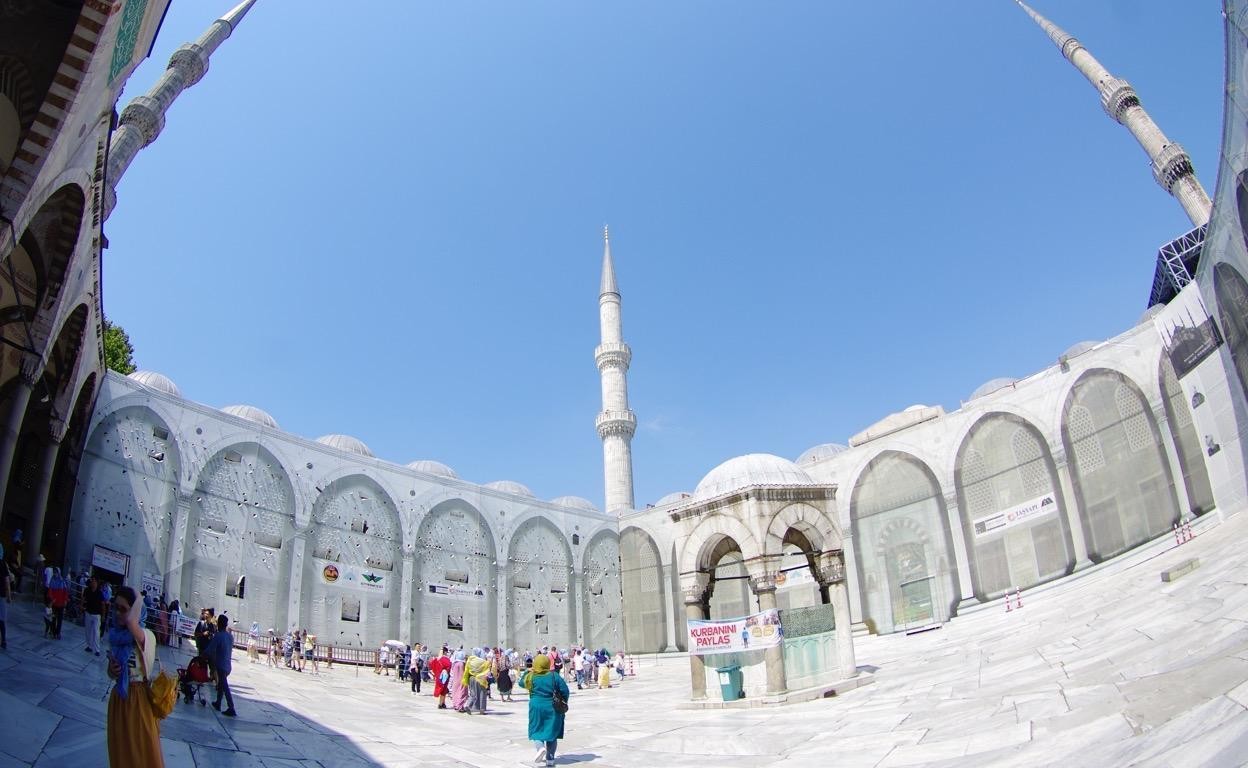
The Sultan Ahmed district — the historic peninsula at the tip of European Istanbul, surrounded on three sides by water (the Sea of Marmara, the Bosphorus and the Golden Horn) — contains within walking distance: Hagia Sophia (the 6th-century Byzantine church that became the Ottoman mosque and is now a mosque again), the Blue Mosque (Sultan Ahmed Mosque, the only mosque in Turkey with six minarets), Topkapi Palace (the Ottoman sultans' court from 1465 to 1856), the Basilica Cistern (the underground Byzantine water storage cavern), and the Hippodrome (the Byzantine chariot racing circuit, now a public square). This concentration of world-class monuments within a 15-minute walk makes the Sultan Ahmed district the finest open-air architectural museum in Europe.
Hagia Sophia, Blue Mosque & Topkapi Palace
Hagia Sophia (Ayasofya) — built by the Emperor Justinian between 532 and 537 CE, a building of extraordinary engineering ambition (the 31-metre dome appears to float on a ring of windows, the first major dome built without pendentives, a structural innovation not equalled for 900 years) and visual magnificence (the interior, when the building operated as a church, was covered with gold mosaic; the current state shows both the Byzantine mosaics that survived the Ottoman conversion and the Ottoman calligraphy medallions) — converted from a museum to a functioning mosque in 2020, meaning entry is now free but prayer times close the building and modest dress is required. The Blue Mosque (the only Istanbul mosque with six minarets, its interior decorated with 20,000 Iznik blue tiles) is directly opposite Hagia Sophia across the Hippodrome. Topkapi Palace (the Ottoman imperial court from 1465 to 1856, now a museum, entry €25 — book online to skip queues; the Harem requires an additional ticket of €15) requires 3–4 hours: the Imperial Treasury (with the 86-carat Spoonmaker's Diamond and the Topkapi Dagger), the Sacred Relics (Mohammed's sword, footprint and personal effects), and the Harem (the imperial household's private quarters) are the highlights.
Grand Bazaar, Spice Market & the Bosphorus
The Grand Bazaar (Kapalıçarşı) — the largest covered market in the world, with 60 covered streets, 4,000 shops and between 250,000 and 400,000 visitors per day, built by Mehmed II after the Ottoman conquest of Constantinople in 1453 and continuously operating since — is one of Istanbul's essential experiences despite its extreme tourist orientation: the best approach is to arrive at opening (9am, before the tourist groups) and walk the inner streets away from the main tourist thoroughfares, where the carpet and jewellery dealers of genuine quality still operate in the bazaar's historic core. The Egyptian Bazaar (Mısır Çarşısı, the Spice Market), a 10-minute walk away in the Eminönü waterfront district, is smaller and more manageable than the Grand Bazaar, with genuine spice merchants, Turkish delight stalls and coffee roasters. The Bosphorus cruise (the public ferry — Istanbul Şehir Hatları — operating from Eminönü pier to Anadolu Kavağı on the Asian shore, 6-hour round trip, approximately €5 including return) is the finest introduction to Istanbul's extraordinary geography.
Beyoğlu, Galata & Istanbul's Neighbourhoods
Beyoğlu — the European new city across the Golden Horn from the historic peninsula, its 19th-century apartment boulevards, the Istiklal Caddesi pedestrian high street, and the Galata Tower (a 14th-century Genoese watchtower converted to a viewpoint with a rooftop gallery and a famously long queue) — is Istanbul's most vibrant contemporary neighbourhood: the best restaurants (Karaköy and Çihangir), the finest art galleries (Istanbul Modern on the Bosphorus waterfront), the neighbourhood bars of Beyoğlu and the covered arcade of the Çiçek Pasajı (Flower Passage, a 19th-century apartment building converted to a row of meyhane taverns) all contribute to a walking area of remarkable energy. The ferry crossing from Eminönü or Karaköy to Üsküdar (5 minutes, €0.50 on the Istanbulkart transit card) adds Asia to any Istanbul itinerary: the Üsküdar neighbourhood on the Asian shore (the Çamlıca Hill above, the finest viewpoint of the European skyline) and the Kadıköy district (a 10-minute ferry from Karaköy, the best neighbourhood food market and street food in Istanbul) are worth at least a half-day.