Lisbon (Lisboa) — Portugal's capital, set on seven hills above the Tagus estuary where the river opens to the Atlantic, a city of 550,000 people with a metropolitan area of 2.8 million — has become one of Europe's most beloved city-break destinations in the decade since its mid-2000s renaissance: a place where a city of extraordinary historical richness (capital of a 15th and 16th century empire that encompassed Brazil, Angola, Mozambique, Goa and Macau, financed by the spice trade and expressed architecturally in the extraordinary Manueline Gothic style), a food scene of international quality, exceptional value compared to Paris or Barcelona, and a combination of Atlantic light and hilly landscape conspire to create one of the most pleasurable urban experiences in Europe. The earthquake of 1755 — which destroyed most of the medieval city and killed 30,000–40,000 people — paradoxically enriched Lisbon: the Pombaline reconstruction that followed created the grid of the Baixa district, one of the finest 18th-century urban schemes in Europe, while sparing the Alfama hill district which predates the earthquake and preserves Lisbon's medieval character.
The Alfama — the oldest neighbourhood in Lisbon, a labyrinth of steep alleys (vielas), tiled staircases and viewpoint terraces (miradouros) on the hill east of the Baixa, its streets too narrow for the earthquake to have spread far and its buildings too old and poor for the Marquis of Pombal's reconstruction to have reached — is the most atmospheric neighbourhood in the city: the place where fado (the Portuguese music of saudade — melancholic longing) was born, where the azulejo tile-covered churches and palaces of medieval Lisbon survive, and where the miradouro of Santa Luzia, looking south over the rooftops to the Tagus, provides one of the finest urban views in Europe.
Belém & the Age of Discovery
Belém — the district 6km west of central Lisbon on the Tagus riverbank, from which Vasco da Gama sailed for India in 1497 and Pedro Álvares Cabral for Brazil in 1500, now accessible by tram or riverside walk from the centre — contains the two finest examples of Manueline Gothic architecture in the world: the Tower of Belém (Torre de Belém, 1516–1521, a river fortress and ceremonial gateway to Lisbon built in the armillary sphere-and-rope decoration style that characterises the Manueline, entry €10) and the Jerónimos Monastery (Mosteiro dos Jerónimos, 1502–1552, built to commemorate da Gama's voyage with the pepper-trade profits it generated, its cloister the most exuberant and joyful Gothic space in Europe, entry €12; combined ticket €16). The Monument to the Discoveries (Padrão dos Descobrimentos, 1960) — a concrete prow projecting into the Tagus with a mosaic world map on the ground showing the Portuguese discoveries by date — is the finest panoramic point in Belém. Try the original pastéis de nata custard tarts at Pastéis de Belém (Rua de Belém 84–92, founded 1837) — the queue is always long but moves quickly, and the tarts still made to the secret recipe of the adjacent monastery are definitively better than any available elsewhere.
Alfama, Fado & the Miradouros
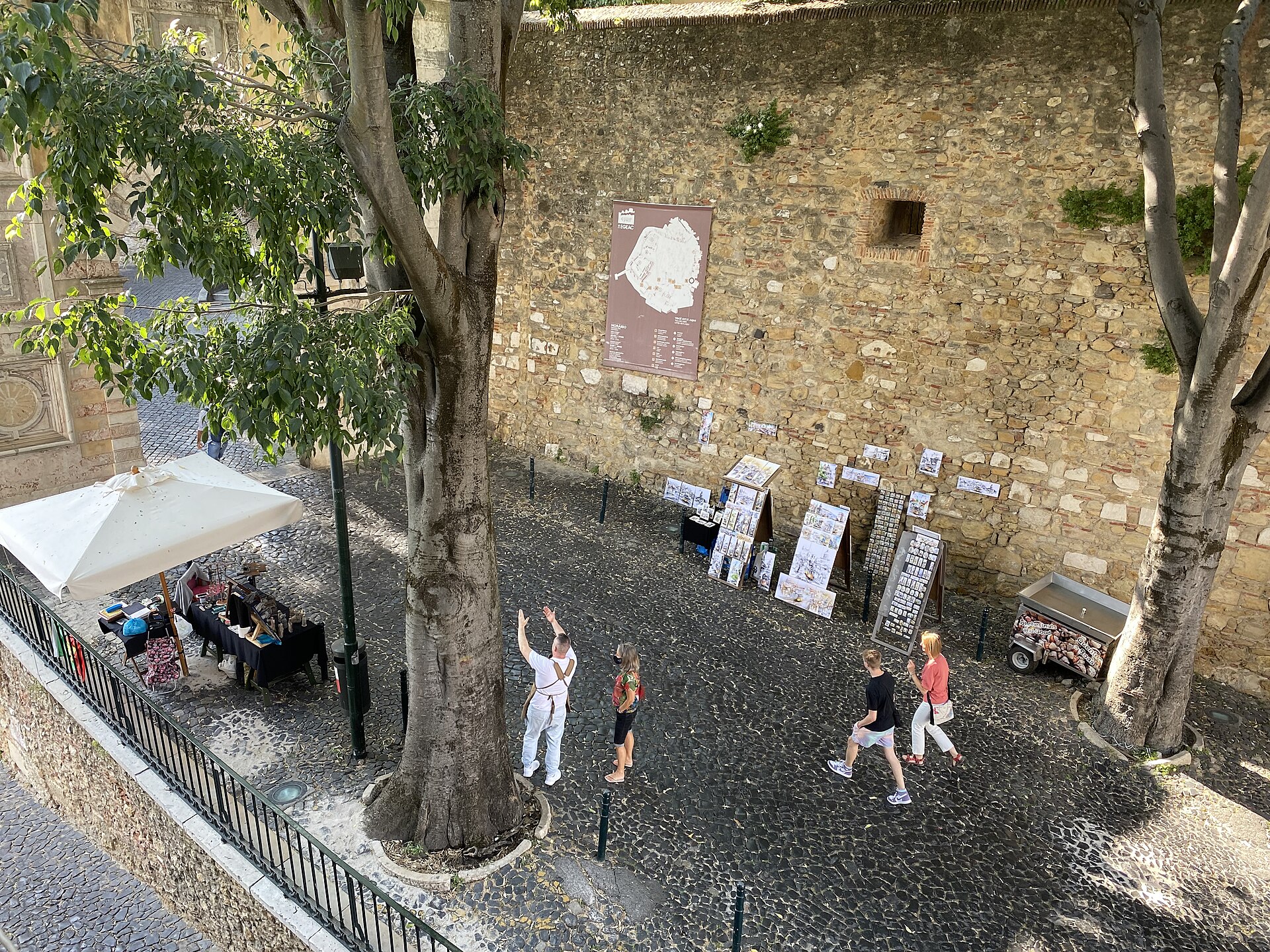
The Alfama is best explored on foot, without a specific plan, in the morning or early evening: the São Jorge Castle above (entry €15, good views but the castle interior is largely reconstructed — better value to visit the castle walls only), the Sé Cathedral (Lisbon's Romanesque cathedral, 12th century, free entry), the narrow alleys of the Mouraria below (Lisbon's former Moorish quarter, now the city's most multicultural neighbourhood), and the successive miradouros (Santa Luzia, Portas do Sol, Graça — each with cafés and the extraordinary rooftop view south to the river) reward a half-day of wandering. Fado houses (casas de fado) cluster in the Alfama and nearby Mouraria: Sr. Fado (Rua dos Remédios 176), Tasca do Chico (Rua dos Remédios 83) and Zé da Viola (Beco do Espírito Santo 14) are among the most authentic — dinner and fado (dinner compulsory, approximately €35–45 per person including food) from 9pm.
Baixa, LX Factory & the Time Out Market
The Baixa — Pombal's post-earthquake reconstruction, a grid of streets between the riverside Praça do Comércio (the ceremonial gateway to the city from the Tagus) and the Praça do Rossio (the central hub, with its wave-patterned stone pavement and the National Theatre) — has the finest 18th-century urban ensemble in Portugal and the main concentration of shops, cafés and hotels. The Time Out Market (Mercado da Ribeira, Avenida 24 de Julho, open daily 10am–midnight) — a 1882 iron market hall with 40 restaurant counters serving food from the best Portuguese chefs, from pastéis de bacalhau to gelato to natural wines — is the finest food hall in Europe and an essential Lisbon experience. LX Factory (Rua Rodrigues de Faria 103) — a 19th-century textile factory complex in Alcântara converted to a creative hub of restaurants, bookshops, design studios and a Sunday flea market — is one of Lisbon's most characteristic neighbourhoods and worth half an afternoon.