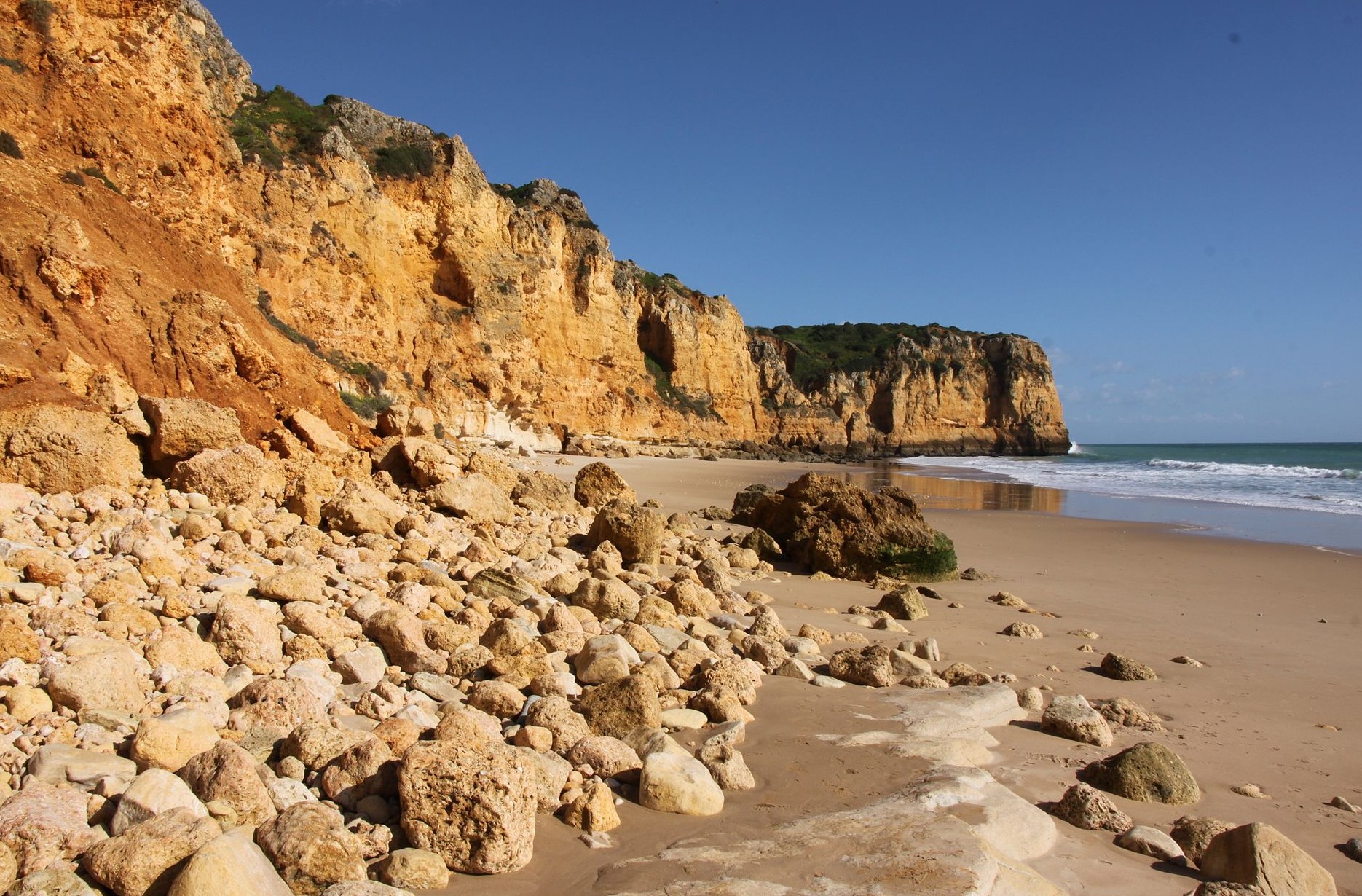
The Algarve — the southernmost region of Portugal, its 155km of Atlantic coastline defined by the extraordinary ochre and gold limestone formations of the western Sotavento coast, the calm estuaries and salt marshes of the eastern Ria Formosa, and the wild Atlantic-exposed beaches of the Vicentine Coast to the west — is the most popular beach destination for UK holidaymakers in Europe: a consistent combination of over 300 sunny days per year (the highest sunshine hours in continental Europe), warm but not suffocating Atlantic water temperatures (19–24°C in summer, 2–3°C warmer than the UK but significantly cooler than the Mediterranean), and a landscape of natural sea caves, golden limestone arches and sheltered coves that no amount of tourist development has managed to diminish. The Ponta da Piedade headland (3km south of Lagos) — where golden limestone pillars, grottos, sea arches and secluded coves create one of the most dramatic coastal landscapes in Europe — is the defining Algarve image and the finest natural spectacle on the Portuguese coast.
The Algarve divides naturally into three zones: the western Barlavento (from Lagos to Cape St Vincent, the most dramatic coastline, the most exposed to Atlantic swell, with the finest geological formations and the most beautiful beaches); the central coast (Albufeira and the resort strip, the most developed, most accessible and most visited section, with wide sandy beaches backed by resort hotels); and the eastern Sotavento (from Faro east to the Spanish border, the Ria Formosa lagoon system with its barrier islands, salt flats and bird-rich marshes, accessible by ferry from Faro — the finest birdwatching coast in southern Europe).
Ponta da Piedade & Lagos
Ponta da Piedade — the golden limestone headland 3km south of Lagos, its grottos, sea stacks, arches and hidden coves accessible by boat from Lagos marina or by foot from the lighthouse car park — is the Algarve's most visited natural attraction and one of the most extraordinary coastal landscapes in Europe. The boat tours (approximately €20 per person for 45–75 minutes from Lagos marina, several operators) navigate the full grotto system at water level, entering cave chambers where the amber-coloured limestone overhead turns the light golden and the water below shifts from turquoise to jade. In calm conditions, kayaking independently from the car park approach beach (rental available, approximately €20/hour) gives more flexibility and intimacy. Lagos itself — a walled town of white-painted houses and terracotta roofs, its medieval walls overlooking the Atlantic, its historic centre largely free of the resort development that blighted Albufeira — has the finest Algarve town centre for restaurants, bars and Portuguese culture.
Praia da Marinha & the Lagoa Cliffs
Praia da Marinha — consistently ranked among Europe's finest beaches, 25km east of Lagos near Lagoa — is a small cove of extraordinary visual perfection: accessed by 120 steps cut into the limestone cliff, the beach is enclosed on three sides by golden rock formations of unusual complexity, with sea arches on the flanking rocks accessible at low tide, crystal-clear water of exceptional transparency, and the rock pool zone to the east offering some of the finest natural snorkelling on the Portuguese coast. The Benagil Sea Cave (3km east of Marinha, inaccessible by land) — a collapsed sea cave with a domed roof opening to the sky above a small sandy beach on the cave floor, accessible by boat or kayak from Benagil beach or Praia da Marinha — is the most photographed interior landscape in Portugal: the light entering through the roof opening illuminates the cave floor and walls at noon in a way that changes hourly. The standard boat tour (approximately €20–25 from Benagil, Portimão or Lagos) enters the cave; kayak approach allows swimming on the cave beach.
The Vicentine Coast & Cape St Vincent
Cape St Vincent (Cabo de São Vicente) — the south-western extremity of mainland Europe, a 75-metre cliff of dark schist on which Vasco da Gama's fleet departed for India in 1497, now marked by a lighthouse and battered by the full force of the Atlantic — is one of Europe's great natural landmarks: the point where the Atlantic and the Mediterranean meet (not literally, but this is how the cape has been perceived since antiquity), where storms funnel around the headland with extraordinary violence in winter, and where the westerly sunset (light directly from the Atlantic, no land or haze to the west for 8,000km) produces one of the finest sunset experiences in Europe. The Vicentine Coast north of the cape — designated a Natural Park, largely undeveloped, with wild Atlantic beaches of tremendous power (Praia de Bordeira, Praia do Amado) and the surf mecca of Sagres — is the finest undeveloped coastline in southern Portugal.