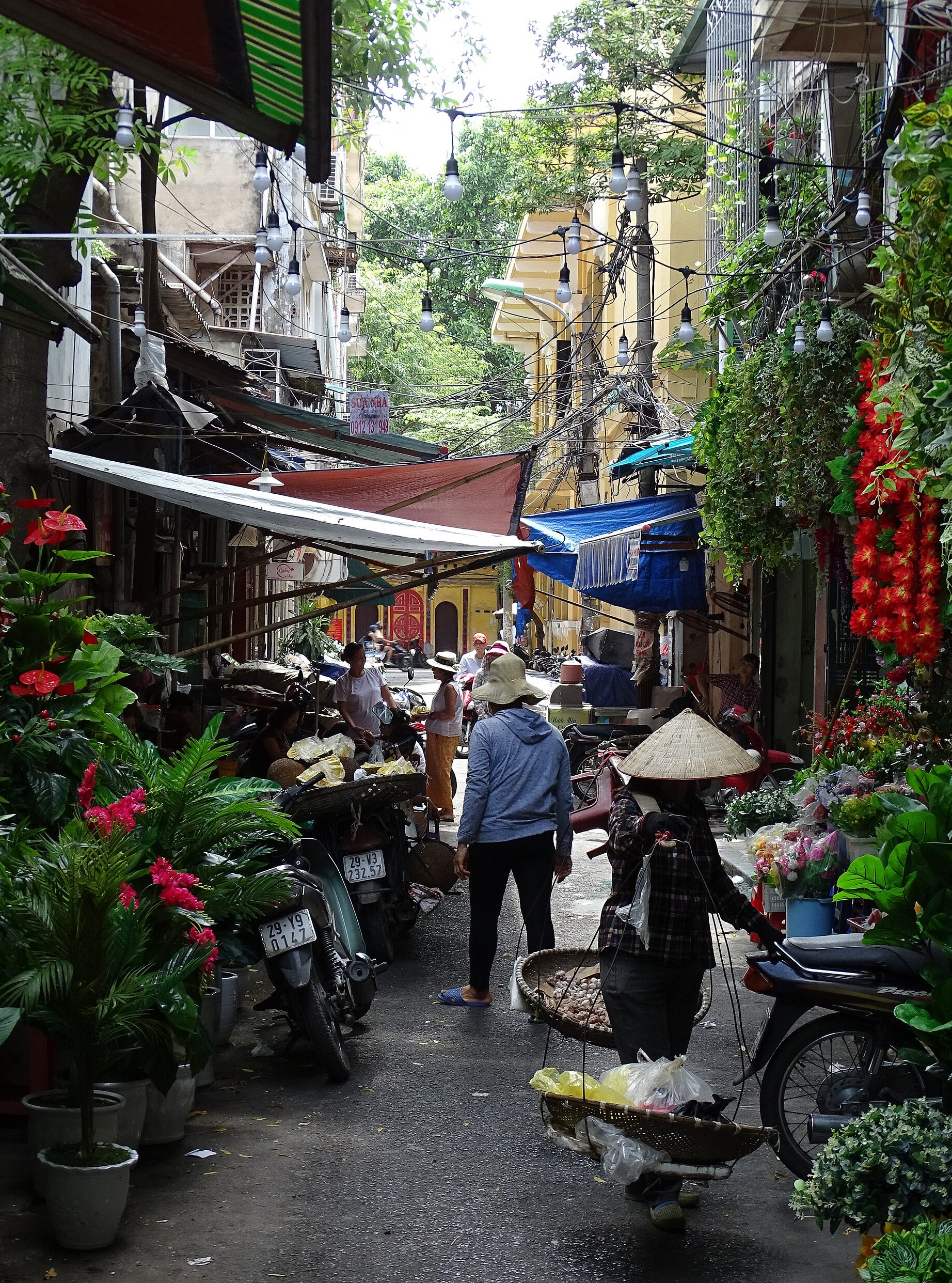
Hanoi — Vietnam's capital and cultural heart, a city of four million people in the Red River Delta — is a city of layers: French colonial boulevards and villas overlaid on a Chinese-influenced ancient capital, Soviet-era public buildings beside Buddhist pagodas, the chaos of motorbike traffic weaving through streets named after the guilds that occupied them a thousand years ago. The city is more reserved, more northern, more historically conscious and more elegant than the frenetic energy of Ho Chi Minh City in the south — a quality that becomes apparent after a few days of exploring its French Quarter's café culture, its Old Quarter's labyrinthine streets, and its temples and pagodas set around the city's lakes.
The Old Quarter (Phố Cổ) — the 36 guild streets that formed Hanoi's commercial heart from the 13th century — is still organised roughly by trade: Hàng Bạc (Silver Street) for jewellers, Hàng Đồng (Copper Street) for metal goods, Hàng Vải (Fabric Street) for textiles. The streets are narrow (the tube house architecture maximises frontage on the taxable street), lined with Chinese-influenced shophouses whose ground floors remain commercial workshops and stores. Walking the Old Quarter is an exercise in historical layering — each street reveals different crafts, foods and communities within a medieval street plan that European capitals long since paved over.
Hoan Kiem Lake & Temple of Literature
Hoan Kiem Lake — the "Lake of the Restored Sword", at the junction of the Old Quarter and the French Quarter — is Hanoi's geographical and emotional centre: a small urban lake with the 18th-century Ngoc Son Temple on an island connected to the shore by the red Huc Bridge, surrounded by ancient trees, benches where old men play chess, and the constant movement of the city's inhabitants using the lakeside as a neighbourhood park. The lake's 200-year-old giant soft-shell turtle (the last of its species, which died in 2016 — it is now preserved and displayed in Ngoc Son Temple) was considered a living embodiment of the legend of the Restored Sword and deeply sacred to Hanoi's people.
The Temple of Literature (Văn Miếu) — established in 1070 as Vietnam's first university, now the finest example of traditional Vietnamese architecture in the capital — is a sequence of five courtyards leading to the main temple complex, with 82 stone stelae (inscribed in 1484–1780) recording the names of 1,307 doctoral graduates of the imperial examination system. The complex of pavilions, lotus ponds and ancient frangipani trees is beautifully peaceful and rewards slow exploration.
Food Culture
Hanoi's food culture is among the most distinctive and refined in Southeast Asia — northern Vietnamese cooking is more restrained in its use of spices and sweetness than the south's cuisine, prioritising depth of stock, textural contrast and the quality of fresh herbs. Phở Hà Nội (beef or chicken noodle soup, the national dish in its northern form with clear broth, rice noodles and fresh herbs) is eaten for breakfast at street-side plastic table establishments from approximately £0.80–1.50. Bún chả (grilled pork patties and belly served in a broth with dipping noodles and fresh herbs — famously eaten by Barack Obama and Anthony Bourdain at Bún Chả Hương Liên in 2016) is Hanoi's other signature dish. Bánh cuốn (steamed rice paper rolls with mushroom and minced pork filling), cháo (rice porridge) and egg coffee (cà phê trứng — a Hanoi invention, beaten egg yolk and sugar over strong coffee) are all worth seeking.
Historical Sites & Day Trips
The Ho Chi Minh Mausoleum complex (where Ho Chi Minh's embalmed body lies in state, open for viewing most mornings except maintenance periods in September–November) is a genuinely strange and moving experience — the Vietnamese people's reverence for their revolutionary leader is tangible in the silent, slow-moving queue of Vietnamese visitors. The Presidential Palace and Ho Chi Minh's simple stilt house (where he lived by choice rather than in the colonial presidential palace) are in the same complex. Hỏa Lò Prison Museum (the "Hanoi Hilton", where American POWs including John McCain were held during the Vietnam War) presents a Vietnamese perspective on the war that is markedly different from American accounts — essential context for understanding the country's history.