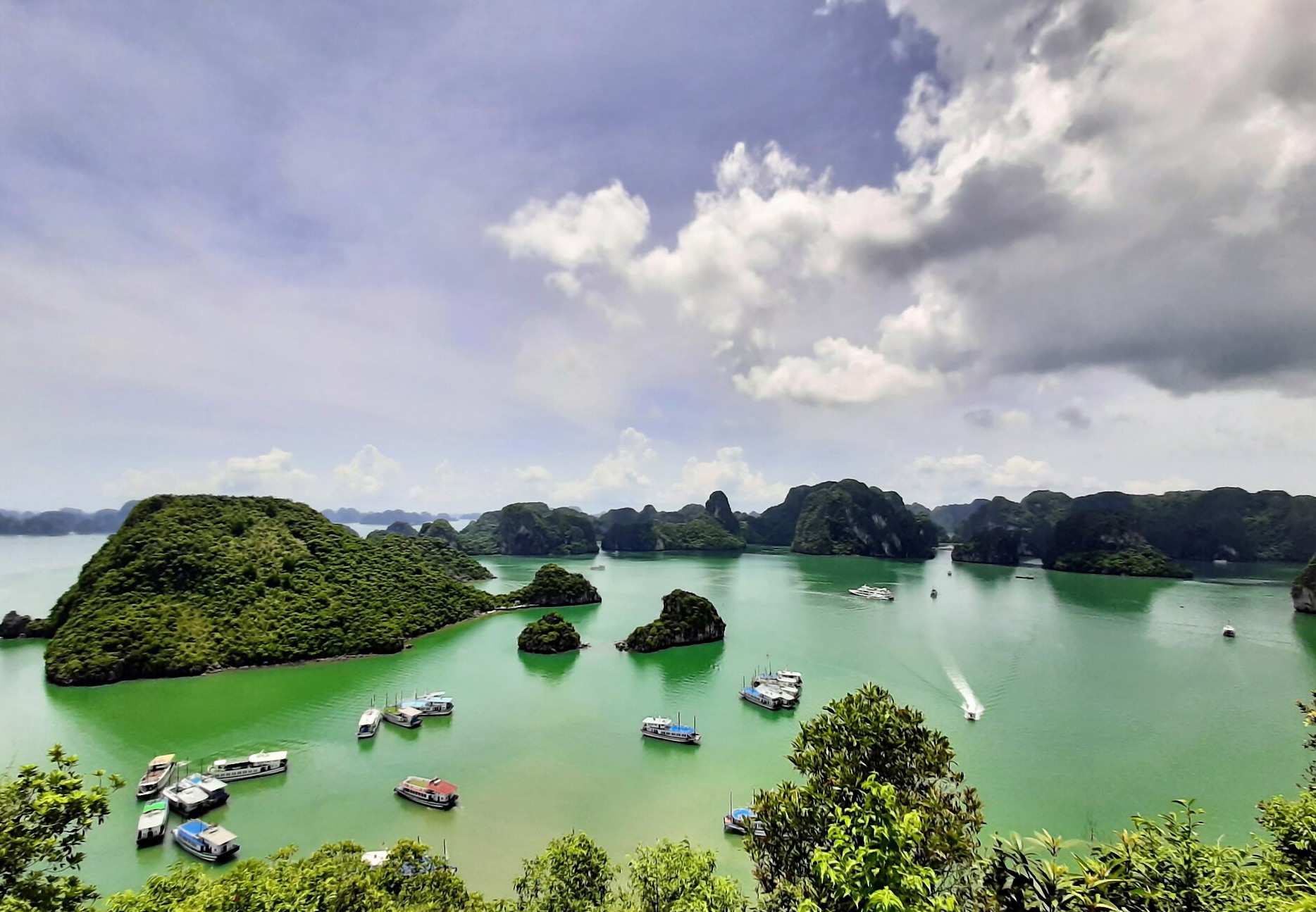
Hạ Long Bay — a UNESCO World Heritage Site in the Gulf of Tonkin, 165km east of Hanoi — is the most iconic landscape in Vietnam and one of the most recognisable natural wonders in Asia: approximately 2,000 limestone karst islands and islets rising from the emerald water of the bay, their vertical walls draped with jungle vegetation, their bases eaten by wave action into mushroom profiles, their summits occasionally crowned with small temples. The islands (halong translates as "descending dragon" in Vietnamese, referring to the legend of a celestial dragon whose tail thrashed the bay into its current topography) are largely uninhabited — a few fishing villages on floating platforms are the only communities — creating a landscape of extraordinary natural purity that the surrounding boat traffic manages to threaten without quite destroying.
The standard Hạ Long Bay experience is a two-day/one-night or three-day/two-night cruise on a wooden junk boat (a traditional Vietnamese sailing vessel, though most are now motorised replicas in traditional form) that departs from Tuần Châu Marina or Hạ Long Town pier and navigates the bay's islands, stopping for cave exploration (Thiên Cung Cave, with its extraordinary stalactite formations, and the vast Sửng Sốt Cave are the two most visited), kayaking through the island passages and around the floating fishing villages, swimming from the boat in secluded coves, and eating the excellent Vietnamese seafood served on board. The experience is entirely dependent on operator quality — the difference between a budget junk and a premium cruise is significant in terms of boat condition, food quality, group size and guide knowledge.
Choosing a Cruise
The Hạ Long Bay cruise market has hundreds of operators at every price point — from basic junks carrying 40+ passengers at £60–80 per person for two days, to luxury boutique cruises carrying 8–12 passengers in private cabins at £200–400 per person. The key differentiators are: group size (smaller is significantly better for the quieter areas of the bay), boat condition and cabin quality (some budget junks have cramped, poorly ventilated cabins), food quality (Vietnamese seafood is excellent when fresh — premium cruises are markedly better), and itinerary (better cruises venture into the less-trafficked areas of Bái Tử Long Bay adjacent to Hạ Long, or the Lan Hạ Bay south of Cat Ba Island, which has comparable scenery with dramatically fewer boats).
Activities on the Water
Kayaking is the finest way to experience Hạ Long Bay — paddling through passages between the karst islands, entering hidden lagoons accessible only at water level through low arches, and exploring the floating fishing villages from a perspective that motorised craft cannot reach. Cave exploration is a feature of most cruises: Thiên Cung (Heavenly Palace Cave) has multi-coloured stalactite formations illuminated by coloured lights; Sửng Sốt (Surprise Cave) is the largest and most visited, with enormous caverns and natural rock formations of considerable drama. Swimming from the cruise boat in secluded coves (the water is warm, clear and generally good in the dry season) and sunset tai chi on the deck are among the cruise's most memorable routines. Fishing (line fishing for squid and snapper) is offered on most overnight cruises.
Lan Hạ Bay & Cat Bà Island
Lan Hạ Bay — adjacent to Hạ Long Bay south of Cat Bà Island — has the same dramatic karst scenery with approximately one-tenth the boat traffic. Cat Bà Island (the largest island in Hạ Long Bay, with a small town, several guesthouses and a national park covering 60% of the island) provides a base for independent exploration: Cat Bà National Park has the world's last wild population of Cat Bà langurs (a critically endangered primate, fewer than 60 individuals, found only here), jungle hiking trails and several secluded beaches. Lan Hạ Bay cruises departing from Cat Bà Town offer a significantly less crowded experience than the main Hạ Long Bay departure ports, at similar prices.