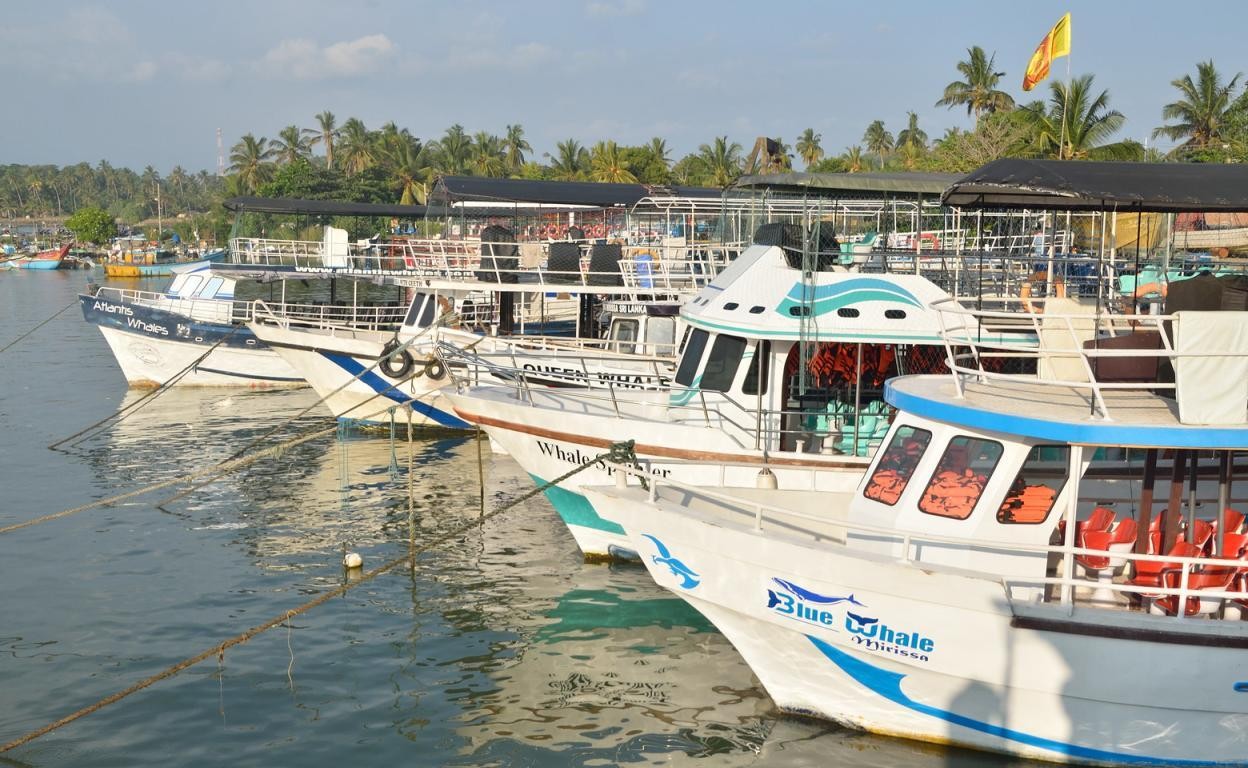
The waters off Mirissa — a small fishing town on Sri Lanka's south coast approximately 150km from Colombo — are home to one of the most accessible concentrations of blue whales on earth. Between November and April, as many as 20–30 individual blue whales (the largest animals that have ever lived — up to 30 metres long and 180 tonnes) may be present in the waters south of Sri Lanka's continental shelf, feeding on the krill and squid brought to the surface by the northeast monsoon's upwellings. Whale watching boats from Mirissa depart at 6:30am and typically reach the whale areas (10–15km offshore) within an hour, with sighting rates above 80% during peak season (December–April).
In addition to blue whales, the waters off Mirissa are home to sperm whales (year-round, mostly in deeper water), fin whales (smaller, faster than blues), Bryde's whales, humpback whales, orca (occasional), spinner dolphins (present in large numbers almost every trip), bottlenose dolphins and the rare but present blue whale calf (January–March). The spinner dolphin shows — pods of several hundred dolphins performing synchronised aerial spins in the wake of the boat — are extraordinary in their own right and a feature of almost every Mirissa whale watching trip regardless of whale success.
The Whale Watching Experience
Mirissa's whale watching boats range from small fibreglass vessels (15–20 passengers) to larger catamarans with deck space and shade. The journey to the whale grounds takes 1–1.5 hours in each direction; whale watching typically occupies 2–3 hours in the middle of the trip, for a total of 5–6 hours at sea. Blue whales are most visible when surfacing to breathe — the distinctive vertical blow (up to 9 metres high) is visible from kilometres away, and the animal surfaces several times in succession before diving for 10–20 minutes. The size of a blue whale in the water — the dive sequence revealing successively the head, back, dorsal fin and finally the enormous tail flukes — is one of the most affecting wildlife spectacles on earth. Respectful operators maintain the legally required distance (minimum 50 metres) and do not chase or surround the whales.
Mirissa Beach & Town
Mirissa itself is one of Sri Lanka's most appealing coastal towns — a 1.5km crescent of beach backed by coconut palms, small guesthouses, beach restaurants serving fresh-caught tuna, octopus and cuttlefish (the same boats that do whale watching by day also fish commercially), and the relaxed atmosphere of a Sri Lankan beach town that has maintained its character while developing a significant traveller scene. The famous Parrot Rock — a small rocky island connected to the beach by a sandbar accessible at low tide — is the classic Mirissa photograph, its small crowd of sunbathers visible against the turquoise Indian Ocean. Mirissa makes a natural base for combining whale watching with a few days of south coast beach time, combining easily with Galle Fort (35km west) and Yala National Park (120km east).
Operator Quality
The quality of Mirissa whale watching operators varies significantly. Responsible Wildlife Sri Lanka and Whale Watch Lanka are among the most consistently recommended operators for conservation-conscious tourism and experienced naturalist guides. Avoid operators who visibly chase or crowd whales, who play loud music on board (stresses the animals), or who offer guaranteed sighting refunds as a marketing tool without clearly ethical practices. A good guide who knows the individual blue whales by their fluke and dorsal fin patterns (several individuals are well-known and named) adds enormously to the experience. Seasickness can be significant — the ocean south of Sri Lanka is frequently rough, particularly in the January–April period when the northeast monsoon generates swell.