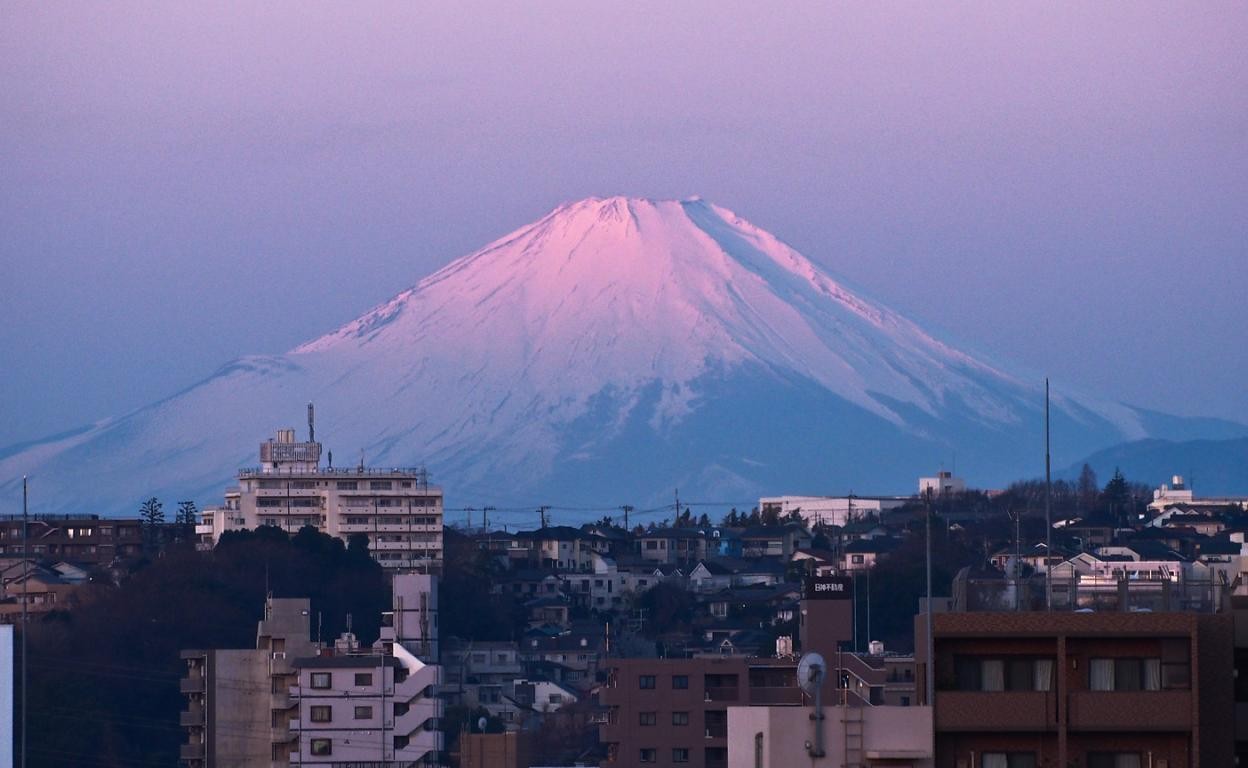
Mount Fuji (Fuji-san) — Japan's highest mountain at 3,776 metres and the country's most instantly recognisable symbol — is an almost perfectly symmetrical stratovolcano that has shaped Japanese culture, art and spirituality for centuries. Hokusai's Thirty-six Views of Mount Fuji (particularly The Great Wave off Kanagawa, in which Fuji appears small but resolute in the background) have made the mountain's profile one of the most recognised shapes in global visual culture. The Shinto belief that Fuji is a sacred mountain (the summit shrine of Sengen Taisha is one of 1,300 Sengen shrines across Japan dedicated to the mountain deity Konohanasakuya-hime) has shaped its cultural significance: climbing Fuji is not primarily a sporting achievement but a religious act, which is why most climbers still ascend at night to reach the summit for sunrise (御来光, goraikō).
The mountain is visible from Tokyo on clear days — from Shinjuku's western high-rises, from the Tokyo Skytree, and most dramatically from the Bullet Train (Shinkansen Nozomi, right side heading southwest) — but the finest views are from the Five Lakes District (Fujigoko) at Fuji's northern base and from Hakone to the south. Snow caps the summit from November to May, creating the most photogenic appearance; in summer the snowless black volcanic cone is less dramatic in photographs but more accessible for climbing. Fuji last erupted in 1707 and is classified as potentially active.
Climbing Mount Fuji
Mount Fuji's official climbing season runs from early July to mid-September — outside this window the mountain closes (the 5th Station road gates shut and mountain huts close). The mountain has four main trails; the Yoshida Trail from the Fujisan 5th Station (2,305m, accessible by direct bus from Tokyo Shinjuku or from Kawaguchiko station) is the most popular, used by approximately 60% of all climbers. From the 5th Station, the summit is 6–7 hours of ascent and 3–5 hours of descent — a total commitment of 9–12 hours. Mountain huts along the trail offer meals and sleeping (book months ahead for the popular 7th and 8th Station huts used by the overnight summit strategy).
The most popular approach is to ascend at night (departing the 5th Station around 10pm–midnight), reach the summit by 4:30am and witness sunrise (goraikō) from the crater rim. The experience — emerging from the cold darkness above the cloud layer to watch the sun illuminate the Pacific and the Japanese Alps — is genuinely extraordinary. Fuji is not a technically demanding climb (no ropes, crampons or special equipment required) but the altitude causes problems for some climbers (acute mountain sickness begins at 2,500m for susceptible individuals) and the terrain is steep loose scoria. A conservation fee of 2,000 JPY (£11) is charged on the Yoshida Trail.
The Five Lakes & Hakone
The Fujigoko (Five Lakes) district at Fuji's northern base — Kawaguchiko, Saiko, Yamanakako, Shojiko and Motosuko — provides the finest ground-level views of the mountain. Kawaguchiko is the most accessible (90 minutes from Tokyo by direct bus) and has the famous shot of Fuji reflected in the lake, with cherry blossom (April) or autumn maples (November) in the foreground — one of Japan's most replicated photographic compositions. The Chureito Pagoda at Arakurayama Sengen Park (236 steps above Fujiyoshida station) provides the classic five-storey pagoda-with-Fuji composition that appears on posters worldwide.
Hakone — the volcanic spa resort 1 hour from Tokyo by Romancecar train — is the finest base for Fuji views on the mountain's southern side: the view across Ashinoko (Lake Ashi) with the torii gate of Hakone Shrine in the foreground and Fuji behind (on clear days) is Japan's most romantic landscape. The Hakone Open-Air Museum (an outdoor sculpture park with Picasso, Henry Moore and a Fuji view) and the hot spring baths (onsen) of Hakone's ryokans add cultural and restorative dimensions to the Fuji experience.
Practical Fuji Advice
Fuji views are notoriously unreliable due to cloud cover — the mountain generates its own weather system and is completely cloud-obscured for most of summer (the official climbing season). The clearest views statistically occur in December, January and February, when the snowcapped summit is visible on many days — but the mountain is completely closed to climbing. September and October have better visibility than July and August while remaining warm enough for comfortable mountain visits. Checking the Fujisan Weather Cam (operated by the Fujisan Radar Dome Museum) and the mountain's webcam at Kawaguchiko the morning of a planned visit gives real-time visibility information.