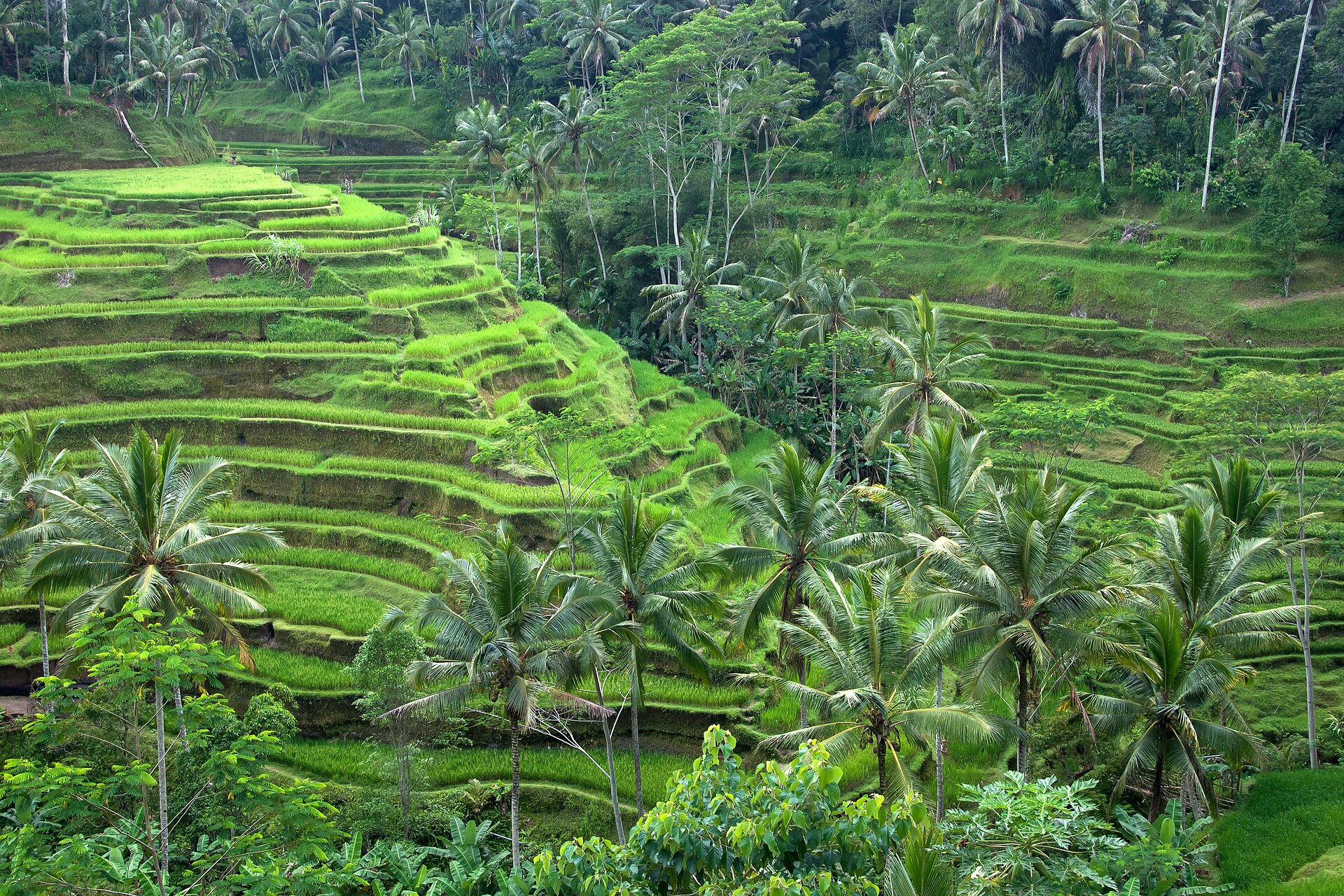
Ubud — set 700 metres above sea level in Bali's forested volcanic interior — is the island's cultural and artistic capital, a town of remarkable beauty where rice paddies run between streets of galleries, temples, traditional warungs and yoga studios, and where every corner reveals another piece of Balinese Hindu culture: a procession carrying offerings to a temple, a gamelan rehearsal echoing from a community pavilion, a woodcarver at work in his open-fronted shop. Where Kuta and Seminyak offer beach tourism, Ubud offers something rarer — genuine immersion in a living culture that remains one of Asia's most spiritually rich and artistically sophisticated.
The town was transformed by the artist colony that settled here in the 1930s — Walter Spies, the German-Russian painter who befriended the Balinese royal family and established a creative community that drew international artists and writers (Charlie Chaplin visited), and whose work established the visual language of "Bali" that still shapes the island's global identity. The Puri Lukisan Museum in the centre of town traces this tradition through its collection of classical and modern Balinese painting. Today Ubud is also the world's leading destination for yoga retreats, holistic wellness and conscious travel — the density of yoga studios, meditation centres and organic restaurants along Jalan Hanoman and Jalan Monkey Forest speaks to a community that has found its niche.
Sacred Monkey Forest & Ubud Palace
The Sacred Monkey Forest Sanctuary — a forested temple complex at the south end of Jalan Monkey Forest — houses approximately 700 long-tailed macaques in three temple compounds. The monkeys are sacred to the Balinese (associated with the monkey god Hanuman) and entirely unafraid of humans — they will approach, sit on shoulders, and reach into bags with remarkable directness. The temple compounds within the forest (Pura Dalem Agung Padangtegal, the main death temple) are beautifully atmospheric, with moss-covered stone demons and nagas presiding over the forest paths. Bags must be secured, sunglasses are safer on your head, and bringing food inside is inadvisable.
The Ubud Royal Palace (Puri Saren Agung) — the residence of the Ubud royal family since the 19th century — sits at the intersection of Jalan Raya Ubud and Monkey Forest Road, its elaborately carved gates and pavilions visible from the street. Traditional Kecak and Legong dance performances are held in the palace courtyard almost every evening — these are genuine performances with full costume, gamelan orchestra and traditional narrative, not tourist-park versions. Tickets available at the gate.
Tegallalang Rice Terraces
The subak rice terraces of Tegallalang — 3km north of Ubud centre — are the most photographed landscape in Bali: emerald-green stepped paddies descending a steep valley, the result of centuries of traditional cooperative irrigation managed by the subak system (UNESCO Intangible Cultural Heritage). The terraces are most intensely green immediately after planting (roughly March–April and September–October, though the cycle varies) and most golden before harvest. The main viewpoints are accessible via a path along the terrace edges — allow 1–2 hours for the full circuit, arriving before 8am to beat the tourist swing groups that arrive from the beach areas by 10am.
Cooking Classes, Art & Wellness
Ubud's half-day Balinese cooking classes — offered by several reputable schools including Payuk Bali and Casa Luna Cooking School — begin with a market visit to source ingredients, then spend 3–4 hours preparing a full Balinese feast (sate lilit, nasi goreng, lawar, black rice pudding) that you eat at the end. They are among the most memorable and practical travel experiences in Southeast Asia. The Blanco Renaissance Museum (the former studio of Spanish-Catalan artist Antonio Blanco, who settled in Ubud in 1952) and the Agung Rai Museum of Art (ARMA) have excellent collections of both Balinese and Blanco's own distinctive paintings. The Campuhan Ridge Walk — a 9km morning hike along a narrow ridge between two river valleys north of Ubud — offers the most peaceful landscape experience within walking distance of the town centre.