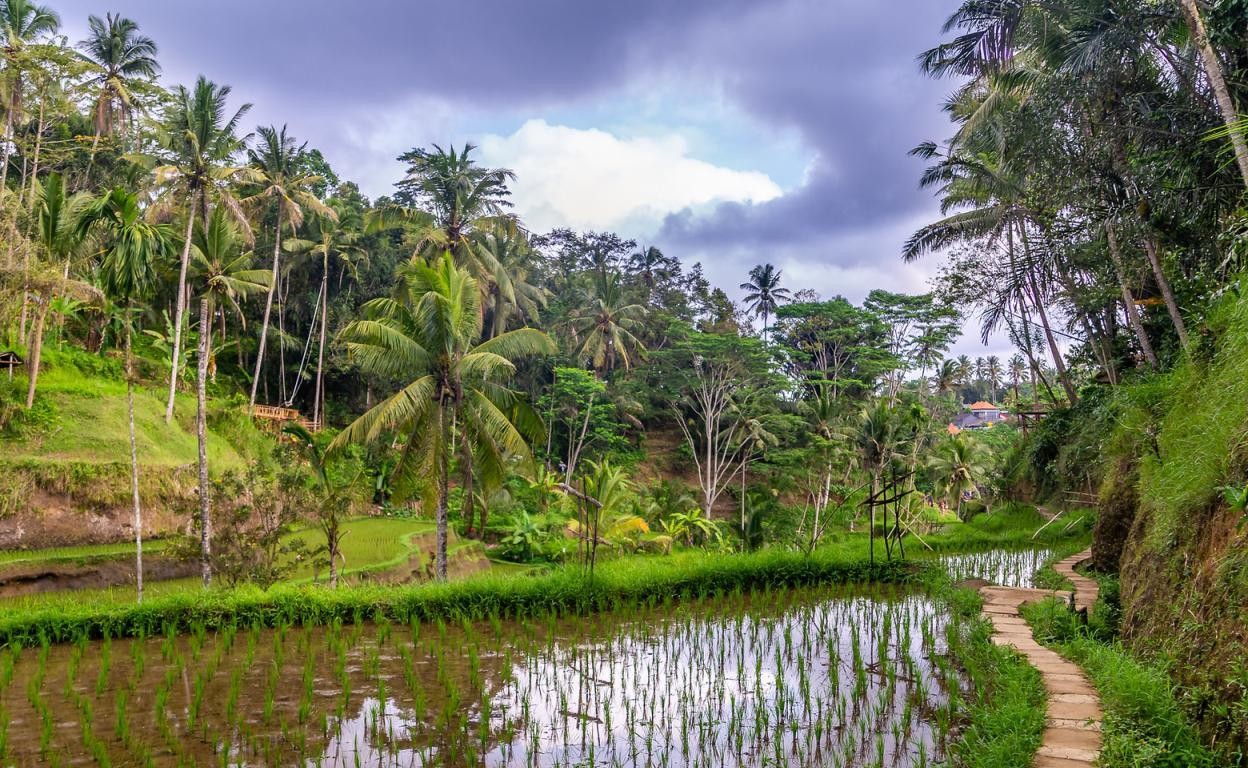
The Tegallalang rice terraces — cascading down the steep walls of a river valley 3km north of Ubud centre — are Bali's most photographed landscape and one of the most replicated images in Southeast Asian travel photography. The stepped paddies, carved from the hillside by generations of Balinese farmers using the traditional subak cooperative irrigation system (recognised by UNESCO as an Intangible Cultural Heritage), are intensely beautiful at every stage of the growing cycle: luminously green when newly planted, a darker emerald as the stalks mature, and golden-brown in the week before harvest when the heavy rice heads bow the stalks towards the water.
The subak system — believed to have been established in the 9th century CE — is more than an irrigation method: it is a social and religious institution managed by subak associations that coordinate planting cycles, water distribution and temple ceremonies across entire river valleys. The system is deliberately non-optimising in the conventional agricultural sense, favouring ecological diversity and spiritual balance over maximum yield — the Balinese consider rice the gift of the gods (specifically the rice goddess Dewi Sri), and the entire agricultural calendar is structured around religious ceremony. This is the context in which these beautiful terraces exist: not merely a scenic landscape but a living expression of a civilisation's relationship with the natural world.
Walking the Terraces
The main terrace circuit is accessible from the road above — paths descend into the valley along narrow bunds (the raised earthwork walls between paddies) and through stands of bamboo and banana palm. The circuit takes 60–90 minutes at a comfortable pace. Several legitimate entry points are managed by local farmers who charge 300,000–500,000 IDR for access — this is entirely appropriate as it compensates farmers for providing walkable paths through their working paddies. The valley floor has a small river and several platforms and swing installations that are popular for Instagram photography; the "Bali Swing" platforms (a separate, ticketed attraction) are slightly north of the main terrace area.
Best Times & Seasonal Changes
The terraces are most dramatically green in the weeks immediately after planting — roughly March–April and September–October, though the specific timing varies by field and by the subak cycle, which is coordinated to stagger planting across the valley to maintain water availability. Pre-harvest (late May–June and November–December) sees the golden ripening rice against a background of green growing paddies in adjacent fields — equally beautiful in different light. At the height of the dry season (July–August) some paddies lie fallow and are brown, reducing the visual impact; this is compensated by the clearer skies and stronger light. Early morning (before 8am) provides the best light quality and the fewest visitors — by 10am tour groups from the beach areas arrive in quantity.
Nearby Attractions
Tegallalang village itself has a strong woodcarving tradition — the roadside shops (genuinely craft-intensive, not factory-produced) sell ornate Garuda figures, Ganesh statues and decorative panels. Coffee and chocolate plantations north of Tegallalang offer tasting experiences for Kopi Luwak (civet cat coffee — genuinely produced here though ethical production requires verification) and home-grown cacao. The Tirta Empul temple complex (8km from Tegallalang) — built around a holy spring where Balinese Hindus perform ritual purification by bathing in the spring-fed pools — is one of Bali's most sacred sites and genuinely moving to witness.