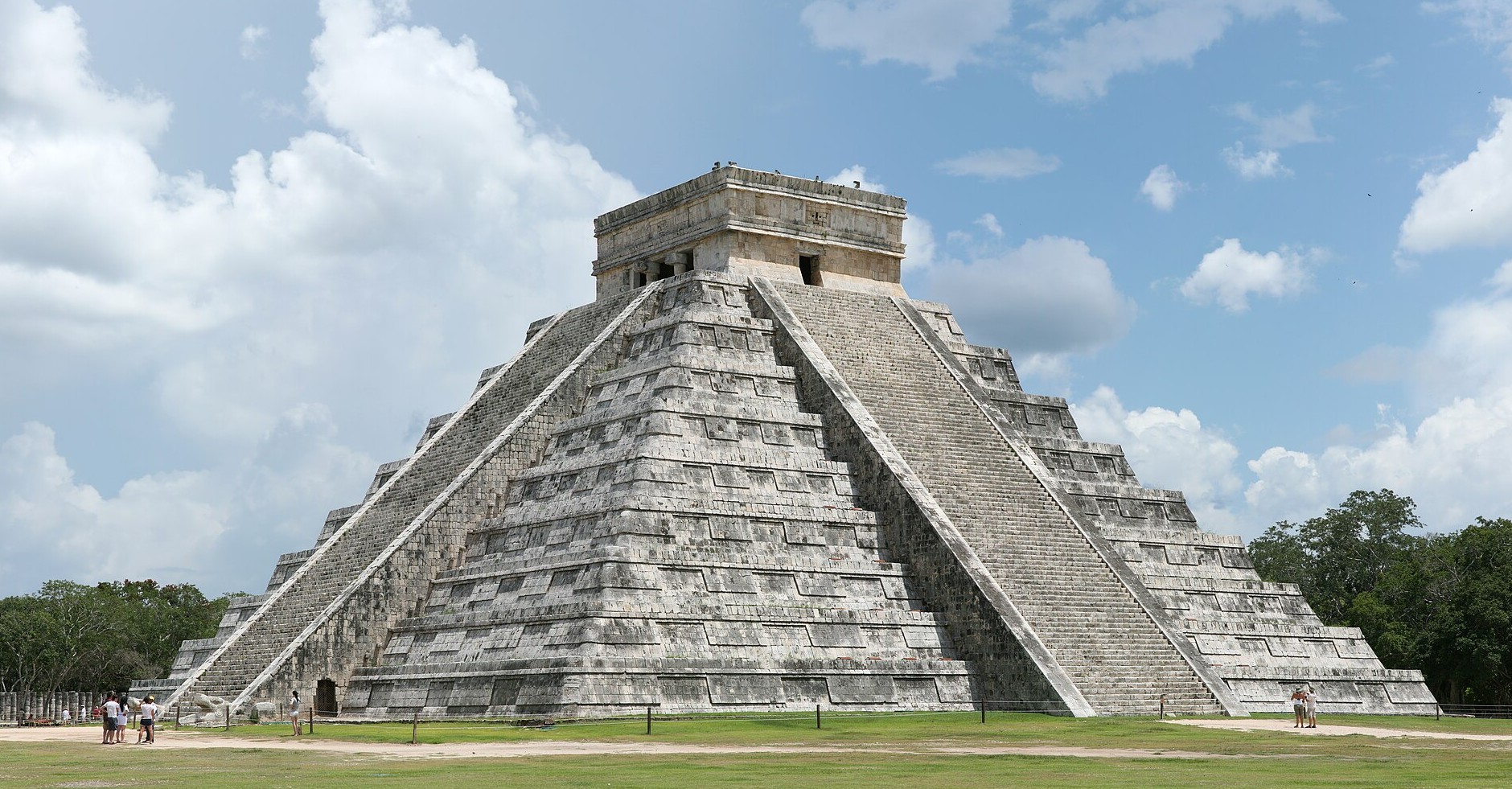
Chichén Itzá — a UNESCO World Heritage Site and one of the New Seven Wonders of the World — is Mexico's most visited archaeological site and one of the most spectacular pre-Columbian cities in the Americas. At its peak between the 9th and 12th centuries CE, this Maya city controlled much of the Yucatán Peninsula from a series of monumental stone structures that remain extraordinarily well-preserved: the stepped pyramid of El Castillo (the Temple of Kukulcán), the Great Ball Court (the largest in Mesoamerica, 168 metres long), the Temple of the Warriors, the Sacred Cenote and the astronomical observatory known as El Caracol.
El Castillo is Chichén Itzá's defining structure — a nine-tiered pyramid aligned with astronomical precision so that on the spring and autumn equinoxes, the shadow of the setting sun creates a serpent of light descending the northern staircase, where the stone head of the feathered serpent Kukulcán waits at the base. This alignment — achieved in a culture without modern astronomy — has been attracting visitors on the equinoxes for decades.
El Castillo & Main Structures
El Castillo's 91 steps on each of four sides, plus the single step of the temple platform, total 365 — precisely the number of days in the Maya solar calendar. The pyramid was built over an earlier structure; on certain days, interior access (now closed to tourists following structural concerns) reveals an inner pyramid with a red jaguar throne studded with jade. The acoustic properties of the main staircase — which produces a sharp chirp when someone claps at the base, mimicking the call of the quetzal bird — were almost certainly deliberate.
The Great Ball Court — where the ritual ball game tlachtli was played using a solid rubber ball — is overlooked by carved relief panels depicting decapitation scenes that still divide archaeologists as to whether they represent the sacrifice of the winning or losing team captain. The Ring of Fire formed by crossing acoustic reverberation in the ball court is one of the world's most remarkable acoustical phenomena.
The Sacred Cenote
The Sacred Cenote — a natural limestone sinkhole 60 metres in diameter and 20 metres to the water surface — served as a place of sacrifice to the rain god Chaac. Archaeological dredging in the early 20th century recovered jade objects, gold discs, pottery, rubber balls and human remains (mostly children) from its depths. The cenote remains a pool of dark green water, dramatically impressive, reached by a paved sacbé (raised causeway) 300 metres north of El Castillo.
Getting There from Cancún
Chichén Itzá is approximately 200km from Cancún — a 2.5-hour drive by road or highway bus. The most comfortable option is a guided day trip from Cancún or Playa del Carmen (including transport, guide and entrance fee); these are widely available and reasonably priced. Self-driving allows more flexibility in timing — arriving at opening (8am) is strongly recommended to beat the crowds and heat. The nearest town for overnight stays is Valladolid (45km away), a charming colonial city worth a night.