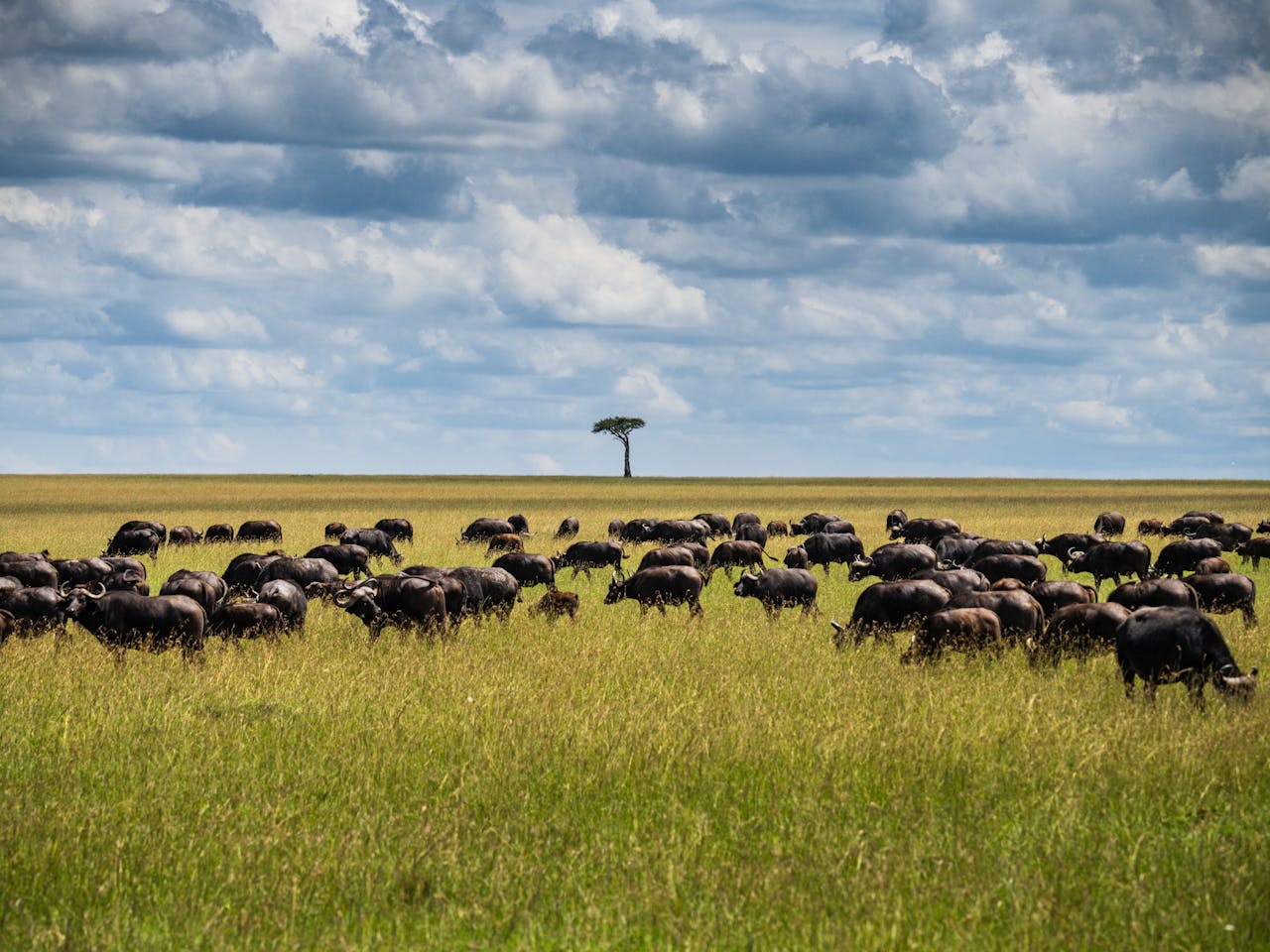
The Ngorongoro Crater — a collapsed volcanic caldera 19km in diameter and 600 metres deep — is one of the natural world's most extraordinary landscapes and Africa's most concentrated wildlife arena. The caldera, formed approximately 2.5 million years ago when a giant volcano collapsed inward, has created a self-contained ecosystem where approximately 25,000 large animals live permanently within a 260 sq km bowl of grassland, swamp, forest and lake. They have no particular reason to leave — water, grass and relative safety exist year-round within the crater.
The result is a wildlife density that is simply without parallel in Africa: lion prides that have never known a territory beyond the crater rim, thousands of wildebeest and zebra that complete their entire lives within sight of the caldera walls, hippos wallowing in Hippo Pool, a steady population of black rhino (one of Africa's few truly reliable rhino-viewing destinations), vast flamingo flocks on the soda Lake Magadi, and a predator concentration that means every game drive in the crater delivers major sightings.
Wildlife of the Crater
The crater's lion population is genetically distinct from other Serengeti lions — the geographical isolation of the crater means there is limited gene flow between the crater pride and the wider Serengeti population. The lions here are exceptionally habituated to vehicles and frequently rest or play within metres of game vehicles. The crater has one of Tanzania's best black rhino populations — perhaps 30 individuals — and patient searching of the Lerai Forest and crater walls area yields sightings more reliably here than anywhere else in Tanzania.
The elephant population is unusual — the enormous bulls that descend into the crater are some of the largest-tusked individuals remaining in East Africa, but cows with calves rarely venture down into the enclosed space. Cheetah are present but less visible than in the Serengeti's open plains; leopard are rarely seen in the crater's grasslands though they occur in the forested rim.
Driving in the Crater
Access to the crater floor requires a 4x4 vehicle (mandatory) and entry at one of two descent routes. All vehicles must exit the crater by 6pm. The standard crater drive visits Hippo Pool (hippos and resident flamingos), the short grass plains (wildebeest, zebra, hyena), the Lerai Forest (elephant bulls, bushbuck, waterbuck), Lake Magadi (flamingos, pelicans) and the central areas where lion and other predators are regularly found. A full crater game drive takes approximately 5–6 hours.
The Crater Rim
The rim of the Ngorongoro Crater sits at 2,286m — cool and often misty, with cloud forest lining the inner edge. The lodges perched on the rim (The Crater Lodge, &Beyond Ngorongoro, Serena Lodge) offer extraordinary views across the caldera floor 600m below, particularly at sunrise when the mist burns off and the wildlife begins to move. The Maasai people, who have grazed their cattle inside the crater for generations, are still permitted to bring livestock down the descent route each morning — one of Africa's most striking cultural juxtapositions.