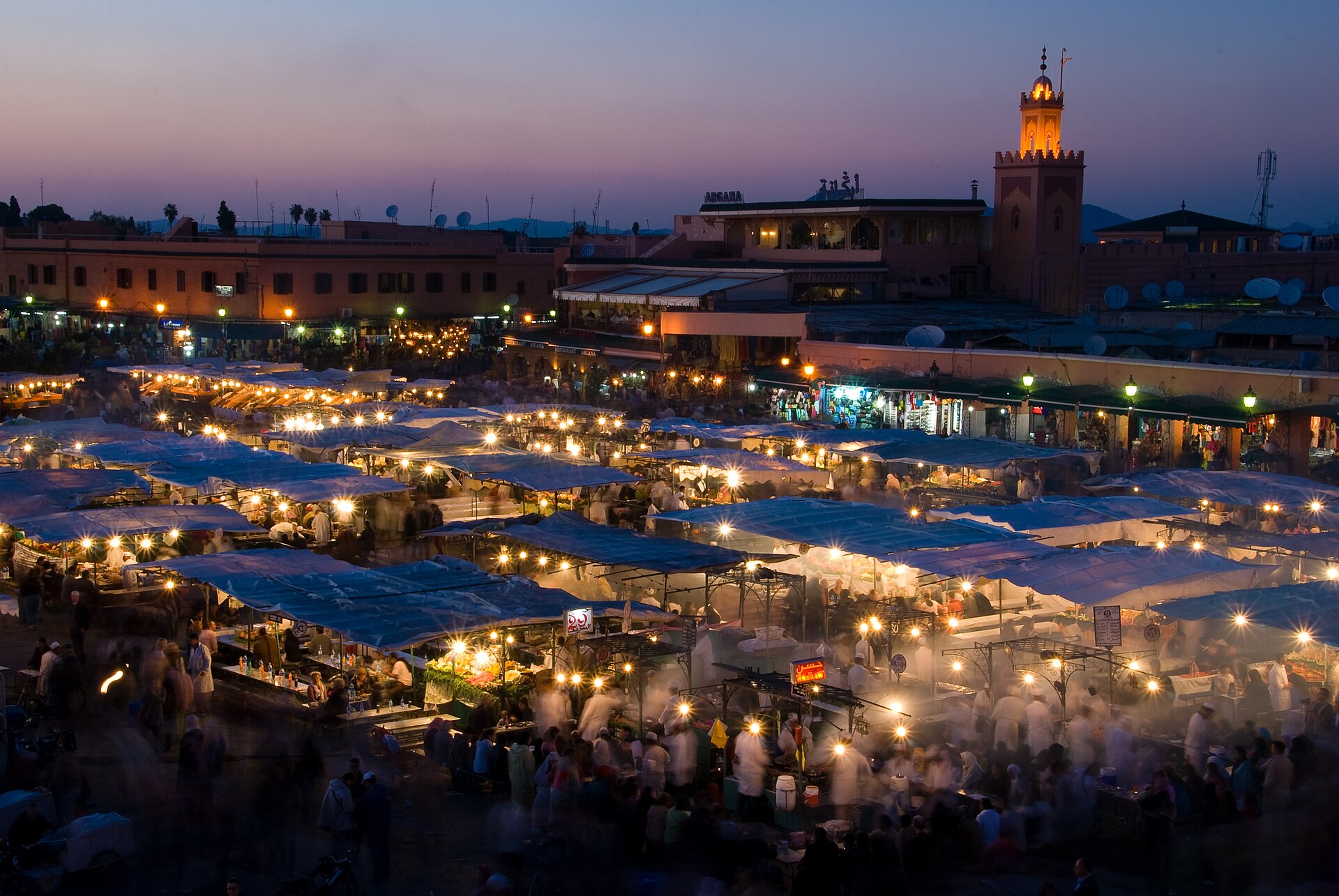
Marrakech is Morocco's most visited city and one of the great sensory experiences in global travel — a UNESCO-listed medieval medina of pink-stained walls, labyrinthine souks, magnificent palaces and gardens, all revolving around the extraordinary circus of Jemaa el-Fna, the main square that transforms from a morning market into an evening carnival of storytellers, snake charmers, acrobats, musicians and food stalls as the sun descends. The medina was settled in the 11th century by the Almoravid dynasty and expanded by successive Berber, Arab and Saadian rulers; walking its alleys — disorienting, aromatic and alive — is one of the most immersive cultural experiences accessible within three hours of the UK.
The "Red City" takes its nickname from the distinctive pink-hued pisé (rammed earth) used in traditional Marrakchi construction, which catches the light at different times of day in ways that constantly transform the appearance of buildings and streets. The best riads (traditional courtyard houses, many now converted to boutique hotels) are found in the tangle of narrow derbs (alleyways) of the northern medina near the Ben Youssef mosque.
Jemaa el-Fna
The vast main square is at its most theatrical in the evening — from around 5pm onwards, food stalls are erected selling harira soup, snail broth, grilled meats, mint tea and fresh orange juice; musicians form circles of djembe drums and Gnawa instruments; storytellers recite in Darija to rapt local audiences; and the haze of charcoal smoke and spice creates a sensory environment unlike anything in Europe. The first-time visitor's experience of emerging from a narrow alley into this tumult at sunset is reliably overwhelming in the best possible way.
By day the square is quieter but still active — orange juice vendors, scribes, the famous water-sellers in colourful hats, fortune tellers and Berber tattoo artists all work the daytime crowds. The rooftop cafés on the square's south side offer the best panoramic view of the action below.
The Souks
North of Jemaa el-Fna, the souks form a dense medieval marketplace where trades and crafts are concentrated by type in separate quarters — the coppersmiths, the leather workers, the carpet sellers, the spice merchants, the lantern makers and the weavers each occupy distinct areas, much as they have for centuries. The Souk des Teinturiers (dyers' souk) — where wool skeins in vivid colours hang from racks above vats of natural dye — is one of Marrakech's most photographed scenes.
Bargaining is expected and part of the pleasure. Initial asking prices in tourist-facing stalls can be three to five times the eventual purchase price; a good-humoured refusal to pay the first price, followed by a counter-offer at around 30–40% of the ask, is the standard opening position.
Palaces, Gardens & Museums
The Bahia Palace, built in the 1890s for a grand vizier, displays the peak of Moroccan craftsmanship — its zellige tilework, carved cedar ceilings, painted plaster and courtyard gardens are extraordinary. The nearby Saadian Tombs, hidden behind the Kasbah mosque for centuries and rediscovered in 1917, preserve a royal mausoleum of remarkable beauty. Yves Saint Laurent's Jardin Majorelle — a vivid cobalt-blue studio complex within a botanical garden — is a peaceful escape from the medina's intensity and now houses the excellent Berber Museum.