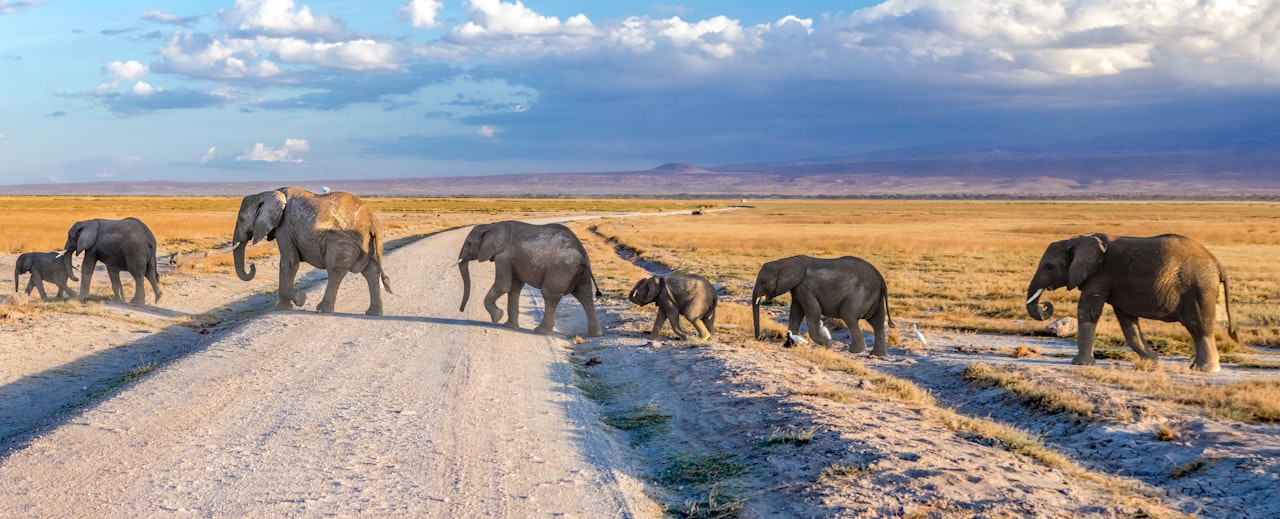
The image of a herd of African elephants moving across a dust-dry plain with the snow-capped summit of Mount Kilimanjaro rising impossibly high above the horizon is perhaps the most iconic photograph in African wildlife. Amboseli National Park, in southern Kenya near the Tanzanian border, is where that image is made — and it delivers on the promise with remarkable consistency. Africa's highest mountain provides a dramatic backdrop that transforms every game drive into a composition, and the park's 391 sq km are home to some of the best-studied and most habituated elephant populations on the continent.
Amboseli's elephants are the park's defining feature. The Amboseli Elephant Research Project, founded in 1972 by Cynthia Moss and continuing today, has studied individual animals over multiple generations — the herds here are exceptionally well habituated to vehicles and allow remarkably close observation of natural behaviour: play, family bonding, greeting ceremonies and inter-herd interactions that reveal the sophisticated social lives of these extraordinary animals.
The Elephant Families
Approximately 1,500 elephants roam the Amboseli ecosystem, with around 400 regularly present within the park itself. The matriarch-led family groups gather at the marshes and springs in the park's centre — fed by underground water filtering through the porous volcanic soils of Kilimanjaro — creating extraordinary scenes of elephant activity: mud bathing, drinking, calf play and the tender interactions between mothers and young that characterise elephant social life.
The elephants of Amboseli are notably large — the park has preserved some of the finest-tusked bulls remaining in East Africa. Sightings of 50+ elephant groups at the Observation Hill viewpoint at sunset, with Kilimanjaro catching the last pink light above them, are among the most moving in all of African travel.
Wildlife Beyond Elephants
Amboseli delivers strong lion and cheetah sightings, with the open plains favouring the latter — cheetah hunts in this wide, unobstructed landscape are some of the most exciting wildlife experiences in Kenya. The Observation Hill viewpoint gives a 360° panorama of the entire park, allowing visitors to spot concentrations of wildebeest, zebra and buffalo from above before driving to them. Hippos wallow in the papyrus-fringed Enkongo Narok swamp; more than 600 bird species have been recorded in the park.
Kilimanjaro: The Cloud Game
Africa's highest mountain (5,895m) is in Tanzania, approximately 50km from the park centre — but when the peak is clear, it seems almost impossibly close. The mountain is most often clear at dawn and increasingly cloud-covered by late morning; the classic Amboseli tactic is to drive to the swamps at first light to combine elephant viewing with maximum Kilimanjaro clarity, then return to camp as the clouds build. Some days Kili remains hidden all day; on others it stays clear until afternoon. The uncertainty is part of the experience.