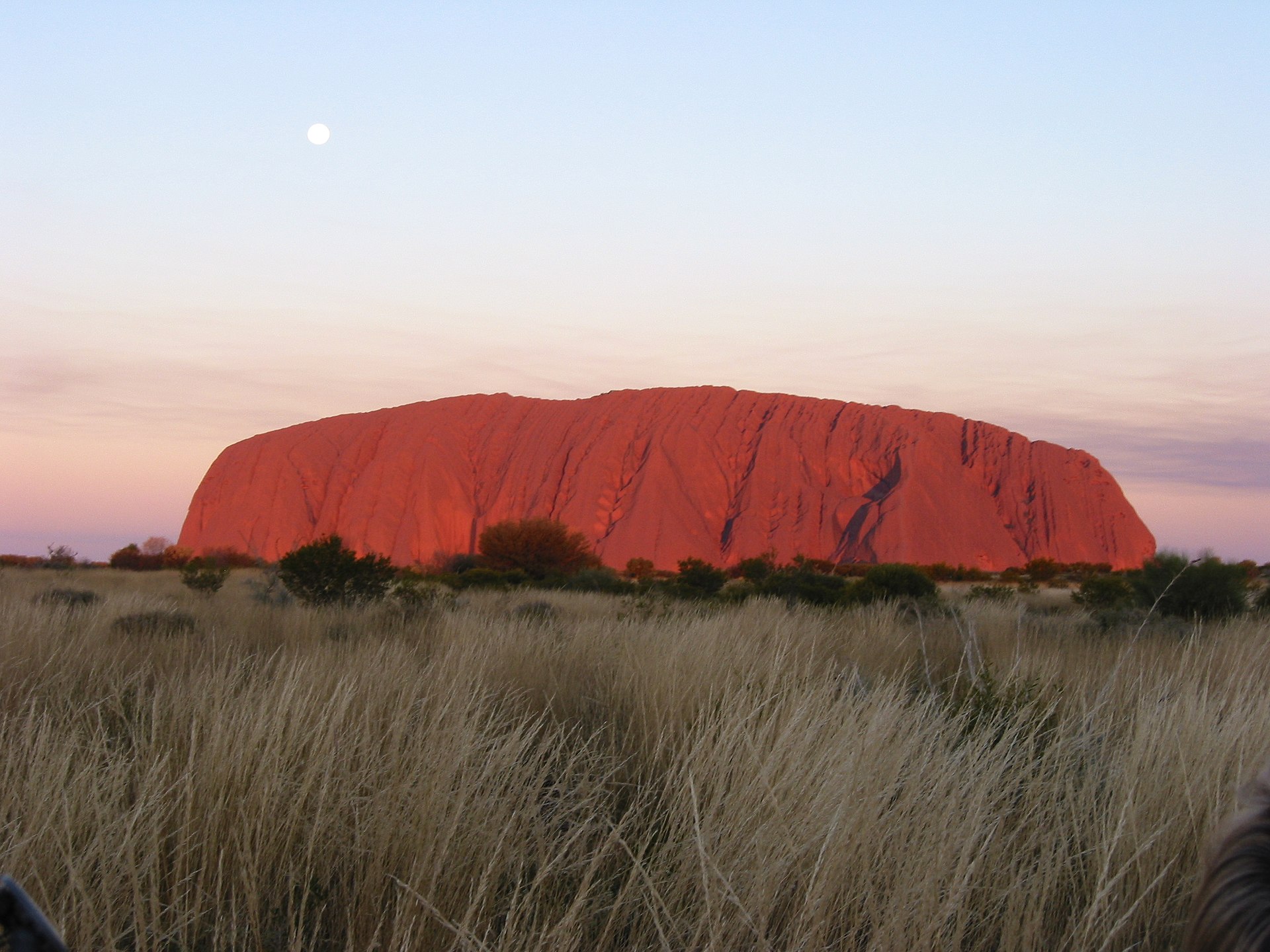
Uluru (Ayers Rock) — the world's most famous monolith, a single sandstone formation 348 metres high and 9.4km in circumference rising abruptly from the flat red desert of Australia's Northern Territory, approximately 450km south-west of Alice Springs, sacred to the Anangu Aboriginal people (the traditional owners of the land, for whom the rock is a living cultural and spiritual entity of immense significance — the stories of the Tjukurpa, the Anangu creation law that is encoded in every feature of Uluru's surface, are among the most ancient continuous oral traditions on Earth) — has been a focus of human reverence for at least 30,000 years and of Western tourist attention since Europeans first encountered it in the 1870s. The rock's colour change at sunrise and sunset — from deep purple to vivid orange to rose to gold in the space of 30 minutes as the sun angles across it, the red iron oxide minerals of the sandstone responding to different wavelengths of light — is one of the most photographed natural phenomena in the world and, in person, still astonishing: photographs prepare you for the spectacle but not for the scale, the silence, or the profound sense of the ancient that the rock communicates in its landscape.
Uluru-Kata Tjuta National Park — the protected area covering both Uluru and the Kata Tjuta (the Olgas), a group of 36 domed rock formations 50km west of Uluru, some rising to 546 metres, carved by the same geological forces and associated with equally significant Anangu sacred stories — is jointly managed by Parks Australia and the Anangu traditional owners under a co-management agreement established in 1985 when the land was returned to the Anangu. Climbing Uluru was banned permanently from October 2019 (the Anangu had requested the ban since the 1980s, but tourism pressure delayed its implementation); the experience of the park is now primarily through cultural walks, guided tours and sunset/sunrise viewing platforms, a change that most visitors who have done both experiences consider an improvement — the base walk (a 10.6km path around the full circumference of the rock) reveals the caves, waterholes and cultural sites of Uluru that the climbers above could not see.
Sunrise, Sunset & the Base Walk
The sunrise viewing area (Talinguru Nyakunytjaku, a dedicated platform 5km from Ayers Rock Resort, the colour change beginning approximately 30 minutes before sunrise and most intense in the final 10 minutes before the sun clears the horizon — at this point the rock's face moves from deep purple-grey to an incandescent orange in a visible progression across the surface) and the sunset viewing area (the car park south of the rock, with the rock's western face in direct light as the sun descends) are the two primary Uluru experiences and require no guide, no booking and no special preparation — only the correct timing (arriving at the viewing area 40–45 minutes before the stated sunrise or sunset time to get a position with unobstructed sight lines). The base walk (10.6km around the full circumference of the rock; 3.5–4 hours at a comfortable pace; no guide required; water essential) passes the Mutitjulu Waterhole (the most significant water source at Uluru, with ancient rock art on the cave walls above), the Mala Walk section (the finest 2km of the base walk, with cultural explanations of the cave paintings), and the Kuniya Walk (the south-western face, with the canyon that is the most architecturally dramatic section of the rock's surface). National Park entry AUD 25 per person for 3 days (buy at the park entrance gate).
Kata Tjuta & Cultural Tours
Kata Tjuta (the Olgas) — 50km west of Uluru on the park's sealed road, the group of 36 domed formations whose tallest (Mount Olga) at 546 metres is higher than Uluru, their ochre and purple layered rock forming valleys and gorges of extraordinary visual drama — contains the Walpa Gorge (a 2.6km return walk between two of the largest formations, the walls pressing close and the light changing as the sun moves across the opening above; one of the finest short walks in Australia) and the Valley of the Winds (a 7.4km loop through the interior of the formation group, the most rewarding full walk in the park; water essential, partially closed in extreme heat above 36°C). The Anangu Tours operation at Ayers Rock Resort (bookable at the resort; guided sunrise/sunset tours with an Anangu guide, approximately AUD 60–120) provide the most direct cultural engagement with the significance of Uluru and Kata Tjuta — the Tjukurpa stories associated with the rock features, explained by traditional owners in their own language with translation, are the element of the Uluru experience that no photography can substitute.
Field of Light & Staying at Ayers Rock Resort
The Field of Light (Tili Wiru Tjuta Nyakutjaku) — an art installation by British artist Bruce Munro, covering 49,000 square metres of red desert with 50,000 stemmed glass spheres that glow in colour patterns after dark, illuminated from sunset until after midnight — is the finest after-dark experience at Uluru and uniquely moving in the desert: the silence, the stars, and the coloured spheres across the dark red ground with Uluru a shadow in the background constitute an installation that is simultaneously contemporary art and a deeply respectful homage to the landscape. Entry (from approximately AUD 45 for the self-guided walk after sunset; or AUD 195 for the "Dinner Under the Stars" combined dining and tour experience) is available through Ayers Rock Resort bookings. Staying at Ayers Rock Resort (the only accommodation at Uluru) ranges from the campsite (from AUD 40 per person per night) and the outback pioneer hotel (from AUD 150) to the Longitude 131° luxury tented camp (from AUD 1,500 per night, with a view of Uluru from the tent veranda and all meals and park activities included — the finest single accommodation experience in Australia).