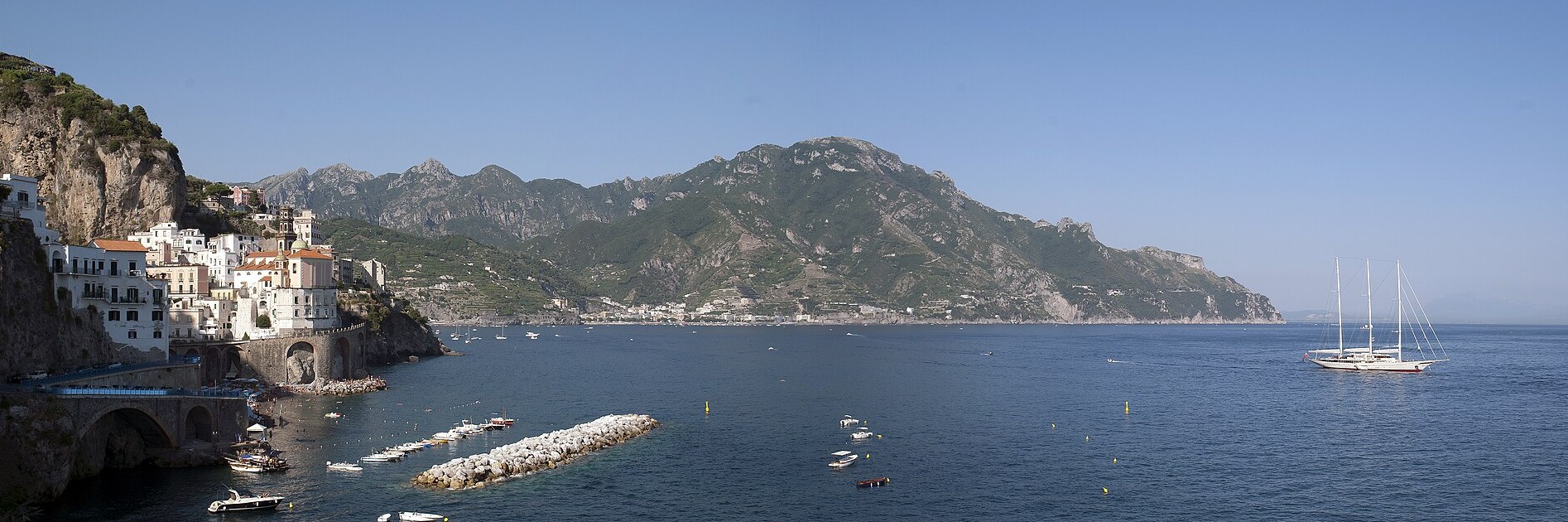
The Amalfi Coast (Costiera Amalfitana) — a 50km stretch of the southern Sorrentine Peninsula in Campania, where the Lattari Mountains drop almost vertically into the Tyrrhenian Sea and the road (the SS163, the "Drive of the Gods") threads between cliff and water with a combination of engineering audacity and visual drama unmatched in Italy — is a UNESCO World Heritage Site and one of the most celebrated stretches of coastline in the world: a landscape of vertiginous cliffs, terraced lemon groves, clifftop villages of pastel-coloured houses, private beaches reached by wooden stairs cut into the rock, and a maritime culture of fishing and ceramics that gives the coast a genuine working identity beneath its luxury tourist surface. Positano — the most photographed village, its houses cascading down the cliff face in a riot of pink and terracotta to a small beach — is the defining Amalfi image; Ravello — on a high plateau 300 metres above the sea, its gardens (Villa Rufolo, Villa Cimbrone) overlooking the full arc of the coast — is the finest experience on the coast for those willing to walk uphill.
The coast's dramatic topography makes it simultaneously beautiful and difficult to visit: the SS163 is single-lane in many sections, blocked regularly by bus-car collisions, and the hairpin bends preclude any driving speed above 30km/h. The SITA bus (the local public bus that operates the full coast road between Salerno and Sorrento) is the most practical transport for independent travellers and provides an authentically terrifying experience of the coast's road geometry without the responsibility of driving it. Ferries between the coastal towns (Positano, Amalfi, Minori, Salerno) operate March–October and are the most pleasant means of travel in good weather.
Positano, Amalfi Town & Ravello
Positano — the most glamorous and most expensive village on the coast — has its character defined by the Spaggia Grande beach (a small, intensely organised pebble beach directly below the village, sunbeds €25–35 per pair), the Fornillo beach (a quieter alternative reached by a 10-minute walk along the cliff path west of the village), and the extraordinary verticality of the village itself (every building reached by steps, no wheeled vehicles within the village). Amalfi town — larger than Positano, its main square (Piazza del Duomo) dominated by the 9th-century Cathedral of Sant'Andrea with its extraordinary Arab-Norman façade — has a more working atmosphere, a good daily market, and the most accessible beach facilities on the coast. Ravello — 6km inland from Amalfi, on a ridge with views that have attracted Wagner, Virginia Woolf and Gore Vidal — is the Amalfi Coast's cultural heart: the Villa Rufolo (from whose garden terrace Wagner conceived the setting for Act Two of Parsifal) and Villa Cimbrone (with the Terrace of Infinity, a balustrade of 18th-century marble busts at the cliff edge above the sea) are among the finest garden experiences in Italy.
Pompeii & Herculaneum
The addition of Pompeii and Herculaneum to an Amalfi Coast itinerary requires only modest adjustment: Naples is the natural hub (1.5 hours from Amalfi by ferry, 1 hour from Amalfi by SITA bus to Salerno then train), and both sites are accessible on the Circumvesuviana commuter train from Naples Porta Nolana station (Pompeii Scavi, 40 minutes; Herculaneum/Ercolano, 20 minutes). Pompeii — the Roman town of 11,000 people buried under volcanic ash in the eruption of 79 CE and first excavated in 1748 — covers 44 hectares (only two-thirds excavated) and requires at least 4 hours for a meaningful visit; the highlights (the Villa of the Mysteries with its extraordinary fresco cycle, the Lupanare brothel with its explicit paintings, the Forum and the Amphitheatre) are spread across the site. Herculaneum (the wealthier seaside resort town, preserved under solidified volcanic mud in a more complete state than Pompeii, with upper floors of wooden buildings intact) is smaller and less overwhelming — 2 hours is sufficient.
Getting There & Staying
The practical base for an Amalfi Coast visit depends on budget and preference: Positano (most expensive, most photogenic, furthest from Naples and Pompeii), Amalfi town (more affordable, central position on the coast, good boat connections), or Sorrento (north of the coast proper, more developed and less beautiful, but with direct train connections to Naples and Pompeii and the widest range of accommodation prices). Naples (Napoli Centrale) is the transport hub for the coast — high-speed trains connect Naples to Rome (1h10m), Florence (2h45m) and Milan (4h45m). Naples itself — the chaotic, magnificent, historically extraordinary third city of Italy — deserves at least one full day: the National Archaeological Museum (the finest collection of Roman art in the world, with Pompeii finds including the Alexander Mosaic and the Secret Cabinet of erotic art), the historic centre (UNESCO-listed, the densest medieval streetscape in Europe), and the pizza — the original Neapolitan margherita, from Pizzeria Sorbillo or Di Matteo.