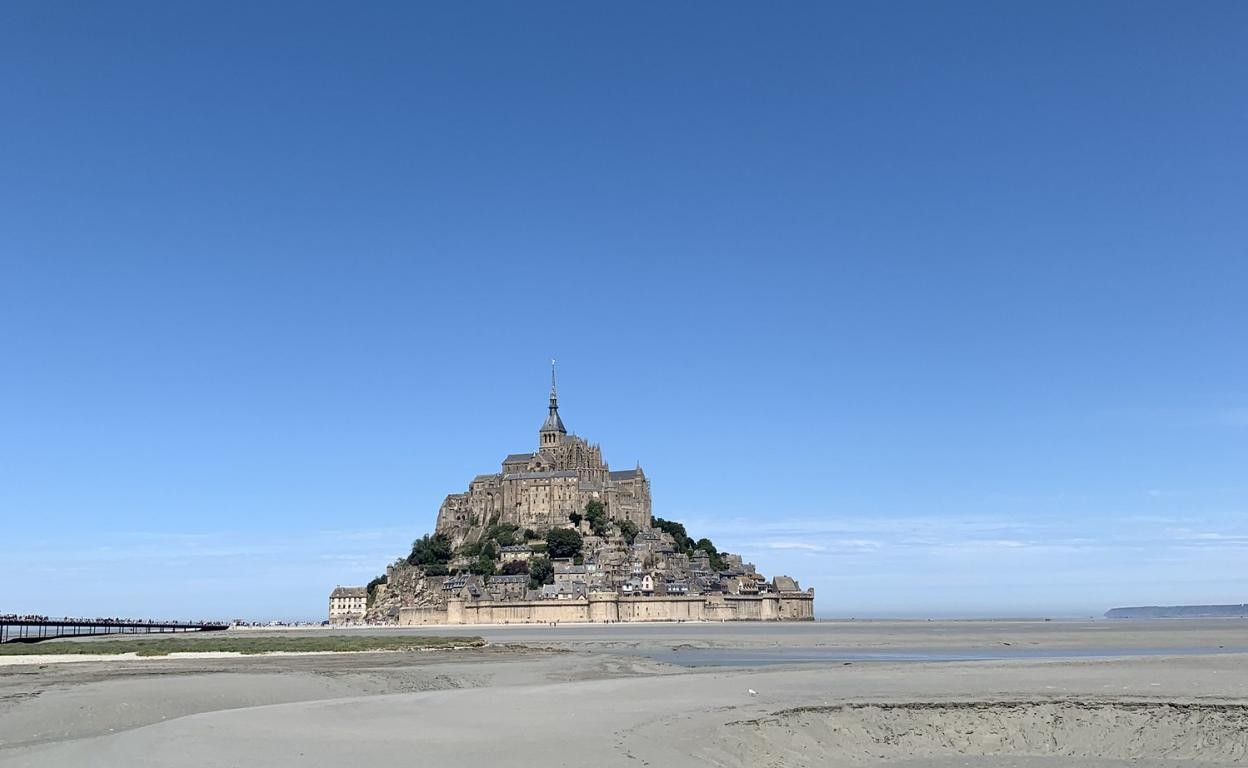
Mont Saint-Michel — a granite tidal island topped by a Benedictine abbey that rises like a fairy tale from the tidal flats of the Couesnon estuary at the Normandy-Brittany border — is France's most iconic monument after the Eiffel Tower and one of Europe's most extraordinary architectural achievements: a medieval masterpiece of engineering and faith, where successive abbeys and churches, monks' quarters, defensive walls and village streets have been stacked vertically on a 92-metre rock over a thousand years, creating an impossibly vertical silhouette that seems to materialise from the sea and the mist of the bay with every change of tide and light.
The tides at Mont Saint-Michel are among the most dramatic in Europe: the bay's shallow gradient (1:10,000) and the specific geography of the Cotentin Peninsula create tidal ranges of up to 15 metres, and the speed at which the tide advances (historically described as "at the speed of a galloping horse" — an exaggeration, but the advance of the tide across the flats can reach 1 metre per second and catches the unwary) gave rise to the abbey's role as a pilgrimage site where the path to salvation could become genuinely dangerous. At high tide, the Mount is encircled by water; at low tide, it stands in the centre of vast sand and mud flats that visitors can cross with guided walks.
The Abbey & Village
The Abbey of Mont Saint-Michel (Abbaye du Mont Saint-Michel) — founded in 708 CE according to tradition, when the Archangel Michael appeared to the Bishop of Avranches — grew to its current magnificent form over 1,000 years: the Romanesque nave (11th–12th century), the Gothic Merveille (the "Marvel", a three-storey monastic building of extraordinary sophistication, 1211–1228), the cloister (a floating garden of Gothic delicacy) and the abbey church above all constitute one of medieval Europe's most impressive monastic complexes. Entry is €13; audio guide essential for context. The village below — a single main street (Grande Rue) of medieval buildings now serving as restaurants and souvenir shops — connects the sea-level entrance to the abbey above through a succession of rampart gates.
Tides, Views & Bay Walks
Mont Saint-Michel's great spectacle — the transformation of the island from beach to sea-surrounded rock — happens twice daily according to the lunar tide cycle. The highest tides (coefficient above 100) occur at new and full moon; the largest tides cover the entire causeway approach and the flats to the island's base, creating the full "island" effect that most photographs show. A tide calendar is essential (available at montstemichel.net) — arrive 1–2 hours before high tide to watch the water advance across the flats from the ramparts. The guided bay walks (trekking out to the Mount across the tidal flats from the mainland, with a professional guide who knows the quicksand areas) are one of the finest activities in Normandy — 3–4 hours through the tidal landscape, barefoot in the estuary, arriving at the Mount from the sea rather than the causeway.
Getting There & Staying
Mont Saint-Michel is most commonly visited from Paris as a long day trip or overnight stay. The TGV from Paris Montparnasse to Rennes takes 1.5 hours; from Rennes, a connecting TER train or shuttle bus reaches the Mount in approximately 1 hour. By car from Paris (3.5 hours on the A11/A84), the approach across the Normandy countryside, with the Mount appearing on the horizon above the flat farmland, is one of France's great arrival experiences. Staying on the Mount overnight (hotels within the village walls; accommodation on the mainland at La Caserne or the main hotel strip) gives access to the Mount at dawn and dusk when day visitors have left — the most atmospheric and photographically rewarding times.