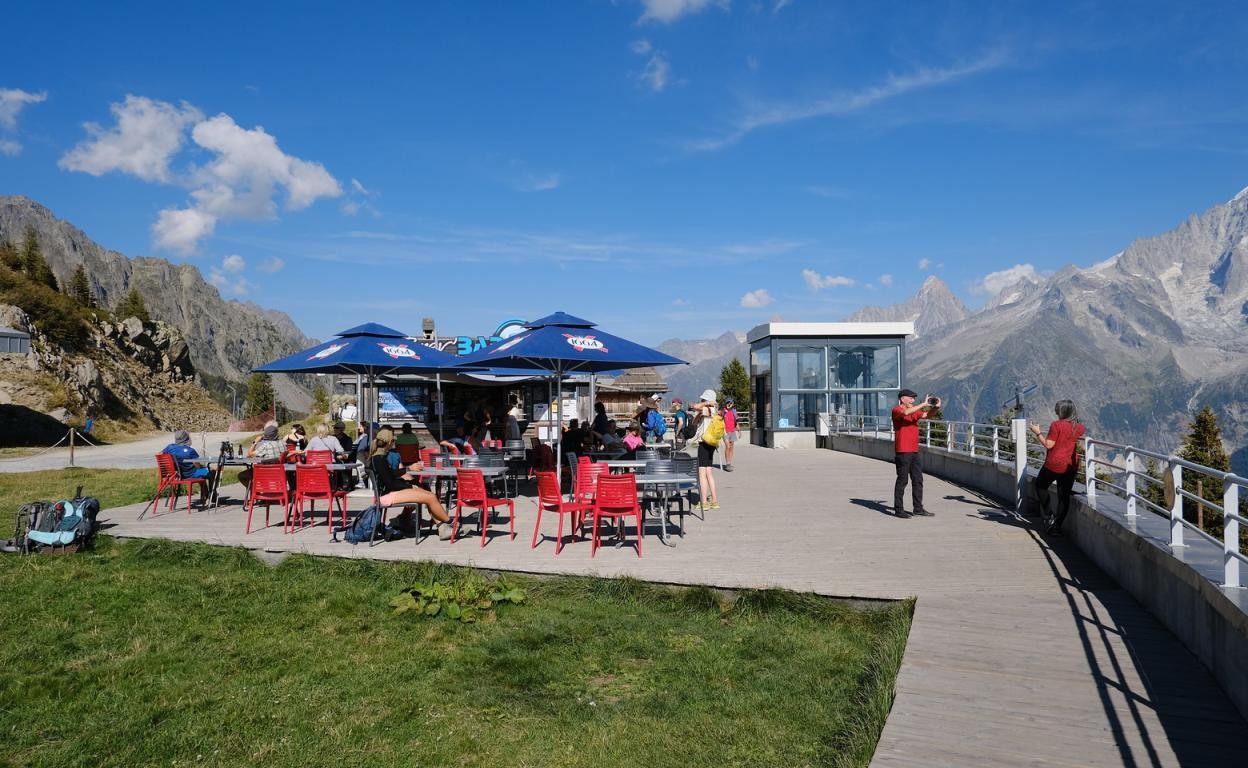
Chamonix — the valley town at the foot of Mont Blanc (4,808 metres, the highest peak in the Alps and Western Europe) in the Haute-Savoie département of south-eastern France — is the spiritual home of mountaineering: it was here, in 1786, that Jacques Balmat and Michel-Gabriel Paccard made the first ascent of Mont Blanc; it was here that the first Winter Olympics were held (1924); and it is here that the world's most serious mountain athletes still gather to climb, ski, run and paraglide in a landscape of exceptional grandeur. But Chamonix is not only for mountaineers and extreme sports athletes: the valley is accessible to anyone with a cable car ticket, and the Aiguille du Midi — a needle of granite at 3,842 metres reached by cable car from the centre of Chamonix — provides one of the most extraordinary mountain viewpoints in the world, placing visitors within touching distance of the summit snowfields, surrounded by a 360-degree panorama of the Mont Blanc massif, the Matterhorn and dozens of 4,000-metre peaks.
The Chamonix valley is also one of the finest ski destinations in Europe: the ski area encompasses 152km of marked runs across the valley's multiple ski areas (Brévent-Flégère, Les Grands Montets, Les Houches and the Aiguille du Midi), connected by valley buses and lifts, with some of the most demanding off-piste terrain in the Alps — including the famous Vallée Blanche (20km of off-piste descent from the Aiguille du Midi to Chamonix, considered the most accessible high-altitude ski route in the world) and the Pas de Chèvre route to Italy via the Mont Blanc tunnel.
Aiguille du Midi & the Vallée Blanche
The Aiguille du Midi cable car (téléphérique) — departing from the centre of Chamonix town and ascending 2,807 metres in vertical height across two stages in approximately 20 minutes — is one of the most dramatic cable car journeys in the world: the upper station at 3,842 metres sits at the summit of a granite needle, connected to the viewing terraces by internal lifts, and the panorama from the top is overwhelming — Mont Blanc's summit above, the Vallée Blanche glacier below, the Italian Alps to the south and the Swiss Alps to the north. Book online well in advance (the lift operates at limited capacity and same-day tickets are rarely available in peak season). The Vallée Blanche — the 20km off-piste descent from the Aiguille du Midi to Chamonix through the Mer de Glace glacier — requires a guide but is achievable by intermediate skiers; it is one of the finest ski days in the Alps.
Mer de Glace & Summer Hiking
The Mer de Glace — France's largest glacier (7km long, 200 metres deep at its thickest), reached by the Montenvers mountain railway from Chamonix (25 minutes, hourly departures) — is a dramatic and increasingly poignant landscape: the glacier has retreated significantly over the past century (markers on the valley wall show the former ice levels), and the journey down to the glacier's surface via cable car and stairs has grown longer with each decade of retreat. Ice caves carved annually into the glacier's interior are illuminated with coloured lights in winter and summer. The summer hiking around Chamonix is exceptional: the Tour du Mont Blanc (a 10-day circuit of the Mont Blanc massif through France, Italy and Switzerland) begins and ends in Chamonix; shorter day walks from the valley include the Lac Blanc trail (from La Flégère, 2 hours, extraordinary glacier views) and the Aiguillette des Houches (from Les Houches, 3 hours, quieter and very rewarding).
Getting to Chamonix from the UK
Chamonix is most commonly reached from Geneva Airport (Switzerland) — 90 minutes by the direct shuttle bus operated by several companies (Mountain Drop-Offs, Alpybus: approximately £25–40 per person each way), making it one of the most accessible high-Alpine destinations for UK visitors. Geneva has direct flights from most major UK airports (easyJet, British Airways, Swiss: 1.5–2 hours). The alternative approach by train from London (Eurostar to Paris, TGV to Bellegarde or Saint-Gervais, local train to Chamonix: 6–7 hours total but increasingly popular as a low-carbon alternative) is practical for a long weekend. Within the valley, the Mont Blanc Express train connects Chamonix to Argentière and Le Tour in one direction and to Saint-Gervais in the other.