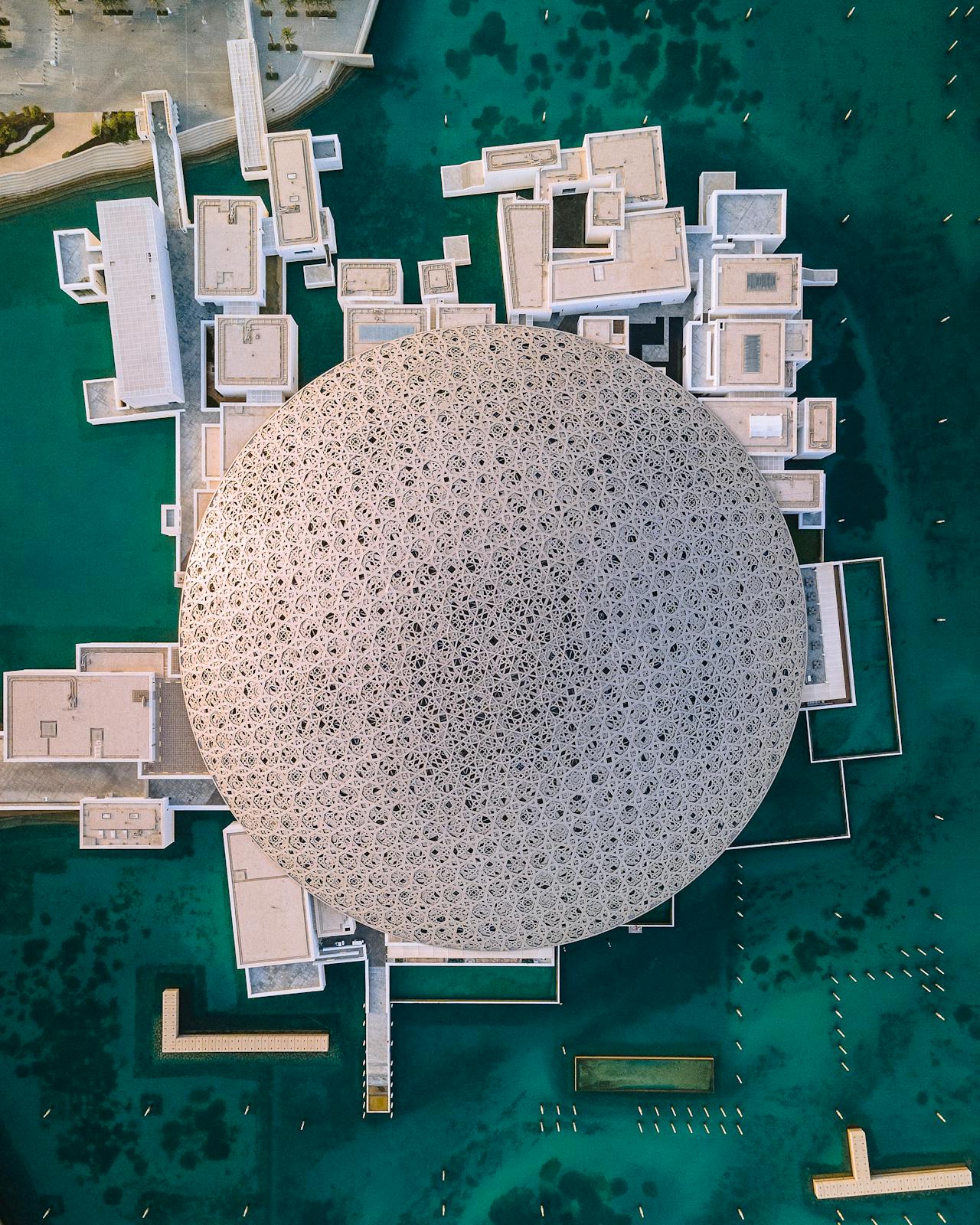
The Louvre Abu Dhabi — designed by French architect Jean Nouvel, opened in November 2017 on Saadiyat Island (the cultural district of Abu Dhabi, 10 minutes from the city centre), its 180-metre aluminium dome composed of 7,850 unique star-shaped geometric elements that filter the Arabian sunlight into the extraordinary "rain of light" effect below — is both the finest museum building in the Arabian Peninsula and one of the most remarkable works of contemporary architecture in the world: a building that floats over a series of gallery pavilions and open water channels, its dome creating a perpetually shifting pattern of dappled light across the white stone promenades and shallow pools beneath, an effect that recalls simultaneously the filtered light of a forest canopy and the geometric patterns of Islamic architecture. The museum is the result of a 30-year intergovernmental agreement with the French Republic (signed 2007) that grants the use of the Louvre name in exchange for a loan of artworks from 17 French national collections and curatorial expertise — an arrangement that has produced the finest universal museum in the Middle East.
The collection — approximately 600 works on permanent display (drawn from the museum's own acquisitions and long-term loans from the French institutions) — is organised chronologically and thematically across 12 permanent galleries, covering human civilisation from prehistoric artefacts to 21st-century art with deliberate emphasis on connections between cultures and civilisations rather than on national or regional traditions: a Bactrian princess from 2500 BCE beside an Egyptian statue of the same period; a medieval Christian painting beside a contemporaneous Islamic manuscript; a Piet Mondrian beside a Kazimir Malevich. The curatorial approach — "universal museum" in the true sense, finding visual and conceptual connections across cultures — is genuinely illuminating and produces unexpected juxtapositions that reward careful looking.
The Dome & the Architecture
Jean Nouvel's dome — 180 metres in diameter, 29 metres above the promenades below, weighing approximately 7,500 tonnes, comprising eight layers of geometric metalwork at varying angles that together diffuse and scatter direct sunlight into the "rain of light" — is best experienced by arriving at midday (when the sun is highest and the light effect most dramatic) and walking slowly through the outdoor promenades beneath the dome before entering the galleries: the shifting patterns of light on the white stone, the glimpses of water channels between the gallery pavilions, and the sound of the Gulf beyond the outer gallery walls combine to produce an experience of architectural beauty unusual in the contemporary museum world. The building extends over the sea on a series of platforms, with promenades and water channels between the pavilions accessible to ticket holders — exploring the exterior architecture before entering the galleries is strongly recommended and takes 20–30 minutes. The museum is best photographed from the sea approach (water taxis available from the Corniche marina) or from the upper-floor gallery terraces overlooking the dome and the Gulf simultaneously.
The Permanent Collection
The permanent collection's 12 galleries trace human civilisation from the first tool-using communities to the present day, with the emphasis firmly on connections rather than chronological survey: Gallery 1 (The First Villages) opens with Neolithic figurines and agricultural implements from across the ancient world; Gallery 4 (Universal Religions) places Buddhist sculpture, early Christian ivory, and Islamic Quran manuscripts from the same century in direct dialogue; Gallery 9 (A New Art for a New World) examines the 19th-century Western tradition alongside contemporaneous art from Japan, Iran and the Ottoman Empire; Gallery 12 (The Studio and the World) closes with 20th–21st century work from global practitioners. Highlights include: a Leonardo da Vinci La Belle Ferronnière (on long-term loan from the Louvre Paris), a Vincent van Gogh self-portrait, a Cy Twombly large-scale painting, and the extraordinary collection of ancient Mediterranean and Near Eastern objects acquired directly by the museum. Temporary exhibitions (check the Louvre Abu Dhabi website for the current programme) are among the finest in the region.
Visiting & Saadiyat Island
The Louvre Abu Dhabi is open Tuesday–Sunday, 10am–8pm (Thursday until 9pm); closed Monday. Entry approximately AED 63 adults (check current prices at louvreabudhabi.ae — prices change for temporary exhibitions). The museum is 15 minutes from Abu Dhabi city centre by taxi (approximately AED 25–35) or by the Saadiyat Cultural Bus (free shuttle from Abu Dhabi Mall and the Cultural Foundation, check schedules on the museum website). The wider Saadiyat Island cultural district — which will eventually include the Guggenheim Abu Dhabi and the Zayed National Museum, both under construction — also contains the Saadiyat Beach Club and the finest natural white-sand beaches in Abu Dhabi: a morning at the museum followed by an afternoon on the beach is a highly recommended combination. The Sheikh Zayed Grand Mosque is 20 minutes from Saadiyat by taxi — combining both on the same day is the finest single day in Abu Dhabi.