Malé — the capital of the Maldives and one of the world's most densely populated cities (approximately 240,000 people on an island of just 6 square kilometres, making it roughly 50 times denser than London) — is a place that almost no tourist visits intentionally but that most Maldivian travellers pass through on the way to or from their resort. The city rewards a half-day stopover: it is a genuinely fascinating urban anomaly, a city of extraordinary density where multi-storey concrete buildings rise from streets of scooters, mosques, tea houses (sai hotels) and the colourful containers of the harbour district, all within a few minutes' walk of each other on an island so small you can circumnavigate it in 45 minutes on foot.
The fish market at the northern harbour — one of the great fish markets of Asia — operates most intensely in the early morning (5–7am) when the overnight dhoni fishing boats return with their catch of yellowfin tuna, skipjack, wahoo, mahi-mahi and reef fish. The sight of skilled Maldivian workers butchering tuna with the speed and precision of a hundred years of practice — blood in the water, the harbour noise, the enormous fish laid out on concrete slabs — is genuinely visceral and entirely authentic. Fish (particularly tuna) is the foundation of Maldivian cuisine and the backbone of the economy; the fish market is where this connection is most visible.
The Fish Market & Harbour
The fish market (best at 5–7am but active until late morning) is at the northern end of Boduthakurufaanu Magu (the corniche road running along the harbour). The market building is open-fronted and visitors are welcome to watch and photograph (with sensitivity — this is a working environment, not a tourist attraction). The harbour itself — Malé Harbour is one of the busiest in the Indian Ocean — has local fishing dhonis (traditional wooden boats), cargo vessels, speedboats serving the resort islands, and the constant ferry traffic connecting the capital to the local islands throughout the atoll network.
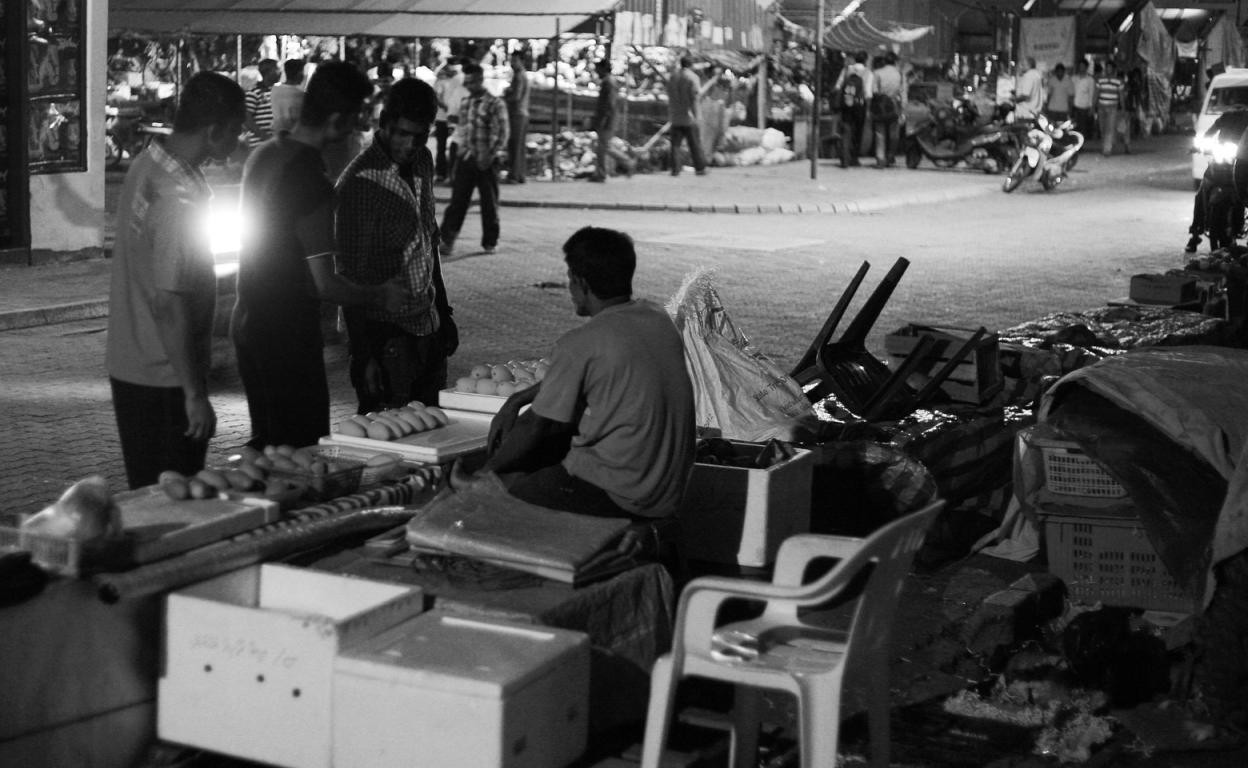
The Local Market (Maaveyyo Magu) nearby sells fresh produce from Maldivian farming islands — watermelon from Thoddoo, coconuts, papayas, betel nut — alongside preserved fish products and traditional snacks. The tea houses (sai hotels) around the market serve short eats (small fried snacks, coconut flatbreads, tuna-filled pastries) with strong sweet tea — the definitive Maldivian breakfast experience and available for approximately £1–2.
Mosques, Museum & Architecture
The Friday Mosque (Masjid al-Sultan Muhammad Thakurufaanu al-A'azam, 1656) is Malé's most important historic building and one of the finest mosques in South Asia — built entirely from coral stone and decorated with intricate Quranic calligraphy both inside and on the exterior walls, its golden dome and white coral-stone minaret are the defining landmarks of the Malé skyline. Non-Muslims can observe the exterior and the courtyard (respectful dress required). The National Museum, in the Sultan's Park, houses the finest collection of Maldivian historical artefacts including pre-Islamic Buddha statues (evidence of Buddhism in the Maldives before Islam arrived in 1153 CE), royal regalia and traditional crafts. The grand Hukuru Miskiy (Islamic Centre), built in 1984 with Saudi funding, is the largest mosque in the Maldives and its gilded dome is visible from the airport island.
Practical Malé Visit
Most travellers encounter Malé on the day of arrival or departure — the airport is on the adjacent island of Hulhumalé, connected to Malé by the Sinamalé Bridge (2018, the first bridge in the Maldives, 1.4km long). A half-day in Malé between an early morning arrival and a noon resort speedboat departure is entirely feasible: fish market at 6am, tea house breakfast, walk through the harbour district, Friday Mosque exterior, National Museum, back to the ferry terminal by 10am. The city is completely walkable; everything of interest is within 30 minutes on foot from the harbour. The contrast between the capital's density and chaos and the resort island's empty seclusion is one of the most striking urban-rural contrasts in the Indian Ocean world.