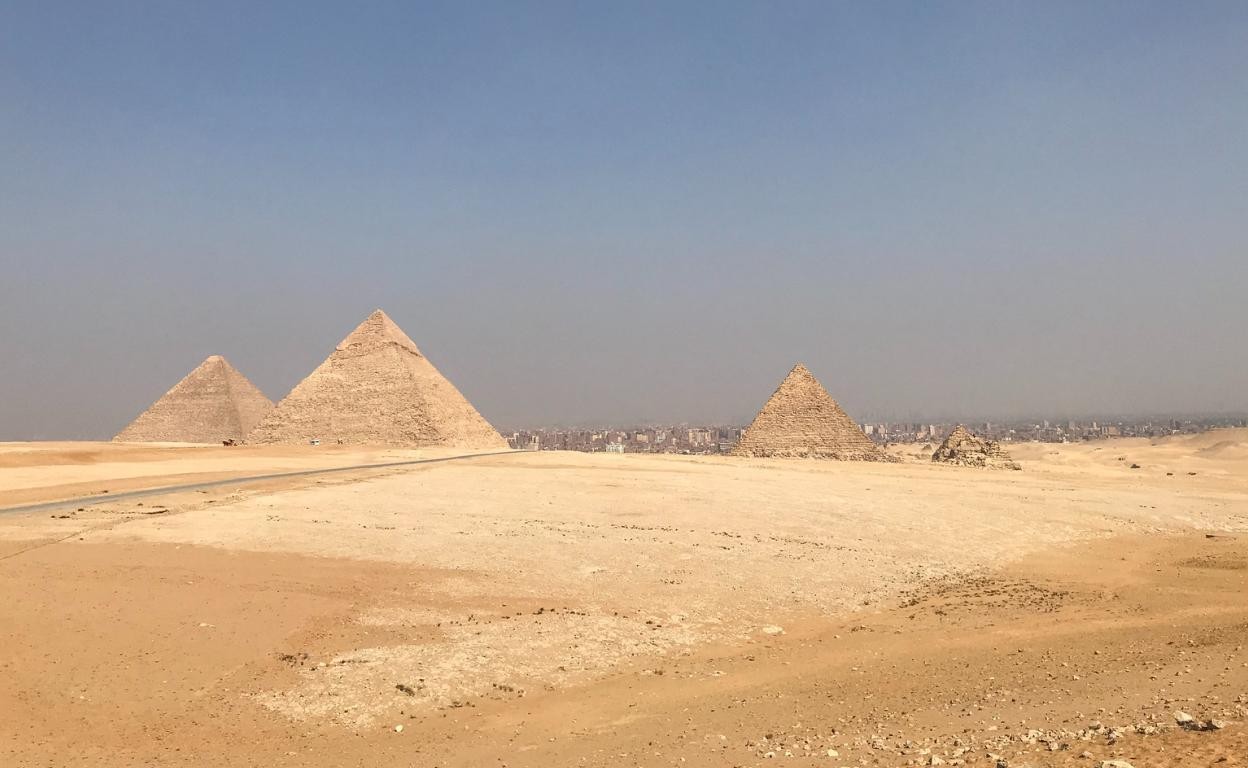
Nothing in travel fully prepares you for the moment the Great Pyramid of Giza emerges from the edge of the Cairo skyline. These are the oldest, largest and most visited ancient monuments on Earth — built over 4,500 years ago with a precision that still baffles modern engineers — and yet they continue to astonish. The Pyramids of Giza and the enigmatic Great Sphinx are the most iconic images in human history, the sole survivor of the Seven Wonders of the Ancient World, and for most visitors, the defining experience of a trip to Egypt.
The Giza Plateau, technically within metropolitan Cairo, holds three royal pyramid complexes: the Great Pyramid of Khufu (the largest), the Pyramid of Khafre (which appears taller due to its elevated position) and the smaller Pyramid of Menkaure. Each pyramid was originally cased in smooth white Tura limestone that reflected the desert sun like mirrors — traces of the casing stone still cling to the upper apex of Khafre's pyramid. Satellite pyramids, queens' tombs, causeways, temples and the pit where the sacred Solar Barque of Khufu lay undisturbed for 4,500 years form the wider complex.
The Great Pyramid of Khufu
The Great Pyramid — built for Pharaoh Khufu (also known by his Greek name Cheops) around 2560 BCE — was the tallest man-made structure on Earth for nearly 4,000 years, a record it held until Lincoln Cathedral surpassed it in 1311 CE. Originally standing 146.5 metres high (erosion and the loss of the capstone have reduced it to 138.5m), it was constructed from an estimated 2.3 million stone blocks weighing between 2.5 and 15 tonnes each.
Visitors can enter the Great Pyramid via the Robbers' Tunnel to reach the Grand Gallery — a corbelled limestone corridor 47 metres long and 8.5 metres high — and the King's Chamber, where Khufu's granite sarcophagus still stands. The passage is claustrophobically narrow and involves bent-double crawling in some sections; the effort is worth it. A separate ticket is required for interior access and daily numbers are capped — buy online or at the gate first thing.
The Sphinx & Khafre's Valley Temple
The Great Sphinx — a 73-metre-long, 20-metre-high limestone figure with a human head and lion's body — is believed to represent Pharaoh Khafre and to have been carved from a single outcrop of bedrock around 2500 BCE. Its missing nose (the subject of many myths) was most likely destroyed by a 15th-century Mamluk official offended by its pagan presence. In ancient times the Sphinx was painted in vivid colours — traces of red paint are still visible on the cheeks.
The Khafre Valley Temple, adjacent to the Sphinx, is one of the finest surviving examples of Old Kingdom architecture: massive pink granite facing blocks, alabaster floors and rows of squared pillars create a space of extraordinary austere power. Originally it contained 23 statues of Khafre, one of which (now in Cairo's Egyptian Museum) is considered the most perfectly preserved royal statue of the ancient world.
The Solar Boat Museum
On the south side of the Great Pyramid, the Khufu Ship Museum houses one of the world's most extraordinary archaeological discoveries: an intact cedar-wood solar barque 43.6 metres long, buried in a sealed limestone pit around 2500 BCE and discovered in 1954 in near-perfect condition. The boat is thought to have been used either to transport Khufu's body across the Nile to the pyramid or to carry his soul through the underworld in the manner described in Egyptian religious texts.
A second solar barque pit was discovered in 1987 but deliberately left sealed to preserve the boat in situ using more advanced conservation methods. The museum housing the first boat has recently been supplemented by a new, climate-controlled Grand Egyptian Museum facility adjacent to the site — one of the most impressive museum buildings in the world.
The Sound & Light Show
Every evening the Pyramids and Sphinx are illuminated in a dramatic sound and light show that projects the history of ancient Egypt across the monuments in multiple languages. While the spectacle is undeniably touristy, watching the Sphinx appear to speak against the backdrop of the illuminated pyramids at night — with the Cairo skyline glittering on the horizon — creates images and memories that endure long after the return home. Shows run in English, Arabic, French, German, Spanish, Italian and Japanese; check current schedules as they change seasonally.